I have been asked by several people, why admirers of Richard Wagner´s music often seems to ignore the role his music played in The third reich (I am not sure this is true), though the exact nature of this role is still the focus of much debate. As a follow up to my previous post, the following video clips may help explain the association by many of Richard Wagner´s music with Nazism.
Below: Furtwängler or Abendrot conducting Meistersinger in Bayreuth 1942
Below: Speech by Göbbels and performance of Meistersinger at Deutsche Oper Berlin conducted by Böhm and with Vilhelm Rode as Hans Sachs in 1935:
I must admit, these clips make my blood run cold, and on a personal level these associations are the main reason I have avoided the Meistersinger for 20 years, only starting to listen to it last year although I admit, that from a logical point of view it probably doesn´t make sense to separate Wagner´s works like that, since I´ve been listening to the all his other works for more than 20 years.
Information for readers not extensively familiar with Richard Wagner: RW himself was not a nazist and did not personally know Hitler, since he died in 1883, but he was clearly antisemitic and several books have been written on the influence of RW´s music on later political events in Germany. However, several of RW´s descendants (including daughter-in-law Winifried and son-in-law Houston Stewart Chamberlain) WERE personally acquainted with Hitler and supported his political views. As far as I know, Wagner WAS NOT Hitler´s favorite composer (allegedly that was Beethoven), but Wagner´s works were performed at several official occasions and among Wagner´s operas Meistersinger was Hitler´s favourite. It doesn´t look like RW generally was a "favourite Nazi composer" since most Nazi party members apparently preferred lighter entertainment such as cabarets etc..
Wednesday, 23 January 2008


The Wagner Clan

Highly recommended: Jonathan Carr´s book The Wagner Clan (more here) telling the story of Richard Wagner´s descendants and the (eternal?) struggle for power in the family (read: Struggle for control of the Bayreuth Festival). Very entertaining reading with essential background information for those interested in Wagner related happenings.
Although, it´s always difficult to say with certainty without having access to the original sources, the writing appears to be both honest and objective.
Only at one small point does the author seem a bit unfair: He brings forward some private gossip about Katharina Wagner (which I do not intend to repeat) and does seem to favour Nike Wagner and her proposals for the Bayreuth Festival. He is, of course, entitled to his opinion, but I cannot help feeling that the last chapter in the book (which covers the last 10 years) may be lacking in objectivity with regards to present day family members. On the other hand, his coverage of the elder generations, which takes up 95% of the book, including Houston Stewart Chamberlain, Friedelind, Cosima,Wieland and Wolfgang Wagner etc. is excellent and appears to be very balanced. And with an unsentimal view of the Bayreuth Festival and the future. Even for those not particularly interested in Richard Wagner´s works, this is a fascinating tale of power, history and politics.
And one of the few books related to Richard Wagner, that I have actually read in full myself, since my main interest has always been the music by and not the person of Richard Wagner. For the last 10 years I have had ambitions of reading Cosima´s (Richard Wagner´s wife) diaries, but they are still unopened on my shelf (as James Joyce´s Ulysses by the way...).
Tuesday, 22 January 2008
Vienna: Major triumph for Christian Thielemann in Meistersinger

This is a so-called traditional production of Meistersinger, recorded live in 2008 at the Vienna State Opera, which for obscure reasons decided to revive Schenk´s 1975 staging of Wagner´s Meistersinger under the label "new production", referring to a socalled "musical reinterpretation" by German conductor Christian Thielemann. We already know Otto Schenk´s Meistersinger from the DVD from the Metropolitan Opera. This Vienna production is not quite as sumptuous, in fact it is rather austere and dusty at times, especially in the first act.
I remember well that in 2008 Thielemann was unanimously praised by the Austrian press for these performances, labelling them the best conducted Meistersinger in Vienna in decades and five hours of pure pleasure - referring mainly to the orchestral performance. I am well acquainted with Thielemann´s mighty way with this score: Light, yet not too light, and with this inherent understanding of Wagnerian phrases, including in Thielemann´s case some very unconventional phrasing slowing the orchestra down at decisive points. Such as the much-debated major pause he always takes between "wach" and "auf" in the 3rd Act, It is still there. Egocentric or courageous? Probably both.
That Christian Thielemann favours traditional productions is no secret and not a problem as such. A traditional production may be as good, or better than a modern. That entirely depends on the individual characterization by the singers. However, too often, traditional sets are combined with a lack of personal direction + a not negligible amount of dust. Which is the case here.
It is understandable that Thielemann likes Johan Botha´s voice as it is both glorious and solid. But.. this is not a CD, and excuse me, the man is simply too heavy and cannot act his way out of a paper bag.
But Ricarda Merberth? Really she is quite disappointing as Eva: Matronly, wobbly and unexquisite, she is the stand-up-and-deliver type of singer. One shouldn´t think Eva would be that hard a part to cast?
She looks rather like the superb Ain Angers mother than his daughter. And with Michaela Selingers feisty Magdalena looking ten years younger and feistier than Eva. Michael Schade as well makes a rather mature, but however well sung David.
Falk Struckmann´s rather metallic voice with a certain lack of warmth may not be to everyones liking, however he is in better shape here than otherwise around that time.
Best is Adrian Eröd as Beckmesser: Funny as well as well sung and the scenes between Beckmesser and Sachs remain among the few infusing some life into this otherwise rather un-dead production.
However, we already know Otto Schens Meistersinger from the Metropolitan Opera released on DVD, with a vastly superior cast. Christian Thielemann´s Meistersinger is worth preserving Otto Schenk´s Vienna State Opera production with the current cast really is not.
The bottom line (scale of 1-5, 3=average):
Johan Botha: 2
Ricarda Merberth: 2
Falk Struckmann: 3
Adrian Eröd: 5
Ain Anger: 4
Michael Schade: 3
Otto Schenk´s production: 2
Christian Thielemann: 5
Overall impression: 2
Monday, 21 January 2008
First-rate Tristan and Isolde in Madrid: Love through the centuries...

Tristan and Isolde, Madrid Teatro Real. January 19th 2008. Production: Lluis Pasqual. Cast:
Tristan: Robert Dean Smith, Isolde: Waltraud Meier, Marke: René Pape, Brangäne: Mihoko Fujimura, Kurwenal: Alan Titus. Conductor: Jesus Lopez-Cobos. Production previously shown at Teatro San Carlo, Napoli .
Director Lluis Pasqual´s main concept for this production of Tristan and Isolde centers around the theme of eternal love: Act 1 takes place in the middle age aboard a viking ship (semirealistically moving with the waves). Then follows Act 2 in a 19th century garden, in which we see the captain (Tristan) in love with the beautiful wife of his General. Act 3 takes place in a present day desert military camp scenario with Tristan in a lazaret and his men surrounding him in camouflage...
Curiously, I have never seen this idea realized in the theatre before (though as an after-thought it seems rather obvious), and it works surprisingly well. Spreading the story over centuries adds to the eternal aspect of the story. Personally, I would have preferred a more detailed stage direction of the singers (the Chéreau style), but others may well disagree. Many will probably appreciate that Lluis Pasqual makes virtually no alterations in Wagner´s story-line, although Tristan is just about to kill Melot in Act II, when he drops the sword and lets himself be wounded.
The soloists are genuinely top-class, a major achievement for the Teatro Real and over-all I don´t think a better cast can be assembled for this work today: Above all, Waltraud Meier and René Pape, both of whom I find entirely unsurpassed as Isolde and Marke, as I´ve written extensively about earlier (to spare regular readers the repetition of my virtually unending praise for those two, see my review of Tristan in Munich and at La Scala, both earlier this season).
Slightly disappointing performance from Robert Dean Smith (Tristan), whom I found rather uninvolved in his acting, but he sang the part beautifully, and made it in full voice and no troubles through the third act, which I believe not many of his contemporaries could do more convincingly.
Mihoko Fujimura has an exquisite beautiful voice with a beautiful dark timbre, and in many ways she is ideal for the part of Brangäne. However she seems to lack a certain dramatic quality, and her phrasings are rather "square" and pointedly regarding the rhythm (as opposed to Waltraud Meier´s more floating style). I cannot help thinking she might be ideally suited for Mozart. Fujimura´s style is quite distinctive, and I am seriously wondering how her relatively small voiced Kundry will stand up to Christian Thielemann´s mighty Vienna orchestra in March...
Jesus Lopez-Cobos´ conducting would have been one of the highlights of the performance with any other casting than the above, and judged on it´s own, he did a brilliant job with a beautiful, balanced orchestral sound, which boasts in particular a strong string section. At times, there was a lack of synchronization with the singers, especially Waltraud Meier, but in this respect I guess it´s merciful conducting Wagner: If it had been Don Giovanni 9 of 10 people would have noticed it, here I suppose 9 of 10 didn´t notice it...
It really seams unfair to point out that the quality of the orchestral playing doesn´t quite match that of Barenboim´s with the Scala or the Berlin State Opera Orchestra, or maybe Thielemann in Vienna, but compared to anyone else, this orchestra is in for a tight race. A genuine top-class achievement, which they should definitely be proud of in Madrid.
As everything else in Spain, opera also starts relatively late: Beginning at 7 pm, this performance was scheduled to end at 00.15 - a timing I much prefer to the 4 pm sessions in Bayreuth. And for the first time, I noticed that wide-screen monitors were put up at several sections of the gallery to show the action on the stage. Whether this is disturbing or actually helpful for those people with restricted view of the stage I am not sure, since I was seated below, but the idea seems interesting.
Sunday, 13 January 2008
Rued Langgaard´s Antikrist on DVD

Danish composer Rued Langgaard (1893-1952) grew up in a strictly religious family, which influenced him throughout his life and career. Antikrist, an operatic oratorio, by many considered his key output, was completed in the final version in 1930, however not readily put on stage. Indeed, the first staged performance only took place in 1999. When Langgaard died in 1952, he was entirely unrecognized as a composer.
This first staged production of Antikrist in Denmark was played in the atmospheric old stables of the Christiansborg castle in the center of medieval Copenhagen. Thus, a seemingly perfect atmosphere for presenting this strange work: Not a conventional opera, but a prologue and 6 scenes depicting the influence of Antichrist on this world. This production is set within a society of fundamentally religious Christians. The claustrophobia, temptations and rigid moral codexes are excellently conveyed, each allocated a distinct scene.
The true revelation of this production. however, was the music: Entirely compelling, it has a definite fin-de-siécle atmosphere reminiscent of the late-romantic Schönberg, but most of all of Richard Strauss, who was loathed by Langgaard´s parents for his superficial compository style.
Beautiful, densely romantic playe by the Danish National Radio Symphony Orchestra conducted by Thomas Dausgaard I cannot see how this production may be bettered.
Furthermore, all soloists were fine, in what is genuinely an ensemble opera: 10 parts, almost equalling the number of scenes, no key roles - Sten Byriel, Camilla Nylund, Susanne Resmark, Helene Gjerris and Poul Elming all stood out.
The bottom line (scale of 1-5, 3=average):
All soloists: 4-5
Staffan Valdemar Holms staging: 5
Thomas Dausgaard: 5
Overall impression: 5
Friday, 11 January 2008
DVD: Renée Fleming and Plácido Domingo shine in Met Otello
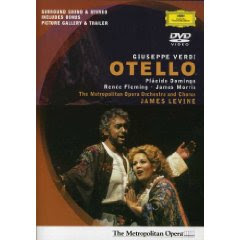

Moshinsky´s Metropolitan Opera production of Otello is a rather traditional affair, not overly spectacular, however not excessively overstuffed. In short a production fitting for a standard "bread and butter" opera, where the cast is bound to change continuously for years to come. Though I do not think a better cast has been assembled for this Otello, than the present one.
Renée Fleming has stated that Desdemona fits her voice so well, that it in fact could be written for her. And she is indeed extremely well-suited to this part with her blooming, creamy voice, here in her absolute prime. I have never seen a better performance from her than this. Furthermore, she has superb stage chemistry with Plácido Domingo, who appears (as of now) on three Otello DVDs: The 2001 Scala production with Barbara Frittoli and Riccardo Muti and the 1992 Covent Garden production with Kiri Te Kanawa and Georg Solti.
Something may be said for each of those versions. Focusing solely on Plácido Domingo, I´d say that he is in better voice than in 2001 and has more poignancy to the interpretation as well as infinitely more chemistry with the Desdemona here than at Covent Garden. So often has it been stated the Plácido Domingo is Otello, that it seems rather redundant to repeat.
Of James Morris´ Iago I am slightly uncertain as of what to say. He can sing the part and he is sly and cunning, but somehow he doesn´t really seem vocally at ease.
Superb performance from the chorus, and an engaged performance from the orchestra under James Levine.
Many may prefer this as their favourite Otello DVD. Personally I may narrowly prefer the Scala version due to the slightly more inventive staging. Again, among the Domingo versions some may chose the Covent Garden Otello, though the lack of interaction between Domingo and Te Kanawa is a major liability in my book.
Renée Fleming "Ave Maria":
Plácido Domingo: 5
Renée Fleming: 5
James Morris: 4
Moshinsky´s staging: 4
James Levine: 4-5
Overall impression: 4
Monday, 7 January 2008
For those not allowed to live

Ilse Weber (1903-1944) was primarily a poet, writer of children's books, and producer of programs for the Czech Radio in Prague. Weber and her husband saved the life of their oldest son when they sent him to Sweden on a Kindertransport prior to their own deportation to the Terezín (Theresienstadt) concentration camp in 1942.
At Terezín, Weber worked as a nurse in charge of the children's ward where she often accompanied herself on a guitar while singing for the children. When her husband was summoned for to Auschwitz in the fall of 1944, she volunteered to accompany him together with her young son Tommy. Her wish not to break up the family resulted in the execution of Ilse and her son in the gas chambers of Auschwitz, while her husband survived her by some thirty years. Wiegala, one of her works, a simple lullaby is rumoured to have been sung by her when she accompanied the children into the gas chamber. More here.
At Terezín, Weber worked as a nurse in charge of the children's ward where she often accompanied herself on a guitar while singing for the children. When her husband was summoned for to Auschwitz in the fall of 1944, she volunteered to accompany him together with her young son Tommy. Her wish not to break up the family resulted in the execution of Ilse and her son in the gas chambers of Auschwitz, while her husband survived her by some thirty years. Wiegala, one of her works, a simple lullaby is rumoured to have been sung by her when she accompanied the children into the gas chamber. More here.
Wiegala and other works by composers imprisoned at Theresienstadt (and all but one executed in Auschwitz) may now be heard on the incredibly moving CD Terezín/Theresienstadt by Anne-Sofie von Otter together with Forsberg, Gerhaher and Hope. Recordings like this do not appear every year. More on the disc here.
Sunday, 6 January 2008
Villazon comeback in Vienna as Werther: Live report and reviews..
For Rolando Villazon´s 2010 March comeback go here. The post below covers his 2008 Vienna comeback.
I have been looking around for a live report from Rolando Villazon´s come-back as Werther yesterday at the Vienna State Opera, and here is is - from the poster Severina from Vienna at the Tamino Klassik Forum (full text in german here - in my translation below):
Dear Villazon fans!
Actually, I had really hoped to report today of our favorite tenors brilliant comeback as Werther, but at least from my perspective, it wasn´t. Measured by the cheers and final standing ovations alone it was, but at the Vienna State Opera that means little. Once the Viennese love someone, they love them forever, and we love Rolando Villazon very much. He knows that as well and that is definitely why he wanted his first opera appearance after nearly 7 months break to be here in Vienna. He would have been much better advised to have started in a small, or at least smaller house. I love him as well, but I do not belong to the fans who leave their ears in the cloakroom. Now I will try and be specific:
First, the good news: Regarding the beautiful timbre, Rolando is completely like he was before. The voice shimmers again in all the colors of the rainbow and does no longer sound so pale and dull as in the Berlin Manon. However, the voice is very, very, very small. Now, he has never had a big voice, but it was always very viable and also filled our giant auditorium easily. Today, however, I heard (was it just me?) a Werther in a continuous piano, which is also beautiful in the phases, but there are also dramatic passages in the opera- and especially top tones. Now, I am truly not a C-fetishist, but occasionally it's quite nice if a high tone is recognizable as such, and it just wasn´t for me. "Oh nature" he sang already transposed, but with beautiful phrasing in the final tone - that is OK, but then it went gradually down from there. In the 2nd act he used some impressive "sighs of desperation" around most high notes - something I also wouldn´t expect from a Rolando Villazon, and at "Traduirre ..." in the 3rd act I almost didn´t hear the phrases in the aria at all. And, furthermore with Marco Armiliato on the podium, Rolando was lucky to have one of the most supporting conductors available who conducted almost a chamber Werther to not overshadow Rolando completely. The final scene of the opera was almost perfect thoug: Because he fitted the "dying voice" perfect, and he, in the truest sense of the word, separated his voice and soul from the body.
Artistically RV was obviously a wonderful Werther from the beginning, but that alone is just too little on an opera stage, but then the end of the opera was simply indescribable. So moving - I would almost say "authentic" – have we never before seen a Werther die in Vienna. There was not one single false gesture, no-melodramatic stumbling around, no pathetic eye-rolling - Rolando produced maximum effect with a minimum of movement. It cannot be done a any better (yes I am really curious about the reviewers: Araiza was once criticized badly because of the final scene, which he played like Villazon did today).
As I said, the applause was huge, and from the bottom of my heart I am happy for him, because that may give him the necessary security. In many passages I had the feeling that he simply did not dare trust his voice yet. Might be that he also sounds even better on Tuesday, which I really hope. At least, RV did not make the mistake to push his voice, which would immediately have been his ruin. He gave what he could give today. And since it nevertheless is the first attempt at ”walking” after 7 months, I just hope that in addition to the beauty of the voice he will have the power to return.
What I find so sympathetic with RV is his ability to be happy, just like a small child. As he showed on his first solo curtain with indescribable applause (as I said, I really give it to him, but he could ......), where he then stood with lowered head for a long time, crushed a few tears, and then he jumped into the air, yelled (the loudest sound I heard from him this evening), and made his usual funny moves. And, of course, as always, he animated his colleagues at the ensemble curtains to "La Ola".
Conclusion: The hope is alive, but today at least, I still see little reason for celebration. And believe me, I would be very happy to be proven wrong by others, if it it generally believed that Rolando returned at the top of his powers.
Reviews (this post will be updated with reviews when they arrive):
AP (Associated Press) was also there, and the reviewer displays similar concerns on the power of the voice, but otherwise found his performance very moving (more here).
Der neue Merker (link here - in German) - basically feels the power of RV´s voice is gone, but he may work that out to his advantage!
Der Standard (link here - in German) - also praises RV´s acting. Does not write about the voice!
Or check out Opera Chic who has also published some live reports.
So - what to make of this comeback? Simply impossible to say without having heard for yourself. With so much hype around the whole thing, it´s hard to know who or what to believe. Including this post! In addition, RV should be given some time to fully recover before being "scrutinized". So this is the last RV post from me, until I actually hear him sing myself or something significant happens...Looking forward to the Verdi Requiem in Berlin - am actually trying to reschedule a meeting in Berlin so I´ll be able to see this (assuming I´ll get a ticket).
I have been looking around for a live report from Rolando Villazon´s come-back as Werther yesterday at the Vienna State Opera, and here is is - from the poster Severina from Vienna at the Tamino Klassik Forum (full text in german here - in my translation below):
Dear Villazon fans!
Actually, I had really hoped to report today of our favorite tenors brilliant comeback as Werther, but at least from my perspective, it wasn´t. Measured by the cheers and final standing ovations alone it was, but at the Vienna State Opera that means little. Once the Viennese love someone, they love them forever, and we love Rolando Villazon very much. He knows that as well and that is definitely why he wanted his first opera appearance after nearly 7 months break to be here in Vienna. He would have been much better advised to have started in a small, or at least smaller house. I love him as well, but I do not belong to the fans who leave their ears in the cloakroom. Now I will try and be specific:
First, the good news: Regarding the beautiful timbre, Rolando is completely like he was before. The voice shimmers again in all the colors of the rainbow and does no longer sound so pale and dull as in the Berlin Manon. However, the voice is very, very, very small. Now, he has never had a big voice, but it was always very viable and also filled our giant auditorium easily. Today, however, I heard (was it just me?) a Werther in a continuous piano, which is also beautiful in the phases, but there are also dramatic passages in the opera- and especially top tones. Now, I am truly not a C-fetishist, but occasionally it's quite nice if a high tone is recognizable as such, and it just wasn´t for me. "Oh nature" he sang already transposed, but with beautiful phrasing in the final tone - that is OK, but then it went gradually down from there. In the 2nd act he used some impressive "sighs of desperation" around most high notes - something I also wouldn´t expect from a Rolando Villazon, and at "Traduirre ..." in the 3rd act I almost didn´t hear the phrases in the aria at all. And, furthermore with Marco Armiliato on the podium, Rolando was lucky to have one of the most supporting conductors available who conducted almost a chamber Werther to not overshadow Rolando completely. The final scene of the opera was almost perfect thoug: Because he fitted the "dying voice" perfect, and he, in the truest sense of the word, separated his voice and soul from the body.
Artistically RV was obviously a wonderful Werther from the beginning, but that alone is just too little on an opera stage, but then the end of the opera was simply indescribable. So moving - I would almost say "authentic" – have we never before seen a Werther die in Vienna. There was not one single false gesture, no-melodramatic stumbling around, no pathetic eye-rolling - Rolando produced maximum effect with a minimum of movement. It cannot be done a any better (yes I am really curious about the reviewers: Araiza was once criticized badly because of the final scene, which he played like Villazon did today).
As I said, the applause was huge, and from the bottom of my heart I am happy for him, because that may give him the necessary security. In many passages I had the feeling that he simply did not dare trust his voice yet. Might be that he also sounds even better on Tuesday, which I really hope. At least, RV did not make the mistake to push his voice, which would immediately have been his ruin. He gave what he could give today. And since it nevertheless is the first attempt at ”walking” after 7 months, I just hope that in addition to the beauty of the voice he will have the power to return.
What I find so sympathetic with RV is his ability to be happy, just like a small child. As he showed on his first solo curtain with indescribable applause (as I said, I really give it to him, but he could ......), where he then stood with lowered head for a long time, crushed a few tears, and then he jumped into the air, yelled (the loudest sound I heard from him this evening), and made his usual funny moves. And, of course, as always, he animated his colleagues at the ensemble curtains to "La Ola".
Conclusion: The hope is alive, but today at least, I still see little reason for celebration. And believe me, I would be very happy to be proven wrong by others, if it it generally believed that Rolando returned at the top of his powers.
Reviews (this post will be updated with reviews when they arrive):
AP (Associated Press) was also there, and the reviewer displays similar concerns on the power of the voice, but otherwise found his performance very moving (more here).
Der neue Merker (link here - in German) - basically feels the power of RV´s voice is gone, but he may work that out to his advantage!
Der Standard (link here - in German) - also praises RV´s acting. Does not write about the voice!
Or check out Opera Chic who has also published some live reports.
So - what to make of this comeback? Simply impossible to say without having heard for yourself. With so much hype around the whole thing, it´s hard to know who or what to believe. Including this post! In addition, RV should be given some time to fully recover before being "scrutinized". So this is the last RV post from me, until I actually hear him sing myself or something significant happens...Looking forward to the Verdi Requiem in Berlin - am actually trying to reschedule a meeting in Berlin so I´ll be able to see this (assuming I´ll get a ticket).
Friday, 4 January 2008
DVD: 1982 Met Tannhäuser

This Metropolitan opera 1982 production of Tannhäuser is, for once, rather easily described: It is quite simply traditional from A to Z, aiming at realistically and meticulously depicting the story of Tannhäuser exactly as stated in the libretto. The team of Otto Schenk and Gunther Schneider-Siemssen, responsible for staging virtually all of Wagner operas at the Metropolitan Opera do what they are reknowned of doing: A Tannhäuser I would not have been surprised to see 100 years previously in Bayreuth.
Detractors will call this an opera museum, admirers will call it a staging faithfully to the intentions of the composers. Your choice. However, regardless of tastes, I suspect most will agree that the setting of the third act is simply stunning.
Of the singers Tatiana Troyanos lush Venus (she looks great as well) and Bernd Weikls beautifully sung Wolfram stand out.
Eva Marton is heard in her rather short prime as an Elisabeth with refreshingly punch, though she has always been a stand-up-and-sing performer. Richard Cassilly is disappointing as a stiff and vocally strained Tannhäuser, though as most will know it is a virtually impossible part to sing.
Engaged and brisk performance from James Levine and the orchestra.
Wagner does not get more traditional than this.
Arrival of the guests in Wartburg:
The bottom line:
Richard Casilly: 2
Tatiana Troyanos: 4-5
Eva Marton: 4
Bernd Weikl: 4-5
John Macurdy: 4
Schenks production: 3
James Levine: 4-5
Overall impression: 3
Posted by 18gianni79 on YouTube
Wednesday, 2 January 2008
DVD: Zurich colonial Aida with Nina Stemme and Salvatore Licitra

Aida. Zurich Opera 2006. Production: Nicolas Joël. Cast: Nina Stemme (Aida), Luciana d´Intino (Amneris), Salvatore Licitra (Radames), Juan Pons (Amonasro), Matti Salminen (Ramfis), Günther Groissböck (The King). Conductor: Adam Fisher. Further information here.
No question that Aida is a tremendously difficult opera to stage. On one hand there are the directors opting for recreation of the old Egyptian splendour, which almost invariably end out looking ridiculous or overstuffed. On the other hand, there are the directors updating Aida, which also more often than not fail, due to the very tight period-specific connection of the plot.
A recent staging in Berlin successfully updated Aida to take place in an 19th Century Egyptian museum around the time of its creation.
Also French director Nicolas Joël opts for setting this Zurich Aida around its time of creation in colonial Egypt to "attempt to give it back its true signification of bourgeouis and exotic drama" according to NJ from the accompanying booklet, who continues "bringing Verdi´s masterpiece closer to the historic beginning of this movement [imperialism of the Middle East] allows us to better understand this opera, but also, we hope, to give life to the characters that the composer´s genuis places far above comic books and photo stories".
Does it work? Not really, I have to say. Even the colonial sets seem overstuffed and old-fashioned. But neither does it ruin the piece entirely.
For those not bothered by Nina Stemmes vibrato, as I am, she will undoubtedly make a great Aida: Warm, engaged and with the required vocal heft.
Salvatore Licitra is passable as Radamés, but no more than that. Luciana d´Intino is a true Verdian spinto mezzo, and had she been a more compelling stage actress she would have been a really great Amneris. Juan Pons unfortunately he is way past his prime as Amonasro.
Undoubtedly, quite a few will be irritated by the split-screen images used throughout, without apparent reason, as the Zurich stage is small enough to be incorporated into a single frame.
Nina Stemme with O patria Mia:
The bottom line (scale of 1-5, 3=average):
Nina Stemme: 4
Luciana d´Intino: 4
Juan Pons: 2
Salvatore Licitra: 3
Matti Salminen: 4
Nicolas Joëls production: 3-4
Adam Fisher: 3
Overall impression: 3
Video by GrandTierBox on YouTube
Subscribe to:
Posts (Atom)
