Showing posts with label plácido domingo. Show all posts

Thursday, 16 April 2009

Waltraud Meier as Carmen

Waltraud Meier´s performance of Carmen at the Metropolitan Opera 1997 is by many, perhaps also by herself, considered one of the low points of her career. Waltraud Meier said of the experience: "I have enormous respect for Zeffirelli, but our two styles just didn't match..The staging was folkloristic, with horses on stage and that sort of thing. It was the most horrible time, but I don't think about it any more. A mistake? Well, my philosophy is that there are no faults, only errors. You learn from your mistakes and come through knowing more."

The production was also infamous for the "that wig goes on stage with or without you"-comment to Angela Gheorghiu´s initial refusal to wear a blonde wig as Micaëla. In the end, she went on with the wig. Plácido Domingo was Don José. James Levine conducted. The whole ting was filmed, but will it also be released on DVD? Maybe not.

But what was it like? Two video excerpts are provided with Waltraud Meier´s Carmen.

Habanera:

Seguidilla:

And the wig with Angela Gheorghiu:


Posted by BullLee2 and Gabba02 on YouTube

Wednesday, 11 March 2009

Berlin Parsifal: Domingo redeems himself in knock-out performance from Barenboim and Waltraud Meier

Parsifal. Berlin State Opera, March 9th. Director: Eichinger. Cast: Plácido Domingo (Parsifal), Waltraud Meier (Kundry), Robert Holl (Gurnemanz), Hanno Müller-Brachmann (Amfortas), Christof Fischesser (Klingsor). Conductor: Daniel Barenboim. Further information here.

There were two major differences between the performance of March 6th and that of yesterday: First, and most importantly, Daniel Barenboim simply nailed it. And secondly, Plácido Domingo proved that he can sing the part of Parsifal, substituting Fridays lack of preparation with a performance it is hard not to admire.

You simply do not sustain a 40+ year top career gaining you virtually legendary status without putting in a considerable amount of hard work combined with keen self-insight and criticism. Mainly for these reasons I was not surprised that Plácido Domingo had improved vastly from his performance last Friday.
Admittedly, Plácido Domingo doesn´t look and move like (some of) his 30 years younger colleagues, but he still sings better than anyone I have heard live in the part. Vocally he is at least as solid as on the 2005 Thielemann-recording, and while he may still have relied on prompting for parts of Act 2 (audible only twice even from the front row seats, which is quite normal), it didn´t significantly detract from this performance. Even if I still don´t think Parsifal brings out his true dramatic strengths (whether 40 or 70 years old), it was hard not to find his performance impressive. Though I´d expect the Simon Boccanegra he returns to the Berlin State Opera with this upcoming October will show him in an even better light.

How often do you sit in the audience, watch a singer and think: I don´t think this part has ever been better performed in the entire history of the work? It is such with Waltraud Meier´s Kundry, whose charisma and plain ability to project the character is beyond description and kicks any vocal deficiencies into oblivion.

It is also such with René Pape´s Gurnemanz. That is: Had he been there. And it is both unfair and unrealistic to expect that veteran Wagnerian (and previous Bayreuth-Hans Sachs), the not overly charismatic Robert Holl substituting at short notice, should suddenly aspire to perform at that level. His was an honorable and solid, though not overly exciting Gurnemanz.

I wouldn´t be surprised if Christof Fischesser went on to bigger things as he is a plainly superb Klingsor, even more secure at this second performance.
Hanno Müller-Brachmann repeated his beautiful and lyric interpretation of Amfortas from Friday.
Also a well-sung performance from Andreas Bauer as Titurel, coming off to the worst possible start as the curtain went up about 2 minutes too early during the Act 1 transformation music exposing him drinking from a waterbottle under the changing sets.
And a minor quibble on a related note: I would rather have the spear not changing hands from Klingsor to Parsifal at all, than to see all sorts of non-convincing spear appearances, especially when, as yesterday, the spear appeared from a hole in the floor next to Domingo, before Klingsor had even thrown it. Bernd Eichinger is obviously no opera director. But he is a film director. Could he not have made that exchange (even when it works) look more convincing?

Now to the real star of the evening:

While I admit to having been seduced by Christian Thielemann´s glitteringly, beautiful Parsifal, compared to Daniel Barenboim´s quite obvious understanding of the deeper structures of the work, Thielemann now seems superficial. Key elements in Barenboim´s reading being string rubato and accentuation as well as emphasis on the contrapunctual elements, of which, it turns out, there are quite a few. The disturbing, underlying elements of the work are exposed far below the glittery beauty in performance, with echoes lingering on for days.
Daniel Barenboim is slow, though for most parts it is a relative slowness as his Act 1 clocks in at 1:50 – exactly as Thielemann´s in Vienna last year. And curiously he even paced both sets of Transformation music considerably faster than usual.
Basically I would just like to know how he does it. How does he see those connections within the music that apparently no-one else sees? How does he approaches the score? I may just have to become a music journalist and interview him to get the answers..To summarize, I have never heard a better conducted Parsifal.

Massive applause to everyone from an unusually mixed audience, including a large fraction of Spanish-speaking visitors as well as the usual loud misunderstood hissings from semi-studied self-proclaimed expert Wagnerians at those (me included) applauding after Act 1 (which is perfectly acceptable, but requires an entire post to explain).

The bottom line (scale of 1-5, 3=average):

Plácido Domingo: 4-5
Waltraud Meier: 6
Robert Holl: 4
Christof Fischesser: 5
Hanno Müller-Brachmann: 5


Daniel Barenboim: 6

Overall impression: 4-5

Saturday, 7 March 2009

Berlin: Embarrassingly underprepared Domingo as Parsifal with Meier, Salminen and Barenboim

Parsifal. Berlin State Opera. March 6th 2009. Cast: Plácido Domingo (Parsifal), Waltraud Meier (Kundry), Matti Salminen (Gurnemanz), Christof Fischesser (Klingsor), Hanno Müller-Brachmann (Amfortas). Conductor: Daniel Barenboim. Further information here.

The Parsifal production of the Berlin State Opera is by film-maker Bernd Eichinger from 2005 and described in detail at my last visit two years ago. In brief, Eichinger sees Parsifal as a journey in time. Furthermore, he doesn´t really seem to know anything about directing opera, making Parsifal a display of filmic sets, leaving the singers free to create the characters. Which is why the appearance yesterday of three leads, all new to the production, didn´t really make any difference, despite a minimal rehearsing time.

As Parsifal, Plácido Domingo was notoriously underprepared, relying heavily on audible prompting, especially in the second act. Famous for his acting skills, he had no connection with the character at all, seemingly stretching himself to the maximum to get through it alive and pronounce the words at least partially correct. Has he ever been dramatically convincing as the innocent fool? I suspect not. But yesterday he was painfully unconvincing, almost downright terrible, I (as a staunch Domingo-Wagner fan) am very sorry to say. The tones, however, were beautiful and probably not to be heard better by anyone today in this part. In a concert performance he would have been stunning. However, is it really possible to watch a performance with no chemistry between Plácido Domingo and Waltraud Meier? I wouldn´t have thought so, but apparently it is.

Plácido Domingo has chosen to sing this role again in public. And hats off to him for not cancelling the performance in front of a sold-out house. But he should have been better prepared as this was far below his own standards.

Waltraud Meier was simply stunning as Kundry. Her magnetic stage presence and dramatic projections make me hope she can continue at least 1o years more with this part. That she may have choked on a couple of high notes I find entirely unimportant in the bigger picture, and furthermore the entire middle-lower register, occupying the majority of the part was as beautiful as ever.

The major draw-back to this evening, of course was René Pape´s cancellation and in my book I suspect these performances will go down as "the Berlin Parsifals René Pape didn´t sing". I would be lying if I said he wasn´t heavily missed.

That said, Matti Salminen was a rather smashing substitute. Salminen´s voice ages well and remains firm, entirely avoiding the vibrato marring the singing of colleagues such as John Tomlinson, Kurt Rydl and Samuel Ramey. Furthermore, he was in fine vocal shape and he is an intellingent singer, fully knowing that extended legato-lines and ringing top-notes (René Pape´s major strong points) are not his aces, converting some of these to sprech-gesang or cunning pianissimi letting Barenboim´s orchestra overshadow him (best example in the Gesegnet sei section, at which point I suspect he was down-right exhausted as well). Not unimportantly, Matti Salminen has the required stage authority and apart from he-who-was-not-here I don´t think a better Gurnemanz is around.

Hanno Müller-Brachmann is an Amfortas way above average with a warm, rounded, slightly lyrical approach. Also quite superb Christof Fischesser as Klingsor, though he was occasionally thrown off guard by Barenboim´s rugged tempi. Both on the highest international level.

Daniel Barenboim doesn´t really make things easy either. The orchestra hasn´t played Parsifal in two years and I strongly suspect he didn´t waste too much time rehearsing it either. On top, he applied some peculiar accentuations and rather rugged shift of tempi, not fully incorporated within all sections of the orchestra and which threw the singers off guard, contributing to the sense of unease prevailing in this performance. But he does get beneath the glittering beauty of a Thielemann Parsifal to the closest I can imagine to the core of the work.

However, the evening as a whole didn´t really take off. Still, a Parsifal vastly superior to the one in Bayreuth, but inferior to previous performances of the same production at this house.

The bottom line (scale of 1-5, 4=average):

Plácido Domingo: 3
Waltraud Meier: 5
Matti Salminen: 5
Hanno Müller-Brachmann: 5
Christof Fischesser: 5

Daniel Barenboim: 5

Overall impression: 4

Thursday, 5 March 2009

damn, double damn

Worst possible (well almost) opera news of the week (the season??, the year??):
Matti Salminen replaces René Pape in the Barenboim-conducted Berlin Parsifal on Friday. Notwithstanding I am a big fan of Salminen, and Plácido Domingo and Waltraud Meier are both appearing as well, I must admit I shall probably have to sell my ticket. Which at least shouldn´t be a problem.

And, as of Wednesday, a look in the comments section will reveal that he will be replaced by Robert Holl Monday. And by Robert Holl also next Thursday with Gergive at the Barbican.

Well...opera is only entertainment after all. I suppose that is the rational way to go about this. But I would be lying to say this isn´t a major disappointment.

Sunday, 22 February 2009

Los Angeles Ring 2009-2010

The 2009-10 Los Angeles Opera Ring will be directed by Achim Freyer and conducted by James Conlon.

Rheingold and Walküre opens Spring 2009. Three complete cycles will be given in 2010.

A website has been set up for the LA Ring with plenty of information.

75-year German director Achim Freyer, a former pupil of Bertold Brecht has worked with opera for 30 years, staging many world premieres. Freyer´s most important stagings may be seen here. One of Freyer´s greatest successes to date is Mozart´s Magic Flute, which he has reinterpreted for several theaters, currently on the schedule in Dresden.
Achim Freyer´s most recent staging was Eugen Onegin in Berlin ealier this season. In 2007 he staged the world premiere of Alice in Wonderland in Munich.

Achim Freyer works with his 1992-founded Freyer ensemble and has developed a highly individual theatrical language emphasizing strictly formalized gestures and movements within a colourful geometric environment of almost childlike simplicity.

What to expect from Achim Freyer´s Nibelungen Ring?

I am relatively well acquainted with Achim Freyer´s work and the below Nibelungen Ring photos as well as the promotional video, a video from the Munich Alice in Wonderland and photographs from previous Achim Freyer productions including extensive Eugen Onegin photos (and review) will provide a reasonable idea. What one does not get from the photographs is the highly stylized movements of the singers, almost like string puppets, one of Freyer´s trademarks which I´d be very surprised if he didn´t continue for this Ring.

Below photos and video excerpts from Achim Freyer´s upcoming Los Angeles Opera Ring:

Rheingold:


Walküre:

Siegfried:

Götterdämmerung:

Sunday, 11 January 2009

DVD: Tan Dun The first emperor

Tan Dun: The First Emperor. Metropolitan Opera 2007. Production: Zhang Yimou . Cast: Plácido Domingo (The first emperor), Elizabeth Futral (his daughter), Paul Groves (Jianli), Michelle DeYoung (Shaman). Conductor: Tan Dun. Further information here.

There are many fine aspects to Tan Dun´s opera The First Emperor, which received its world-premiere at the Metropolitan Opera 2006: The rhythms in the instrumental sections are incisive and oriental colorite as well as traditional Chinese instruments are well integrated into a standard Western symphonic orchestra. Furthermore, elements of Peking Opera are incorporated successfully. However, when the singers start to sing, the compository quality drops markedly. It seems Tan Dun´s composition for voice is limited to extended wailing legato lines. Which do in fact seem endless, when repeated...endlessly.

In brief, the First Emperor (Domingo) orders his General to capture the composer Jianli (Paul Groves) and make him compose an Anthem in his honour. During the capture Jianlis family is killed and his village is ruined. In return, the General is promised the Emperors daughter. However, the Emperors daughter and Jianli falls in love, though the Emperor persuades Jianli to give her up temporarily. Believing she is betrayed, the Princess commits suicide before she finds out that Jianli has poisoned the General. Mad with grief, Jianli bites his tongue off in front of the Emperor, who kills him to spare him further pain. Now the Anthem is heard: It is a slave chorus, Jianli´s revenge.

Elizabeth Futral has the exact exquisite manners of an Oriental Princess, and though she is not given much to work with vocally, she makes the most of what she has. Also Plácido Domingo seemed to struggle with this eternal wailing, but has the bearing of an Emperor. Paul Groves is the only one, who occasionally is given more than endless legato lines in the part of Jianli.

The staging is rather spectacular, incorporating several elements of Peking Opera, and all could have been rather well. Had Tan Dun´s composition only been a bit less monotonous.

Plácido Domingo from the first act:

The bottom line (scale of 1-5, 3=average):

Plácido Domingo: 4
Elizabeth Futral: 4-5
Paul Groves: 4

Zhang Yimou´s staging: 4

Tan Dun (as conductor): 4
Tan Dun (as composer): 2

Overall impression: 3

Monday, 17 November 2008

Top 20 favourite operas revisited

The below revised list, is obviously not intended to reflect on the greatest operas composed – it simply reflects the 20 operas I, for the moment prefer to listen to, together with a brief mentioning of some of my favorite recordings of those operas on CD and DVD.

To be updated, when necessary..

Operas are listed in alphabetical order by the composer:

Bartok: Bluebeard´s Castle. CD: Kertesz with Christa Ludwig/Walter Berry. DVD: Still looking. In the meantime the Solti conducted film is rather fine, especially on the musical side.

Berg: Lulu. CD: Boulez w/Stratas. DVD: Christine Schäfer in the Glyndebourne production. Bechtolf´s Zurich production with Laura Aikin is a viable alternative.

Debussy: Pelléas and Melisande. CD: Karajan w/von Stade. DVD: Boulez/Stein from Welsh National Opera.

Dvorak: Rusalka. CD: Mackerras with Fleming/Heppner. DVD: The Paris Carsen production with Renée Fleming.

Gounod: Faust. CD: Undecided. DVD: Ken Russell´s Vienna production, but basically I am waiting.

Mozart: Don Giovanni. CD: Furtwängler w/Siepi. DVD: Essentiallly still waiting. Kusej´s 2006 Salzburg production will do in the meantime.

Mussorgsky: Boris Godunov. CD: Undecided. Probably Abbado (Shostakovich version). DVD: Matti Salminen in Willy Decker´s Barcelona production. The alternative is the Gergiev-conducted Tarkovsky production.

Mussorgsky: Khovanshchina. CD: Abbado from Vienna. DVD: Waiting. In the meantime Abbado´s Vienna production is not a bad choice (the only alternative is Winge´s production from Barcelona)

Offenbach: Les Contes d´Hoffmann.
CD: Undecided. DVD: The Paris Carsen production until hopefully David McVicar´s 2003 Salzburg production will be released.

Shostakovich: Lady Macbeth from Mtsensk.
CD: Undecided. DVD: Jansons/Kusej with Westbroek/Ventris from Amsterdam.

Strauss: Salome. CD (difficult choice) - on top probably Reiner w/Welitsch, Böhm w/Rysanek. Other fine discs are Solti w/Birgit Nilsson, Schønwandt w/Inga Nielsen, Sinopoli w/Cheryl Studer. Welitsch first. DVD: Waiting for Karita Mattila. For an interesting directorial take, see David McVicar´s London production. Some may prefer Götz Friedrich´s 1974 film with Teresa Stratas.

Strauss: Die Frau Ohne Schatten. CD: Solti or Böhm w/Rysanek. DVD: Solti conducting Götz Friedrich´s Salzburg staging. The only alternative is Sawallisch with a Kabuki-inspired staging.

Tchaikovsky: Eugene Onegin.
CD: Undecided. DVD: The Salzburg Breth/Barenboim production with Peter Mattei. As a close second, the Carsen MET production with Renée Fleming/Dmitri Hvorostovsky.

Verdi: Macbeth.
CD: Abbado w/Verrett, Cappucilli. DVD: Claude D´Anna´s film with Leo Nucci and Shirley Verrett, for once is a convincing opera film.

Verdi: Don Carlo. CD: Giulini w/Domingo, Caballé, Verrett, Raimondi. DVD: Still waiting.

Verdi: Otello. CD: Chung w/Domingo or Levine w/Domingo. DVD: La Scala/Domingo.

Wagner: Tristan and Isolde. CD: Furtwängler or Barenboim (no order). And Pappano for René Pape and Plácido Domingo. DVD: Chéreau/Barenboim with Waltraud Meier from La Scala 2007. Alternatively the Heine Müller/Barenboim 1995 Bayreuth production. Other fine alternatives are the Ponelle/Barenboim Bayreuth production, the Munich Konwitschny production or the Lehnhoff Glyndebourne production.

Wagner: Meistersinger. CD: Solti (~1996). DVD: I am not really happy with any of the available choices, though ultimately I prefer the Schenk/Levine version from the Met.

Wagner: Ring des Nibelungen – counts as one opera. CD: Solti or Keilberth (in that order, probably). DVD: Kupfer/Barenboim from Bayreuth as first choice. Chéreau/Boulez from Bayreuth as second. For a traditional ring, the Schenk/Levine Met production is the only available choice.

Wagner: Parsifal. CD: Knappertsbusch 1962, Barenboim or Thielemann (no order). DVD: Still waiting. Of the available choices, I´d narrowly prefer the Lehhoff/Nagano production from Baden-Baden.

And the runners-up: Simon Boccanegra, Elektra, Jenufa, Le damnation de Faust, The rake´s progress, A handmaid´s tale, Flying Dutchman, Lohengrin, Wozzeck, Tannhäuser, The magic flute, Peter Grimes, Samson et Dalila, Billy Budd, L´amour de loin, Prince Igor, Carmen.

Sunday, 2 November 2008

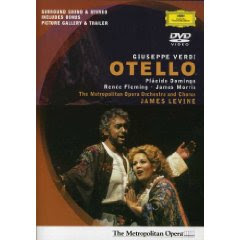
DVD: Domingo La Scala Otello

Otello. Teatro alla Scala 2001. Production: Graham Vick. Cast: Plácido Domingo (Otello), Barbara Frittoli (Desdemona), Leo Nucci (Iago), Cesare Catani (Cassio). Conductor: Riccardo Muti. Further information here.

Graham Vicks Otello opened the 2001 La Scala season and was at the same time Plácido Domingos farewell to a role, he had dominated for more than 30 years.

Plácido Domingo is 60 years here, and in pure vocal terms he was in stronger voice on his earlier Otello DVDs from Covent Garden 1992 and Metropolitan Opera 1995. However, this seems a minor concern, when he presents with such a truly majestic Otello as seen here. Psychologically, his portrayal of the ultimately insecure stranger made leader, has never been better.

Barbara Frittoli´s Desdemona is youthful, but nevertheless a strong and unsentimental woman. And her relationship with Otello is entirely believable. How she compares to Renée Fleming at the competing Met DVD? Depends on tastes, I´d say. Where Renée Fleming is the more refined and multifacetted Desdemona, Barbara Frittoli wins by her freshness and youthfulness. However, the beauty of Renée Fleming´s Desdemona is almost unearthly.

Graham Vick provides a very spartan single set inside an ornamentated marble semicircle. Beautiful period costumes are applied. The focus, clearly is on the psychological drama. We clearly see, how Otello, despite his advanced age is genuinely insecure compared to his very young wife. Leo Nucci´s Iago works rather by scheming friendliness, as his appearance is rather un-menacing.

Riccardo Muti provides powerful conducting. I know from personal experience how his Otello may blow you away in the theater, however I feel he fails to extract the subtleties from the scores. That this may be done without losing any power, Solti is only one example of.

All in all, this Otello ties closely with the Metropolitan production as a recommendation as the best Otello on DVD.

Plácido Domingo - Niun mi tema:


The bottom line (scale from 1-5, 3=average):

Plácido Domingo: 5
Barbara Frittoli: 5
Leo Nucci: 4

Graham Vicks production: 4

Riccardo Muti: 4

Overall impression: 5

Saturday, 25 October 2008

Turandot DVD: Franco Zeffirelli is almost alive..

Turandot. Metropolitan Opera 1986. Director: Franco Zeffirelli. Cast: Eva Marton (Turandot), Plácido Domingo (Calaf), Leona Mitchell (Líu). Conductor: James Levine. Further information here.

For the first two acts, the first one in particular, Franco Zeffirelli gets away with it so well, that I almost felt compelled to stop referring to him as Franco "the undead" Zeffirelli. Though, based on the tasteless final act, the term still comes in handy, though admittedly it is not very sophisticated..

What exactly makes Franco Zeffirelli deserve the label "opera director" I do not know: He designs the lavish sets and dumps authentic-costumed singers in them. A set designer in productions without a director seems more appropriate.

Needless to say, he presents a genuinely conventional Turandot. Which actually works rather well in the first two acts due to the rather fine and realistically created environment of ancient China. For the third act, the set suddenly explodes in tastelessness..

Plácido Domingo is predicably superb as Calaf, by far the best on DVD. Eva Marton gets reasonably away with Turandot, thought she would have gained much had she not been flat. Leona Mitchell´s Líu I never really warmed too, contrary to the audience.

James Levine? Superb. The structure of Puccini´s operas is something he apparently seems to have an intuitive understanding of.

In summary, not the worst of the Metropolitan Opera´s Zeffirelli productions by far. If one leaves before the third act that is, which also has the advantage of avoiding Alfano´s ending.

For a Turandot on DVD, David Pountney´s superb totalitarian nightmare will be preferred for those inclined towards a directed version of Turandot, though not for those wanting to hear/see a fine interpretation of Calaf or a memorable reading of the score.

Straniero ascolta (Eva Marton and Plácido Domingo):


The bottom line (scale of 1-5, 3=average):

Plácido Domingo: 5
Leona Mitchell: 3
Eva Marton: 3

Franco Zeffirelli: 3

James Levine: 5

Overall impression: 3-4

Monday, 14 July 2008

Trapped in the dark middle ages with no escape: Vienna Lohengrin with Claudio Abbado and Placido Domingo on DVD

Lohengrin. Vienna State Opera 1990. Director: Wolfgang Weber. Cast: Plácido Domingo (Lohengrin), Cheryl Studer (Elsa), Dunja Vejzovic (Ortrud), Hartmut Welker (Telramund), Robert Lloyd (Heinrich). Conductor: Claudio Abbado. Further details here.

Traditionalists may initially be uplifted by the though that director Wolfgang Weber takes all Wagner´s so-called intentions including the 10th century Lohengrin setting very serious. Beware, the optimism may be short-lived, though: The dark middle ages have never been more genuinely dark and medieval than in this Vienna staging...

The staging "allows the singers plenty of room to develop" - indeed, as stage direction seems absent from this production. Though the director may disagree, dressing Ortrud in red is not enough to create compelling drama...

In brief: This staging is unbearably boring and tedious. Trapped in the dark middle ages with no escape indeed...

Once and for all: I do not care about Plácido Domingo´s German diction when he sings and acts like he does here. Though, technically speaking, his diction is excellent. His German is not. I´ll spare readers a lenghty explanation of just why Plácido Domingo is the best tenor in this repertoire for as long time back as I can remember, but keywords include: Legato singing, dramatic presence, beautiful barytonal glow, convincing interpretation.

Cheryl Studer is a vocally a very fine and moving Elsa, though rather monodimensional on stage. However, the Queen of monodimensionalism is Dunja Vejzovic´s very passive Ortrud, who constantly looks bored more than anything else. Matched by the slightly more energetic, though wooden Hartmut Welker. Robert Lloyd´s nasal singing frankly irritates me as Heinrich, and overshadows whatever additional qualities he may have.

Claudio Abbado conducts with transparent beauty and myriad of details. In the perfect world he would have added more energy and intensity as well. And chosen another stage director..

In short: Not recommended despite excellent performances from Domingo, Studer and Abbado.

Plácido Domingo and Cheryl Studer, 3rd act confrontation (the highlight of the DVD):


The bottom line (scale of 1-5, 3=average):

Plácido Domingo: 5
Cheryl Studer: 4
Dunja Vejzovic: 2
Hartmut Welker: 2-3
Robert Lloyd: 2

Wolfgang Weber´s production: 1
Claudio Abbado: 4-5

Overall impression: 2

Saturday, 5 July 2008

DVD: Placido Domingo presents Parsifal - the search for the grail

Parsifal - the search for the grail. A film special with Plácido Domingo. 1998. Further information here.


First of all, this is not a filmed production of Wagner´s last opera Parsifal, but rather a 90-minute documentary centered around the sources of Parsifal - primarily the Grail legend and its treatment in modern culture, mixed with selected scenes from he opera.

The documentary is filmed on location in Bayreuth, St. Petersburg and Ravello (Southern Italy), and includes a brief interview with Wolfgang Wagner (grandson of Richard) on the Bayreuth Festival stage in an (almost) understandable German. Modern works inspired by the Grail legend are also presented, such as Monty Python and Indiana Jones.

Then, however, so-called experts comment on various aspects on the Grail legend and Wagner´s treatment of the sources, mainly resulting in simplistic and naive comments revealing a minimum of insight into the complexity of Wagner´s score: Conclusions on how Parsifal carries a message of universal peace and the racial messages of Parsifal and their influence on Hitler and Holocaust also seem simplistic and I am not at all convinced they are substantiated by facts.

The highlight of the documentary is the passages from a live Parsifal performance in St Petersburg featuring Plácido Domingo, Violeta Urmana, Matti Salminen, Nikolai Putilin and Valery Gergiev. Unfortunately, these clips are far too short.

The film is narrated by Plácido Domingo, whom I generally consider an intelligent man. Though also he makes some very simplistic comments on the universal messages of Parsifal, which I will do everyone a favor of not repeating here..

Though this documentary may serve as a fine introduction to the opera Parsifal, it definitely does not hold for repeated viewing.

Sunday, 1 June 2008

Die Walkure dream team in Barcelona: Domingo, Meier and Pape in marvellous Act 1 performance

Waltraud Meier (center) with Evelyn Herlitzius, Alan Held, Jane Henschel, René Pape and the Valkyries. At this point Plácido Domingo is still having dinner....

Die Walküre. Concert performance. Teatro Liceu, Barcelona. May 31th 2008.

Cast: Plàcido Domingo (Siegmund), Waltraud Meier (Sieglinde), Renè Pape (Hunding), Alan Held (Wotan), Evelyn Herlitzius (Brünnhilde), Jane Henschel (Fricka). Cond: Sebastian Weigle. Further information here.

Scheduled as a concert performance, this was in fact a semi-staged performance: Three (or more) chairs placed on the stage in front of a brown screen. With the orchestra in the pit and the singers moving and acting as in a fully staged performance, the difference between this and a "modern" stage production may have been very small indeed..

The beautifully restored Liceu Opera House, of course was packed. The atmosphere was electric. None of the protagonists had cancelled. The performance was marvellous. The drinks were cheap. The auditorium was fantastic, being perhaps the most beautiful traditional opera house I have been in. What more can you ask for, except cheaper tickets?

Well, mainly a better conducted performance. Sebastian Weigle was actually booed by some at the end of the evening, and while I strongly disagree with this type of behaviour, I appreciate the underlying point: He was not good. This was in fact one of the most boringly conducted Wagner performances, I´ve heard in a theatre of this level. And a pity, really, since the quality of the orchestra seems to be rather high. And especially since his sleepwalking Wagner reading prevented the first act to be truly electric, despite fabulous performances from the singers. He was equally boring last year in the Bayreuth Meistersinger, which I then attributed to his unfamiliarity with the special covered pit...

This was in theory a complete performance of Die Walküre, but in reality the performance was built upon a dream-team Act 1, as I don't expect anyone payed the steep 150+ Euro ticket prices (my only real complaint about this performance apart from the conductor) to see Alan Held (who was in fact a very fine Wotan) or Evelyn Herlitzius´ lively Brünnhilde, once again demonstrating that huge sounds may be produced by slim singers. Otherwise Jane Henschel was a fine Fricka.

Now, to the point: Why does Plàcido Domingo keep singing Siegmund at 67+ years? The simple answer: I suppose, because nobody does it as well as he does...
If singing Siegmund was a competition on generating the loudest sound or displaying the freshest voice, he would perhaps be pressed by some his younger colleagues. But then there is the characterization, the vocal drama, the intensity. In fact, the only one beating Plàcido Domingo's Siegmund today, is his own Siegmund 15 years ago..
In this respect, it is incomprehensible that we do not have his Siegmund (preferably with Waltraud Meier's Sieglinde) on disc or DVD from his prime, but hopefully this will change..

I have now heard Plàcido Domingo as Siegmund four times within the last year, and he seemed in equally fine shape here in Barcelona as he was in London last autumn, with a Wälse cry (almost) effortlessly filling the auditorium and a thrilling dramatic intensity including superb chemistry with Waltraud Meier.

And again, no: Domingo's German diction is not bad. He has, in fact, excellent diction of a heavily accented German, of which I understood anything. How many times have I not heard native German tenors sing Siegmund and not being able to understand a word? Countless. Next to Renè Pape, who probably has the most perfect German diction seen on stage today, German speakers (as myself) probably cannot help occasionally noticing his somewhat strange German. But more as a curiosity than anything flawing his performance, in my opinion.

Should he stop singing the part, just because he was better 15 years ago? I don`t think so. If several significantly better singers were around, then maybe...

Plácido Domingo curiously only turned up at the second Third Act curtain call (thus missing the first), which I´ve been told was due to him having dinner outside the Theatre during Act 3 and simply not hearing the cell phone call for him to return!

Nevertheless, Plàcido Domingo was not the best singer of the evening. That was Renè Pape.

You don't need a beautiful voice to sing Hunding - most basses just yell their way (and quite effectively) through it. But it does help and it's refreshing for once, to hear all the words sung in full noble Wotan-type voice with complete command of the stage. But completely, 100% mean, he just cannot be with that beautiful voice...And, while he has the low notes well within his grasp, they are clearly outside his comfort zone. Which is just fine, since Renè Pape has really moved on from this part, and with his upcoming Wotan (about time!), I suspect his Metropolitan Opera performances of Hunding next season will be among his last ones, for the foreseeable future.

Had Richard Wagner been alive today, one of the singers that would have made him really happy (he would probably have tried to have an affair with her as well!) would have been the superb Waltraud Meier. In superb voice, completely unstrained, Sieglinde remains one of her most moving portraits. She has everything this part asks for: The vulnerability, the passion, the slight madness, the capability of going over the edge..And as always with Waltraud Meier, I know perfectly well what her vocal flaws are, I just don´t care about them..

And finally, to the really important issues:

Plàcido Domingo looked fine. Renè Pape looked great. Waltraud Meier looked..well, as much as I hate to say it: Disappointingly plain. She was wearing the same type flowery dress, as last year in the same team's Munich Walkure, and it just makes her look unsophisticated, which is the last thing she is, being one of the most beautiful and sophisticated women on stage today. Hopefully, she'll take the opportunity to change it before this summer's Walküre performances with Daniel Barenboim and the West-Eastern Divan Orchestra...

Other reviews in Spanish/Catalán from Barcelona-based bloggers GTL torn T and In fernem Land.


Monday, 26 May 2008

DVD: Domingo in Covent Garden Solti-conducted Otello

Otello. Royal Opera Covent Garden 1992. Production: Moshinsky. Cast: Plácido Domingo (Otello), Kiri Te Kanawa (Desdemona), Sergei Leiferkus (Iago), Robin Leggate (Cassio). Conductor: Sir Georg Solti. Further information here.

The Prince and Princess of Wales (Princess Diana) was present at this Otello-performance to celebrate Sir Georg Solti´s 80th birthday in what turned out to be their last official public appearance together. And as some will know, Sir Georg Solti and Princess Diana died within the same week some years later.

On Moshinsky´s production it can be said that it is traditional, however on the minimalistic side avoiding the excesses of a Zeffirelli.

On Plácido Domingos Otello I offer nothing which hasn´t been put in writing numerous times already: In my opinion, Otello is his best part, in which he has been unrivalled for about thirty years and his performance here could not be bettered. A superb singing-actor with Shakesperean singing and acting. Opposing him is Sergei Leiferkus, who presents a vocally convincing characterization of Iago, however with a weak stage presence entirely without menace.

While Kiri Te Kanawa vocally is fine as Desdemona, though without the bloom or vocal expressiveness of a truly great one, she is, in my opinion, among the most boring singing-actresses to have had a major career. There is no chemistry between her and Plácido Domingo, something I am not inclined to blame on him. She is far inferior to both Barbara Frittoli at La Scala and Renée Fleming at the Met on the competing DVDs featuring Plácido Domingo as Otello.

Sir Georg Solti, on the contrary, is inferior to no-one being typically explosive and dramatic. Furthermore, he manages to shape the lyric phrases as well and creates thrilling dramatic intensity in a way Riccardo Muti may only dream of. It may be his 80th birthday, but he conducts as if he was half that age.

Plácido Domingo aso Otello is the way to go on DVD with the choice between this version, the MET and Scala. Personally, I´d opt for the Scala version.

Plácido Domingo and Kiri Te Kanawa, Gia nella notte densa:


The bottom line (scale of 1-5, 3=average):

Plácido Domingo: 5
Kiri Te Kanawa: 3
Segei Leiferkus: 4

Moshinsky´s production: 3
Sir Georg Solti: 5

Overall impression: 4

Saturday, 26 April 2008

DVD: Gala concert at the Vienna State Opera

Gala for the 50th anniversary of the reopening of the Vienna State Opera. Vienna State Opera, November 5th 2005
Excerpts from: Don Giovanni, Rosenkavalier, Aida, Meistersinger, Frau Ohne Schatten, Fidelio

Artists include: Agnes Baltsa, Plácido Domingo, Thomas Hampson, Bryn Terfel, Violeta Urmana, Edita Gruberova, Angelika Kirchschlager. Conducting: Daniele Gatti, Zubin Mehta, Seiji Ozawa, Christian Thielemann, Franz Welser-Möst. More information here.

No matter how high the quality of the individual performances, these galas, in my opinion, tend to border on the tedious. Not the least due to the excessive applause between the contributions, at several points outlasting these in time. At least you get an impression of the atmosphere in the packed house, I suppose. During these applause session the camera repeatedly lingered on selected guests, of whom I only recognized Christa Ludwig, seated next to the entrance of the soloists and greeting many as they passed.

Is it worth watching? Definitely yes. Is it worth owning? I suppose that depends your affinity for this sort of thing and degree of liking for the individual performers.

Of particular note:

Bryn Terfel, despite a beautiful voice, is (still) not at his best in the Wagnerian repertoire (here as Hans Sachs).

Violeta Urmana - a really fine dramatic soprano. Couldn´t she be an option to resolve the much-talked-about Norma crisis at the Metropolitan Opera? I am sure she´d be great (here as Aida).

Agnes Baltsa - an immense presence on stage. She must have been completely mesmerizing to experience live in her prime, and was in impressively fine voice here (as Amneris).

Plácido Domingo - in very fine voice (as Radamés).

Angelika Kirchschlager - perhaps the ideal Octavian of today? (here as Octavian).

Christian Thielemann - does have a rather attention-seeking way of conducting (whether intentional is not for me to say), but the orchestra played gloriously with him (Meistersinger and Rosenkavalier).

Angelika Kirchschlager and Genia Kühmeier in the final scene of Rosenkavalier, Thielemann conducts:

Monday, 28 January 2008

Inga Nielsen - more than 50 years of recording

Inga Nielsen - Voices. Live and studio recordings 1952-2007. Further information here.


Inga Nielsen (1946-2008) was the leading Danish Soprano of the past 30 years. With an astonishing freshness to her sound she moved from lyric to dramatic soprano in the 1990s, and I remember her superb live performances as Salome (on CD as well) and Elsa at the Royal Danish Opera. Other major achievements included The Empress (Die Frau Ohne Schatten), Chrysothemis and Erwartung, roles she performed in all the major opera houses.

At times, she also performed at less stellar venues: I vividly remember a performance of Strauss´ Vier letzte lieder at my local town hall in Gentofte, Copenhagen around 1985 with a local youth orchestra in which I was playing second violin. How we got through the Strauss score alive I don´t know. And why she accepted to sing with us at all still surprises me.

The present double-CD is a more than overdue documentation of her work, and spans a period of more than 50 years of recording, beginning with "This year´s at the spring" in 1952 accompanied by her father Arne Nielsen (she was 6 years old).
Among the highlights is a complete performance of Erwartung, conducted by Gerd Albrecht, in which her clear and fresh soprano shines eerily throughout. Also the excerpts from Die Frau Ohne Schatten ( "Wehe mein mann") and Elektra ("Ich kann nicht sitzten") shows her at her best. And on top, Plácido Domingo appears in the duet "Toi! Vous! Oui...c´est moi" from Manon.

To hear Inga Nielsen in a complete role, the recording of Salome with Michael Schönwandt and the Danish National Radio Symphony Orchestra is among the finest on disc and strongly recommended.

Friday, 11 January 2008

DVD: Renée Fleming and Plácido Domingo shine in Met Otello

Otello. Metropolitan Opera 1995. Production: Moshinsky. Cast: Plácido Domingo (Otello), Renée Fleming (Desdemona), James Morris (Iago). Conductor: James Levine. Further information here.

Moshinsky´s Metropolitan Opera production of Otello is a rather traditional affair, not overly spectacular, however not excessively overstuffed. In short a production fitting for a standard "bread and butter" opera, where the cast is bound to change continuously for years to come. Though I do not think a better cast has been assembled for this Otello, than the present one.

Renée Fleming has stated that Desdemona fits her voice so well, that it in fact could be written for her. And she is indeed extremely well-suited to this part with her blooming, creamy voice, here in her absolute prime. I have never seen a better performance from her than this. Furthermore, she has superb stage chemistry with Plácido Domingo, who appears (as of now) on three Otello DVDs: The 2001 Scala production with Barbara Frittoli and Riccardo Muti and the 1992 Covent Garden production with Kiri Te Kanawa and Georg Solti.

Something may be said for each of those versions. Focusing solely on Plácido Domingo, I´d say that he is in better voice than in 2001 and has more poignancy to the interpretation as well as infinitely more chemistry with the Desdemona here than at Covent Garden. So often has it been stated the Plácido Domingo is Otello, that it seems rather redundant to repeat.

Of James Morris´ Iago I am slightly uncertain as of what to say. He can sing the part and he is sly and cunning, but somehow he doesn´t really seem vocally at ease.

Superb performance from the chorus, and an engaged performance from the orchestra under James Levine.

Many may prefer this as their favourite Otello DVD. Personally I may narrowly prefer the Scala version due to the slightly more inventive staging. Again, among the Domingo versions some may chose the Covent Garden Otello, though the lack of interaction between Domingo and Te Kanawa is a major liability in my book.

Renée Fleming "Ave Maria":

The bottom line (scale of 1-5, 3=average):

Plácido Domingo: 5
Renée Fleming: 5
James Morris: 4

Moshinsky´s staging: 4

James Levine: 4-5

Overall impression: 4

Sunday, 4 November 2007

London ROH Ring - the high (and down)lights

To be remembered from the Warner/Pappano London Ring:

Stephen Milling´s superb Hunding.

Sir John Tomlinson´s eminent dramatic presence as Wotan with emphasis on the Walküre monologue.

That Plácido Domingo still beats everyone else as Siegmund.

The extensive Plácido Domingo-Ring-coverage from mad musings of me

That Siegfried is equivalent to a long waterdeprived walk in the desert if inadequately casted..

Monday, 29 October 2007

The London Warner/Pappano Ring: Walküre revisited

Walküre. October 28th 2007, Royal Opera House Covent Garden. Production: Keith Warner. Cast: Eva-Maria Westbroek (Sieglinde), Plácido Domingo (Siegmund), John Tomlinson (Wotan), Lisa Gasteen (Brünnhilde), Stephen Milling (Hunding). Conductor: Antonio Pappano.

As I reported on this Walküre production with a virtually identical cast last week I will be brief:

Plácido Domingo is still the best Siegmund around. Stephen Milling is still the best Hunding around and Eva-Maria Westbroek is still a wonderful Sieglinde. Sir John Tomlinsons still performs Wotans monologue as the true highlight of Walküre it should be.

This time the Brünnhilde was Lisa Gasteen, who generally hits (almost all) the notes, but didn´t make any particular impression apart from that.

Antonio Pappano continued his brisk Keilberth-style conducting from Rheingold and fully deserved the thunderous applause he got.

Sunday, 21 October 2007

Plácido Domingo on stage directors, atonal music, opera stars and how to manage an opera house


My translation below of excerpts of an interview with Plácido Domingo in the latest edition of the German magazine Opernwelt (Albrecht Thiemann interviews) (I find some of his points quite interesting and have enlightened these)

On the future of opera

Plácido Domingo: First of all, I do not believe that opera as an art form is endangered. Most often, such statements come from people who advocate radical operatic productions and a need for each opera to "identify with our times". But what does the search for truth mean in this context?
We have over the last forty years invested a lot of time, energy, research and money to reconstruct the operatic sound to match what the composers of the Baroque era, the Viennese classics, etc. had in the ear had when they wrote their works. Suddenly countless musicians experiment with historical instruments. This has undoubtedly enriched our hearing of these works. And that raises the question for me: Why do we now insist that our ears perceive the music the same way as the composers who wrote it, while with our eyes and our intellect, the exact opposite is organized on stage?

Does anyone seriously believe that Verdi imagined Rigooletto at a monkey planet or that Mozart would have been delighted to see his operas as the zeitgeist of the 21st Century? And have those responsible for radically new interpretation of the established masterpieces ever thought, that perhaps they are the ones jeopardizing the future of opera?

These millions [used on semi-innovative opera productions] should instead be used to get something really new. In short, new works for both the eye, ear and intellect. To avoid misunderstandings: I have nothing against innovative staging approaches to masterpieces of the operatic literature, as long as they are tastefully executed and with talent behind. In Los Angeles, for example, William Friedkin set the prelude in "Ariadne auf Naxos" in the Malibu villa of a filmmaker. It was a great idea with which the audience could relate immediately... So what makes one "upgrade" acceptable and another not? It is the way a production is formed and how it is implemented. Whether talent and empathy is obvious and whether it becomes clear why it it is set in another era.

On atonal music

Plácido Domingo: In terms of atonal music, I have done my duty: Ginastera, Abril and to a certain extent, Tan Dun. When I sing atonal music, it should have a distinctive sound. Atonality for the sake of atonality sake does not interest me. I say this being quite aware that opera revolves around singing and the beauty of the human voice. Around the world people go to the opera to hear beautiful voices. Of course, I realize that the transformations of music during the last hundred years is needed to make new, unprecedented expressions and to test effect orms, not least in the field of musical theater. But the voice a deeply romantic instrument. Therefore, I often wonder whether it would not be better, to leave the atonal segments to the orchestra and give the voice more tonal music to express human feelings and dramatic situations. Yes, I believe in atonal vocal music, but I do not think that atonality is a "must" to create a significant new work.

On the difference between the Opera in Washington and Los Angeles

Plácido Domingo: The audiences in Washington and in Los Angeles, for example, cannot be lumped together. It is my conviction, that we make opera to entertain and enlighten. Also, I must consider the fact that in Washington, many people in one way or another are related to politics, while in Los Angeles you rather feel the presence of the movie industry and big business. Because every four to eight years, the government changes in Washington, there is a high turnover. Many people leave the city, while others come here. Especially when the power passes from the Democrats to the Republicans or vice versa. These findings influence my artistic planning, of course. An example: At the Washington National Opera, I have an American opera on the repertoire every season....For I believe that the capital of the United States should deal with American culture. That applies especially to new works. The true value of a piece of new music can, in many cases, be measured only after the hype around the "world premiere" settles down. It is also like this in Europe.

At the Los Angeles Opera....I have tried to get personalities from the film industry to work with opera. I have asked directors known from the film and music industry to direct classic operatic repertoire on stage: William Friedkin, Maximilian Schell, Marte Keller, Gary Marshall, Vincent Patersen, Julie Taymor. I have also commissioned a new opera - by a composer who usually works for the film industry.
Incidentally, my faith in film directors was developed long before my connection with the Los Angeles opera. For example, I was the one, who persuaded John Schlesinger to stage "Les Contes d'Hoffmann" at Covent Garden and "Un ballo in maschera" in Salzburg.

On funding

Plácido Domingo: Opera in Europe has for decades been funded by public means only. But the world is changing and there is now also countries where we can no longer readily rely on the flow of public money to opera. Even valid contracts mean little when the promised funding is just not there.
In the United States, opera has always been privately funded. The crucial point is that the artistic independence is maintained regardless of where the money comes from.

On contemporary European and American operas

Plácido Domingo: "Moses and Aron" has been staged several times in the US, among other places at the Metropolitan Opera. But unfortunately, the performances were poorly attended. Zimmermann's "Soldaten" was staged at the New York City Opera, but here the interest was so low that a revival of the production was cancelled. That does not mean that Americans have anything against contemporary music from Europe. The works of Benjamin Britten, Dmitri Shostakovich and Hans Werner Henze have been well received here. Some works just come across the Atlantic better than others. That composers like William Bolcom, Tobias Picker and Scott Wheeler are more or less unknown in Europe is an example of this. Could the neglect of contemporary operas from America perhaps relate to some kind of chauvinism? If this is true, it would be very foolish. If you wonder about the weak presence of works such as Zimmerman's "Soldaten" at American opera houses, I may just as well ask why a Bolcom opera like "A View from the Bridge," a success both at the Chicago Lyric Opera as well as the Metropolitan Opera and to be shown in the 2007/08 season at the Washington National Opera, have never been performed in Europe?

On American vs. European stage directors

Plácido Domingo: There are several American directors having great success in Europe: Francesca Zambello, David Alden, Robert Wilson, Peter Sellars – to mention only a few. On the other hand, American opera houses also have engaged several European stage directors. Achim Freyer, for example, made a fantastic «La Damnation de Faust» in Los Angeles. And he will stage a new Ring Cycle there as well.

On the importance of opera stars vs. the ensemble

Plácido Domingo: Of course, the ensemble is of paramount importance, I agree. But it is also a fact that every major opera house has a "wish list" of about 15 singers whom they´d prefer to hire. The ideal combination is one of established stars and young singers. This mixture holds a double advantage: The stars help the box office sales; the houses help the stars of tomorrow.

Rudolf Bing once said something very beautiful and true about this subject: "I loathe dealing with stars. But I need them. "

On chosing repertoire

Plácido Domingo:
As a head of an opera house, you have to be very conscious of your audience. I should not forget that I don´t manage a Festival, but two houses with many subscribers. In Washington, as well as in Los Angeles, most visitors are locals, not tourists. And I cannot close my eyes to most of the wishes and needs of this core audience. In a house where Verdi's "Vespri siciliani" and Strauss' "Frau ohne Schatten" has never been played, I must first play such pieces before I introduce Berg's "Wozzeck," Hindemith's "Cardillac" or Luigi Nono's "Intolleranza".... Therefore, I cannot make radical choices. The problem with many radical productions - termed "Euro-trash" is that the viewers are robbed of imagination. An example [of the opposite]: Wieland Wagner´s staging of the works of his grandfather were revolutionary in their poverty, and yet they had a magical world created only by light. It was possible to be a spectator listening to wonderful sounds quite alone, while the eye associated many different things with the action on stage. At festivals such as Salzburg and Bayreuth, where year after year the works of a single composer (Mozart, Wagner) is at the center and the audience are mainly tourists, you have other opportunities to show "radical" stagings/performances.

On looks vs. voice in opera careers

Plácido Domingo: Ultimately, the best ones make it. Has it not always been so? Just give me one singer of historic rank, who did not in the true sense of the word have "extraordinary" vocal quality. Does the look matter? Not necessarily. But, of course, it helps the credibility, if you are visually suitable to a role on stage.

How have you managed to keep your voice fresh for almost five decades ?

Plácido Domingo: The answer is: with discipline and self-knowledge.

On stadium/arena concerts

Plácido Domingo: I have performed some 3,300 nights in 124 different roles on the operatic stage. These performances were always very satisfying for me, because in the opera you follow a role from beginning to end: A criminals, sometimes an emperor, priest or hero, painter or saint, a biblical figure, clown, duke, king or general. It's great, to embody so many different people. I have done about 100 Arena concerts in order to access a different audience: You sing every four or five minutes, a new aria or duet, a musical number, a song or something from an operetta or Zarzuela. Melodies, which most people know and love. What is wrong about dealing with various forms of expression of the music to an audience?
Related Posts Plugin for WordPress, Blogger...