As some of you may have noticed this blog has been inactive the last couple of years.
When I started this blog I worked in Denmark, but in 2011, after I became a board-certified surgeon, I made a significant change to my life and for the past 5 years I have worked mainly in humanitarian and war surgery with Doctors without Borders and ICRC as well as working as an offshore medic on an oil rig in Angola.
I write about all this on my website www.theflyingsurgeon.com and the facebook page, also named the flying surgeon
Thank you for following, reading and commenting on this page. I am still as interested in opera as before and follow what others are writing with great interest.
Saturday 19 November 2016


Monday 2 September 2013
Rusalka in the basement of Fritzl

A both shocking and haunting production, this Rusalka is one of Martin Kusej´s best stagings and probably one that many will find it hard to forget – whether one agrees or not with the “concept”.
Inspired
by the horrors of the likes Josef Pritzl and Wolfgang Priklopil, Martin Kusej
completely ignores any trace of the romantic era painting a grim and shocking
picture of contemporary sexual violence.
While
Fritzl/Rusalka´s Father/Water Goblin and his wife/Rusalka´s Mother/Jezibaba
live upstairs, Rusalka together with her sisters are kept prisoners in the
cellar of an (from the outside) idyllic house. the mother/Fritzl´s accomplice
but also she who helps Rusalka escape.
It is
simply heartbreaking to see how Rusalka is damaged beyond repair and does not
stand a chance adapting to life outside, when she escapes, aided by her
mother/Jezibaba. Obviously an insensitive Prince (perfectly played by Klaus Florian
Vogt), who carries on a premarital affair with the Foreign Princess does not
help her either, however it is clear that the psychological damages inflicted
upon Rusalka during her childhood as a prisoner are too severe and incompatible
with a normal life on the outside. Finally, Rusalka flees back to the comfort
of her prison, the only place she knows and among the most outstanding features
of Kusej detailed direction is the ambiguity of the psychological portraits –
Rusalka´s ambiguity towards her father and also her mothers/Jezibaba´s
ambiguity as both an accomplice and support in Rusalka´s escape.
In the end,
however, Fritzl is finally caught by undercover police, but damaged and
shattered, the children end up in a mental institution and, by now, Rusalka is
clearly insane. The closest I have ever
seen an opera come to a psychological thriller. It may not have been Dvorak´s
intention, but it works.
Originally
planned for Nina Stemme as Rusalka, Kristine Opolais gave up her Metropolitan
Opera debut (Musetta in Boheme) when Stemme pulled out - retrospectively the
right choice as she later was hailed as one of the most noteworthy debuts of
the 2012-13 Met season as Magda/La Rondine.
Kristine
Opolais is the ideal interpreter of this haunted Rusalka, looking and acting
the part worthy of a Hollywood-star and with a silvery, agile voice, she
certainly is up to the demands of the part. That her voice does not quite
appeal to me should not be held against her.
Gunther
Groissbock is terrifyingly convincing as Fritzl/Water Goblin in what could
easily be one of the most thoroughly unsympathetic character´s ever seen on an
opera stage (contrary to Dvorak´s intention). Probably not what he expected
signing up for this production....
Not
less outstanding are Klaus Florian Vogt´s cool, egocentric Prince, Janina
Baechle´s Jezibaba, herself a damaged creature and Nadia Krasteva´s looker of a
Foreign Princess.
There
is only one let-down here, and for me that is Tomas Hanus in the pit, whose
style is rather rigid, reluctant and transparent and does not truly capture
Dvorak´s flow.
Almost
unwatchable, at the same time one of the strongest stagings I have ever seen.
Production trailer:
The bottom line (scale of 1-5, 3=average):
Kristine Opolais: 5
Klaus Florian Vogt: 5
Günter Groissbäck: 5
Janina Baechle: 5
Nadia Krasteva: 5
Martin Kusej´s production: 5
Tomas Hanus: 4
Overall impression: 5
Wednesday 1 May 2013
don giovanni in dull zambello staging

Don Giovanni, DVD. Royal Opera House, Covent Garden, 2008. Production: Francesca Zambello.
Conductor: Charles Mackerras. Cast: Simon Keenlyside (Don Giovanni), Kyle
Ketelsen (Leporello), Joyce DiDonato (Donna Elvira), Ramon Vargas (Don
Ottavio), Marina Poplavskaya (Donna Anna), Miah Persson (Zerlina), Robert
Gleadow (Masetto), Eric Halfvarson (Commendatore).
I have
never really understood why Francesca Zambello has been invited and
re-invited to stage operas in virtually all the major opera houses: I have never
once seen a staging by her which I found exciting, or even interesting. Okay, once she was involved with something exciting: The Carmen with Jonas Kaufmann andAnna Caterina Antonacci. However, this was exciting despite Zambello´s best efforts to drown Carmen in dullness.
Suffice to say that I agree with all those who found
this Don Giovanni ugly and boring and I disagree with those finding the DVD
much better: A circular wall of glass, dark colours throughout. A death-scene
with live flames and then a bare-chested Simon Keenlyside in baggy pants, not
to mention the foolish wigs both he and Leporello wear – is this a comedy or
tragedy, really? The characterization seemed monodimensional as well with Don
Giovanni the rogue, Leporello the more anonymous, Donna Anna the elegant and Donna Elvira the desperate.
As to the
musical side, things look rather better. Best of all is Joyce DiDonato,
a strong-voiced clear Donna Elvira. Also Kyle Ketelsen, in strong voice, shows quite a comic talent as Leporello. Robert Gleadow (23 years old at
the time of the recording..) and Miah Persson are sweet. However, while Marina Poplavskaya as always inhabits her character more than 100% ,vocally she seems quite thin and overchallenged, especially in “Or sai chi
onore”.
Simon Keenlyside himself is clearly among the top choices of
any Don Giovanni production today, though I´d like to see him in a better
directed production, frankly. As always I almost forgot the Don Ottavio: Here Ramon Vargas, though I
do not really know what to say about him: He sings his arias well, but Mozart
did not give him much to work with in terms of characerization to begin with.
There are
many, many Don Giovanni DVDs out there, and off-hand I can without difficulty
name at least 5 better than this one. In fact, all the Don Giovanni DVDs I havereviewed are better than this one, though I admittedly have seen worse as well.
Much worse. The late Sir Charles Mackerras (deceased in 2010) was engaged, and
clearly masters the score, despite the fact that I largely disagree with the
ornamentations he asked the singers to perform, though they were in no way
offensive.
The masked trio:
The bottom
line (scale of 1-5, 3=average):
Simon Keenlyside:
4-5
Kyle
Ketelsen: 4-5
Marina
Poplavskaya: 3
Joyce
DiDonato: 5
Miah
Persson: 4-5
Robert
Gleadow: 4-5
Francesca
Zambello´s production: 2
Charles
Mackerras: 4
Overall
impression: 3
Saturday 27 April 2013
Calixto Bieito
CALIXTO BIEITO

Directorial approach: Very contemporary, often describing characters living on the edge of society in stagings often including nudity, sex and violence. At his best, his productions are both aesthetic and with a distinct and quite unique contemporary feel.
Major achievements in opera: Breakthrough beginning of the 00´s with highly controversial stagings of Ballo di Maschera and Don Giovanni in Barcelona and London. Other notable stagings include Carmen (the best production on DVD, in my opinion), Wozzeck (also top choice on DVD) as well as Entführung from Seraillet set in a brothel (Komische Oper Berlin 2009).
CALIXTO BIEITO - SELECTED PRODUCTIONS
Ballo di Maschera, Barcelona 2000 - the infamous opening scene in which 14 men squat on open loos, pants down:
Entführung, originally at Komische Oper Berlin 2004:
Parsifal, Stuttgart 2010:
Boris Godunov, Munich 2013:
CALIXTO BIEITO ON DVD
CALIXTO BIEITO - LIVE PERFORMANCES REVIEWED BY MOSTLY OPERA
Ballo in Maschero, Copenhagen around 2003 (seen but not reviewed)
Thursday 25 April 2013
Katharina Wagners Meistersinger: A winner on DVD

I remember very well this production, the first I saw in the BayreuthFestival house in 2007. Arriving at the last minute, I squeezed into my hard
seat on the 25th row followed this spectacle, which had opened a few
weeks earlier, to almost universal criticism.
For some reason, Meistersinger normally receives a very traditional
treatment even by directors otherwise renowned for inventive staging. Perhaps
it was the depart from this “traditionalisation” that made many
criticise Katharina Wagner´s staging? Or perhaps the fact that the succession (to
Wolfgang Wagner as Festival Director) at that time was very much debated, and
that she, as his grand-daughter was judged as much politically as artistically?
I, for one, remember having seen dozens of negative comments related to this staging from people who had not
even seen it at the time. Anyway I found at the time, and I still find now, that this staging is more
than interesting, and the DVD with the frequent use of close-up, provide myriad
of details, which were impossible to notice from the 25th row in the
house. Especially the last 45 minutes are quite extraordinary, presenting a daring and entirely novel interpretation:
To truly enjoy this staging you will probably need to accept/agree that
this opera is an allegory of changes in society; about how society reacts to
change and how much change it can accept:
In Act 1 we are in a 19th century brotherhood of sorts: Traditionally
clad “meistersingers” sit around the table, reading small yellow books of German classics. At that time, Sachs,
barefoot, is a slightly controversial outsider. But not nearly as controversial
as the modern-dress Walther, who sprays paint on everything and everybody. Not
a singer, but a painter, the point is driven through, by him assembling a puzzle
of Nürnberg all in disorder compared to Beckmessers perfectly assembled Nürnberg puzzle.
In Act 2, the sullen Eva hangs around what looks like an East-German Canteen in the 1950´s, where Sachs sits with his typewriter in the corner. In the only hint at shoemaking, sneakers seem to be dropping from
the sky and all ends in an orgy of paint-throwing.
The real stuff begins in Act 3: Now Beckmesser is suddenly the
outcast with his T-shirt “Beck in Town” and finds himself in Sach´s fancy apartment, where the
heads of the old German masters (Brahms etc.) dancing in the background. Sachs, with his elegant suit, is now constructing a neat idealised family-concept
literally within the frames of a doll-house for Walther and Eva to be filmed in.
How come this sudden change? Then, in the choral scene preceding the “wach auf”,
Sachs is captured and tied to a chair by these heads while they, often clad in
underwear, perform a weird dance and Eva blindfolded walks amidst them. What is
going on here, seriously? Next however, Katharina Wagners master-stroke begin
in earnest with an eerie scene in which Sachs´s helpers capture a stage
director and conductor, putting them in a coffin, starting the fire to burn
them exactly at the “wach auf” in a scene reminiscent of the Nazi epoque. Very strong theater, indeed. Et voila, what comes out of the coffin? A golden calf it seems. When a model of the
auditorium emerges from under stage, we the audience are double spectators to Walther
bringing home a check of 10.000 from the Nürnberg Bank, while Beckmesser now is
an outcast.
The staging requires a familiarity with German culture, both ancient and
present, that I perhaps do not have and there are myriads of details to
discover here, as the pace is furious, especially in the third act.
To summarize, Sachs and Walther essentially submit to conformism while
Beckmesser moves in the other direction.
No, Katharina Wagner does not have all
the answers and admittedly the staging of the first act seems a bit
heavy-handed. But then again, the first act is really long and not for
the first time do I wish Wagner would have lived to revise (read: shorten) it,
though I have no idea if he ever thought about that and anyway, if he had lived
any longer his next project (after Parsifal) would probably have been a
revision of Tannhäuser (needed as well).
More singers stand out on the DVD than I remember from the live
performance, especially Franz Hawlata,
underpowered in the theater but not here, taking fully advantage of the close-ups for us
to see his detailed and impressive acting.
Walther really is a super role for Klaus Florian Vogt, probably his best role together with Lohengrin and Michael Volle also leaves nothing to be desired. As
for the rest nobody was exceptional, one way or the other, though admittedly Michaela
Kaune was vastly better than the Amanda Mace I saw the year before.
Katharina Wagner presents with the only production on DVD truly departing
from medieval Nürnberg and trying to wrestle with this issues. For this alone,
this is a must-see.
Trailer for the DVD:
Trailer for the DVD:
Franz Hawlata: 4
Michaela Kaune: 3-4
Klaus Florian Vogt: 5
Michael Volle: 5
Norbert Ernst: 4
Carola Guber: 4
Katharina Wagner´s production: 4-5
Sebastian Weigle: 4
Tuesday 23 April 2013
Disappointing Meistersinger from Zürich

It is not the first time, that otherwise quite inventive stage directors seem to freeze and revert to previous times static theatre when faced with Meistersinger. While it is perhaps not surprising that no-one seems to have truly decoded this piece, why not at least give it a try? Katharina Wagner did, with mixed, but nevertheless interesting results. Nikolaus Lehnhoff, as seen here? Well, suffice to say, we are light years from his production of Tristan and Isolde, to be seen at Glyndebourne around the same time.
Nikolaus Lehnhoff´s style is easily recognizable though; simplistic, geometric sets in stylish colours and characters in period costumes; just take a look at the abstract blue second act with a massive stair-case which could easily have been re-used for his Lohengrin. The best are the equally abstract 3rd act sets, including and excellent amphitheatre excellent ballet. However, when the answer to the question "what did you learn from this staging regarding the characters and their relationship?" is "nothing", then the raison d´être for this DVD eludes me. Especially as none of the singers were stand-outs either:
Peter Seiffert, sings Walther like Tristan, though not without strain. His real-life wife Petra-Maria Schnitzer is better vocally, though not exactly youthful. Is it really that difficult to cast these two characters? After all this is not Tristan and Isolde. Also as Magdalene we see the rather mature Brigitte Pinter and while Matti Salminen brings his usual command to Pogner, he is not in optimal vocal shape. Age notwithstanding, I have seen much better performances from him recently.
José Van Dams strong point is his characterization of Sachs. The voice? Rather too dry, however his strong stage presence and the experience he brings to the role makes up for a lot.
Best of all however: Michael Volle, in a role he repeated in Bayreuth a couple of years later: Vocally strong, always interesting and never ridiculous. A better Beckmesser is not to be seen today.
Finally, Franz Welser-Möst presents a rather swift reading, which is not bad at all, especially as he keeps momentum throughout. However, the competition is stiff, and he does not reach the level of neither Barenboim, Thielemann nor Levine on competing DVDs.
Final scene:
José Van Dam: 3-4
Peter Seiffert: 2
Petra Maria Schnitzer: 3
Michael Volle: 5
Matti Salminen: 4
Christoph Strehl: 4
Lehnhoffs production: 3
Franz Welser-Möst: 3
Overall impression: 3
Sunday 21 April 2013
pique dame barcelona dvd
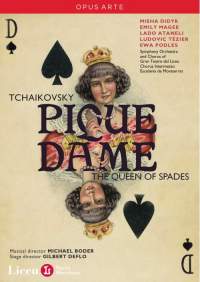
Tchaikovsky´s
opera about the gambling addictive Hermann, who loves Lisa, but kills her
grandmother the Countess in order to gain three secret winning cards is not
quite at the same level of his Eugene Onegin, but nevertheless contains some
beautiful music and 2-3 famous arias (one by Yeletsky, Lisa´s rejected fiance, 1-2 by Lisa). But above all it is the role of the Countess, which offers one of
the few possibilities for great singer personalities and the role is often cast
with singers far past the age of normal
retirement, presently both Anja Silja and Agnes Baltsa may be seen in the role.
The production by Gilbert Deflo is elegant and largely traditional: Period costumes, a sparse background, same recipe as he has previously used as in his Paris versions of Manon, Ballo in Maschera and Rigoletto (Zürich). Unfortunately it is not at the same levels as his best work, such as an extraordinary version of Prokofiev´s Oranges. Thus, while the central confrontation between Hermann and Countess is quite thrilling, other parts, especially the first act seems a bit jaded.
The production by Gilbert Deflo is elegant and largely traditional: Period costumes, a sparse background, same recipe as he has previously used as in his Paris versions of Manon, Ballo in Maschera and Rigoletto (Zürich). Unfortunately it is not at the same levels as his best work, such as an extraordinary version of Prokofiev´s Oranges. Thus, while the central confrontation between Hermann and Countess is quite thrilling, other parts, especially the first act seems a bit jaded.
Hermann really is a quite unsympathetic character and Misha Didyk plays him well. Vocally, however he is quite overchallenged sounding heavily strained in almost every forte passage. Emily Magee is an at times wonderful and very touching Lisa, though she seems to mature for the role, which doesn´t seem to lie well for her and is not among her best. Ludovic Tezier in what is basically a one aria + a bit more role, sings his one famous aria well and looks sufficiently disappointed by Lisa´s rejection of him.
However, by far the strongest performance is Ewa Podles grandiose Countess, a true primordial force and an entirely sufficient reason to watch this DVD or at least the 2nd act.
Unfortunately
the orchestra is somewhat disappointing as well, lacking both punch and density
under Michael Boder.
Pique Dame
is not well represented on recent DVDs, but however I doubt that this will end
up as a first choice in five years time.
Ewa Podles and Misha Didyk in Act 2:
The bottom
line (scale of 1-5, 3=average):
Misha
Didyk: 3
Emily
Magee: 4
Ewa Podles:
5
Ludovic
Tezier: 4
Gilbert
Deflo´s production: 3-4
Michael
Boder: 3
Friday 19 April 2013
singers disappoint in smashing carsen tannhäuser staging

With this production of Tannhäuser, Robert Carsen has created one of his best stagings: Elegant, well thought out as well as thought-provoking. There is only one problem: This was a co-production between the opera houses of Paris and Barcelona. In Paris, the cast including Nina Stemme and Sophie Koch was superb. In Barcelona, less so. And however illogical and unfortunate, the DVD was filmed in Barcelona.
To Robert Carsen, ths opera evolves around an artists struggle with the
creative process: Tannhäuser
is a painter. We begin in his studio, where he is painting the naked Venus.
Multiple copies of Tannhäuser try and paint Venus as well, but all ends in an
orgy of nakedness. And is this not the problem perhaps? That nakedness, itself,
is not enough to be exciting let alone artistic inspiration? In any case, Tannhäuser completes his painting and in Act
2 finds himself in a modern art gallery. Hermann is the owner. A reception is
about to begin. Unsurprisingly, what we see next is a successive revelation of
paintings (note that we, the audience only see the reverse side, never what is actually on the painting) during the
traditional “Sängerfest”. Shocked by Tannhäusers painting of the naked Venus
(presumably, as we never get to see it), he is expelled from the Gallery. During all this, Carsen makes extensive use of the auditorium as both
gallery guests as Elisabeth and Tannhäuser enter and exit from between the rows
of spectators.
So
far, no real interpretative controversy. However this is to come in the third
Act, which opens with Elisabeth dreaming about Tannhäuser whilst performing
some act of autoeroticism. When the painters/pilgrims return from Rome, their
scaffolds are empty, stripped of their paintings. With the antecedents in mind
it really is not that surprising that when Tannhäuser finally calls out for
Venus, she arrives together with Elisabeth. The two women have merged into one
so to say, representing two different but equally essential aspects of womanhood.
Thus, when Tannhäuser now reveals his painting (after Elisabeth has touched it)a high-class audience it is recognized as a masterpiece and
is assigned a place on the wall in a gallery full of masterpieces – its final
place being on the wall just beneath Botticelli´s Venus from Milo. As the
painting is turned around just before it is revealed the curtain drops.
The
weakness, however, are the singers. In Paris they had Nina Stemme, Sophie Koch
and Eva-Maria Westbroek (in a previous run). Here, Beatrice Uria-Monzon looks
stunning, just as fine as her Act 1 body-double, but vocally she is shaky and
her vibrato is unpleasant.
As
for Peter Seiffert, his acting is not too bad, but vocally he is just not very
pleasant to listen too. His real-life wife Petra-Maria Schnitzer does better,
but there is no bloom in her voice and she is no match for the Paris ladies.
Best are Markus Eiche (a substitute for Bo Skovhus) as Wolfram and Günter
Groissböck as Hermann.
Weigle
is doing fine without being extraordinary, however a Tannhäuser without a real
Tannhäuser is a hard sell. As for alternative versions, the idea of Tannhäuser centered around creative
struggles is also explored in Kasper Holtens staging from Copenhagen, now available on DVD, but
otherwise my recommendation would probably either Alden´s production fromMunich or Lehnhoff´s from Baden-Baden.
Arrival of the guests (Act 2):
The
bottom line (scale of 1-5, 3=average):
Peter
Seiffert: 2-3
Beatrice
Uria-Monzon: 3
Petra-Maria
Schnitzer: 3-4
Günter
Groissböck: 4
Markus
Eiche: 4
Sebastian
Weigle: 4
Wednesday 17 April 2013
giulio cesare by david mcvicar

We are in
the 19th Century at the time of the British colonisation of
Egypt and the opera evolves around the clashes between the British (Giulio
Cesare) and the Egyptians (Cleopatra and her brother Tolomeo). David McVicar has created a fast-paced exciting production, that really has to be considered a must for those interested in baroque opera. Even those not normally inclined towards baroque, such as myself, may find this production highly entertaining, which I certainly did. First of all, what really sets this production
apart are the many rhythmic dances and movements accompanying the music. Secondly, there really are some quite funny moments as well - to just mention one, take a look at Cleopatra when she dumps her cigarette into the urn of one of Cesar´s rival, Cornelia´s
late husband Pompeo.
Danielle
De Niese gives us an entirely unsophisticated, almost vulgar version of Cleopatra. Her
voice rings clear, she has a very direct manner of delivery and she is a
fabulous dancer. She definitely has the “X” factor she seems completely involved in the portrait of this scheming
character, no doubt helped by David McVicar´s entertaining personenregie.
No wonder she had her international breakthrough with this role. Later, however, it became
clear that she applies this particular stage manner to all of her
roles at which point her career seemed to stagnate a bit.. However as Cleopatra,
and as Poppea as well, she is fabulous. .
While I
personally prefer a countertenor in the part of Giulio Cesare, I must admit
that I have never seen a female singer as convincing as Sarah Connelly
in a pants role: Her masculine bearing as well as forceful masculine straight-toned singing is simply
extraordinary. Futhermore her presence comes with a hint of an underlying menace, very appropriate for a Roman emperor/British general.
Patricia
Bardon sings Cornlia with beauty but the Erda-like power the part demands, she does not have. And yes, she sings Erda too, with the exact same problems as here. Angelika Kirchschlager
in her first baroque production is a youthful Sesto, looking at least 20 years younger than Kirchschlager´s age.
Christophe
Dumaux seems
to be the Tolemeo of choice today appearing in almost every production of
importance. While he sings beautifully, he somehow fails to leave a lasting
impact on stage – after all he is Giulio Cesar´s main adversary but up against
Sarah Connelly he seems bleak.
To complete the cast, there is an
extraordinary rhythmic drive and vivacity in the Orchestra of the Age of
Enlightenment conducted by William Christie.
This
production will be seen later this spring at the Metropolitan Opera, where
Patricia Bardon will repeat her Cornelia with David Daniels as Giulio Cesare
and Natalie Dessay as Cleopatra, a role she also performed in the Pelly
production from Paris. And Christoph Dumaux, of course, as Tolomeo.
This could
well be the production of choice for many and in any case it is certainly worth
a view. Personally, I still prefer Negrin´s production from Copenhagen, due to
the even greater vivacity and Andreas Scholl´s Giulio Cesare.
Danielle De Niese - Da tempeste:
The bottom
line (scale of 1-5, 3=average):
Sarah Connelly: 5
Danielle De
Niese: 5
Angelika
Kirschschager: 5
Patricia Bardon:
3-4
Christoph Dumaux:
4
David
McVicar´s production: 5
William
Christie: 5
Sunday 14 April 2013
Bieito and Don Giovanni - which scandal?

Don Giovanni. Gran Teatre del Liceu, Barcelona, 2002. DVD. Production: Calixto Bieito. Conductor: Bertrand de
Billy. Cast: Wojtek Drabowicz (Don Giovanni), Kwanchul Youn (Leporello), Regina
Schörg (Donna Anna), Véronique Gens (Donna Elvira), Anatoly Kocherga
(Commendatore), Marcel Reijans (Don Ottavio), Marisa Martins (Zerlina), Felipe
Bou (Masetto).
This is the production, which
created massive scandal when seen at the English National Opera, London in 2001.
However, despite the presence of both urine and oral sex on stage, I was far from shocked and those frequenting contemporary theater productions (which I rarely do, by the way) will probably feel the same. On the other hand, it will not be to the taste of those preferring a traditional-traditional production - so take a look at it before buying this for your new mother-in-law.. Though I´d recommend
everyone to at least take a look as I find this one of the freshest stagings of
Don Giovanni that I have seen.
Calixto Bieito has created a
production which succeed in creating a real contemporary ambiance, a quite rare achievement in opera.
This Don Giovanni is all about a group
of young people living on the edge of society and constantly
seeking boundaries. Don Giovanni is quite happy shagging girls in the back of the car, the
latest being Donna Anna, quite consensual by the way. And after the murder of her, by the way,
aggressive father, Don Ottavio promises her to cover up the entire story in
exchange for certain sexual favors. At least this is the impression I get.. In any case Donna Anna
is mightily pissed off at Donna Elvira, when she realises that she also has had
an affair with Don Giovanni. Donna Elvira, on the other hand, is disgusted when
she realises she has performed certain sexual favour to Leporello, believing
him to be the Don.
Décors mainly consist of a car park,
and a pub with a pool table, background for Masetto and Zerlina´s tasteless
party as well. And the final supper, complete
with cheap take-away, rubbish, peeing on the floor, drinking beer from cans –
and the Commendatore popping up from the luggage compartment of a car obviously not
dead, but almost, as he is killed by Don Giovanni a few minutes later. However, just when I
thought Don Giovanni might indeed save his butt, he is murdered by all the
other main characters acting together in the final scene, the last stab thrown
in by an unwilling Donna Elvira, her hands forced by all the others.
A very contemporary production, all
about a restless and alienated young generation. And as such well in accordance with the
underlying ideas of the work, from which Bieito essentially does not deviated
much. In 2008 in Salzburg Don Giovanni was a heroine addict, but as to the
description of youth living on the edge I have never seen a more convincing
production than this. The personenregie is exciting and there never was
a dull moment.
All the singers act splendidly,
however vocally they are not all top-notch.
Best are Véronique Gens as an
elegant Donna Elvira and Kwanchul Youn, now a Wagnerian bass, as a splendid
Leporello, demonstrating a real comical talent, which he unfortunately does not have so many occasions to show off amidst the many Gurnemanz he performs nowadays.
Wojtek Drabowicz has the right semi-eloquent manners for this Don, but unfortunately not the voice (why not have signed up Simon Keenlyside, who by the way has performed in this production, as the Don for this).
Wojtek Drabowicz has the right semi-eloquent manners for this Don, but unfortunately not the voice (why not have signed up Simon Keenlyside, who by the way has performed in this production, as the Don for this).
Bertrand de Billy is fast at times too fast for his ensemble, though vastly better than in his later Salzburg performances.
Though, I realise, this will not be to everyone´s taste, in my view it is a completely valid interpretation at least worth to have a look at.
The bottom line (scale of 1-5,
3=average):
Wojtek Drabowicz: 3
Kwanchul Youn: 4
Regina Schörg: 3
Véronique Gens: 4-5
Marcel Reijans: 3
Marisa Martins: 3
Felipe Bou: 3
Anatoly Kocherga: 4
Calixto Bieito´s staging: 5
Bertrand
de Billy: 4
Subscribe to:
Posts (Atom)
