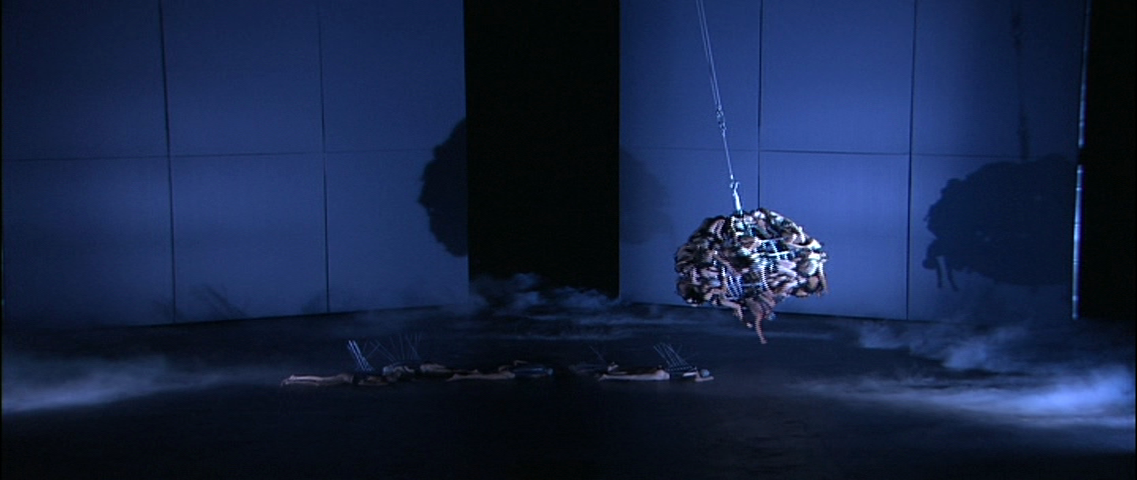
Lulu. DVD. Barcelona Liceu 2010. Director: Olivier Py. Conductor: Michael Boder. Cast: Patricia Petibon (Lulu), Ashley Holland (Dr Schön), Paul Groves (Alwa), Countess Geschwits (Julia Juon), Franz Grundheber (Schigolch), Will Hartmann (Der Maler).
I remember all sorts of pre-opening hype when this Lulu production originally was seen in Geneva in 2010, attached with a warning for those under 16. Not unexpectedly, the production really does not live up to all this hype. Yes there is (semi)-nudity as well as prostitutes and weird sex scenes, but most of all Olivier Py has created a somewhat over-stuffed production.
The overstuffing consisting mainly of the confusing background, resembling a look at a seedy neighbourhood complete with prostitutes in action, a Parisian wheel and flashing signs reading the likes of “mein Herz ist schwer”, “I hate sex”, “sexe”, “comme toujours”. The action, then takes place in front of this colourful tableau where additional colours, disguises etc. are added.
Visually it is quite arresting. Especially as the DVD camera angles change intermittently and you thus zoom in on various aspects of this spectacle. But as to Olivier Py´s take on the story? What is his take on Lulu? What does he want to tell us? Apart from Lulu being a woman of changing shapes, that is. That I am not sure.
In many ways, Patricia Petibon is a wonderful Lulu. Her acting is stunning and she has a special dignity and allure, which is quite rare and makes ones eyes glued to her. Vocally. she does seem to be stretched out rather thinly. While her middle register seem rather solid, in the high register many notes comes out close to screening.
Ashley Holland is a convincing Dr. Schön, Julia Juon very good as Countess Geschwitz, and also Franz Grundheber as well as Will Hartmann convinces in minor parts. Only occasionally did Paul Groves seem overparted as Alwa.
As for the orchestra, Michael Boder really does not make them their best. His reading of the score fails to draw out the melodies and themes that glue this piece together. Vastly inferior to both Andrew Davis on the previous Glyndebourne DVD as well as Antonio Pappano on the new DVD from Covent Garden. Another alternative could be the previous Zurich Opera production, which however uses the two-act version and not Cerha´s instrumentation (staged first 1979 in Paris) used here.
Fanciulla del West. DVD. Nederlanse Opera 2009. Production: Nikolaus Lehnhoff. Conductor: Carlo Rizzi. Cast: Eva-Maria Westbroek (Minnie), Lucio Gallo (Jack Rance), Zoran Todorovich (Dick Johnson)
Director Nikolaus Lehnhoff: “The American Way of Life, lightly satirised, lies at the heart of our production: it is an adventure that takes place somewhere between Wall Street and Hollywood”.
Essentially, I´d agree with his characterization, though in several scenes I´d substitute “lightly satirised” with “quite heavily satirized”: The exaggerated use of money, just to mention one example, which rain on Dick Johnson and Minnie, when they finally depart in search of a better life. Minnie´s home in a pink trailer is not exactly underplayed either. But essentially, the core of the opera remains that of Puccini´s initial intentions: It is still about Minnie and her search for love.
The audience applauded the rather weird third act sets of a car park cemetery (do we really do this in Europe?) where Eva-Maria Westbroek descended through a long flight of stairs like a glamorous Hollywood star of the 1930´s. According to Eva-Maria Westbroek, this is her favourite role. And really, this evening was Eva-Maria Westbroeks show. With wonderful sensitivity and an immensely touching stage presence it is hard to imagine a better Minnie. I have heard say that her high notes do not bloom, but really, the notes are they are all there, secure and on pitch as well. Combined with a wonderful vocal flexibility, just right for Puccini.
None of the men reached that level, though both Zoran Todovich and Lucio Gallo look their parts and act convincingly, however slightly vocally overparted.
Act two - in Minnie´s trailer:
The bottom line (scale of 1-5, 3=average):
Eva-Maria Westbroek: 5 Zoran Todorovich: 3-4 Lucio Gallo: 3-4
Carlo Rizzi: 3-4 Nikolaus Lehnhoff´s production: 4-5
German opera director. Born 1939 in Hannover. Studied theater and art in Munich and was Dr. Phil. in 1962. For the next 10 years he was (the last) assistant to Wieland Wagner in Bayreuth and after Wagners death assistant at the Metropolitan Opera.
Directorial approach: Simplistic, aesthetic often with contrasting colors and dominating geometric lines. Abstract and classic in the outlook, at times occasionally static, the inspiration from Wieland Wagner shines through.
Major achievements in opera: Opera debut (and breakthrough) 1972 with Die Frau Ohne Schatten in Paris (with Karl Böhm). From then on he continued to stage his production in most major houses, such as the Nibelungen Ring 1983-5 in San Francisco and 1987 in Munich.
Closely associated with Glyndebourne for more than two decades he was important in the Janacek revival with stagings of Katia, Jenufa and Makropolous Case in the beginning of the 1990´s. Salzburg debut 1990 with Idomeneo
He has never been a fully accepted "member" of the German Regietheater school, perhaps due to the timelessness of many or his works.
Throughout his career he has had a close artistic collaboration with Anja Silja.
NIKOLAUS LEHNHOFF - SELECTED PRODUCTIONS
His Parsifal production (on DVD from Baden-Baden 2004) takes place in a post-nuclear apocalyptic wasterland, is widely reknown and has been seen in several houses (San Francisco, Chicago, London, Baden-Baden, Barcelona):
Die Gezeichneten, from Salzburg in 2005. Stunningly beautiful and one of his best stagings:
Excerpt from Lehnhoffs San Francisco Nibelungen Ring premiered 1983, here Götterdämmerung 1995:
Tristan and Isolde, the first Wagner production ever to be staged in Glyndebourne in 2003 was widely acclaimed, on DVD as well:
Turandot. DVD. Metropolitan Opera 2009. Production: Franco Zeffirelli. Conductor: Andris Nelsons. Cast: Maria Guleghina (Turandot), Marina Poplavskaya (Liu), Marcello Giordani (Calaf), Samuel Ramey (Timur).
As Metropolitan HD transmissions often resulting in DVD releases, and as several HD transmitted operas already have been released on DVD, some of the new DVDs from the Metropolitan Opera feature productions already available on DVD. They did it with Manon Lescaut for no obvious reason and now again for this Turandot, again for no obvious reason. Last time around on DVD, the highlights were James Levine and Plácido Domingo. This time, the highlights are Andris Nelsons and Marina Poplavskaya.
Though somewhat dusty this is by far not among the worst of Zeffirelli´s Metropolitan Opera stagings, with quite spectacular sets for the first two acts, as I also commented in my review of the previous DVD of this production.
Maria Guleghina, has stage present and strong middle range, but entirely lacks the shining top of Lise Lindström, who in fact made her Metropolitan Opera debut in this run of Turandot, but unfortunately did not perform in the HD transmission, which eventually became this DVD release. And while Marina Poplavskaya does not have the biggest voice, she is a wonderfully moving Liu on stage. And while Marcello Giordano, as usual I´d almost say, hits the notes, the reason he is not a household name is clear: Lack of X-factor.
Interestingly, the Metropolitan Opera comprimario veteran Charles Anthony, who just died earlier this year was the Emperor, in which was his last run of performances at the Met after 57 years and more than 2900 appearances. During the intermission interview he named the debuts of Marian Anderson and Leontyne Price amongst his biggest experiences at his Met career.
Of Samuel Ramey, I´ll only say that he was amongst the very greatest basso cantantes of the century, but if he intends younger audiences to remember this, now is the time to retire.
Video clip of most of Act 2: Riddle scene to Liu´s death:
The bottom line (scale of 1-5, 3=average):
Maria Guleghina: 3 Marcello Giordani: 3 Marina Poplavskaya: 4 Samuel Ramey: 2
Rienzi. DVD. 2009. Deutsche Oper Berlin. Production: Stölzl. Conductor: Sebastian Lang-Lessing. Cast: Torsten Kerl (Rienzi), Camilla Nylund (Irene), Kate Aldrich (Adriano)
A stunning production of a less than stunning work, one might say. Even Richard Wagner himself saw Rienzi as a youthful experiment, not worthy of performing in Bayreuth. And he was right of course. While many elements in both the libretto and music points forward, especially to Lohengrin, the history of the rise and fall of the Roman Tribune Rienzi in itself is just a bit too disorganized, dramatically as well as musically.
By pseudo-historic video footage in the style of Riefenstahl´s propaganda films, Stölzl has created the universal dictator – however with an abundance of references to Adolf Hitler, to begin with the ouverture where we see the general Rienzi with imperialistic attitude surveying the mountains in a setting close to Berghof and ending with Rienzi´s downfall in a subterranean bunker. The white angular R seen on helmets, banners and clothes of course represents Rienzi . With an ever so slight irony seen throughout the production as well: They did not use real historic footage, but rather stylish caricatures.
But what a streamlined production and what a good decision of the production team to shorten the opera to a little more than 2 hours (unabridged it would have been Wagner´s longest opera).
Torsten Kerl´s interpretation of Rienzi is almost uncanny and very believable and Camilla Nylund is becoming more and more mature voiced as the “heidi”–type sister Irene, with clear incestuous references. In contrast Kate Aldrich is a youthful and well-sung, though not large-voiced Adriano, in a trouser role not common for Richard Wagner.
I cannot imagine a better production of this opera.
Anna Nicole. DVD. London Royal Opera House. 2011. Production: Richard Jones. Conductor: Antonio Pappano. Cast: Eva-Maria Westbroek (Anna Nicole), Gerald Finley (Howard Stern), Alan Oke (J. Howard Marshall II), Susan Bickley (Anna´s mother).
To summarize: Vickie Lynn Hogan aka. Anna Nicole Smith was born in 1967, grew up in a small Texas town, dropped out of high-school, married at 17, gave birth to her son Daniel at 18, separated a year later, embarked subsequently on a Playboy/modelling career, married oil tycoon (and 63 years her senior) J. Howard Marshall, who died 13 months later in 1994, spent the rest of her life battling over his estate while she continued to put on weight and abuse drugs, found her 20-year old son Daniel dead in her hotel room in 2006, gave birth to daughter Dannielynn the same year and died the following year.
In summary, the worlds first reality star, one might say.
And a life told in a little under 2 hours in composer Mark-Anthony Turnages fast-paced opera, receiving it´s much-hyped world-premiere 2011 at the London Royal Opera House. That jazz remains one of the main influences of Turnages compositions is quite obvious and he has produced a score, which entertains, but which I doubt would be sustainable in itself.
The libretto is a major accomplishment by Richard Thomas (of Jerry Springer - the opera) effectively using a choir of journalists continuously present to comment on the action, playing on rhymes while incorporating the most swearing ever heard on an opera stage.
The staging by Richard Jones quite brilliantly underlines the score, presenting Anna Nicoles life in small fragments: Meeting her first husband in a diner, having her breasts augmented, wearing Jimmy Choo´s bought by J Howard Marshall, being interviewed by Larry King etc. All the while the journalists who gradually zoom in on her life metamorphose into black-clad anonymous camera-men. For Anna Nicoles life was a life led in public. And she is not ridiculed, but rather portrayed as a woman without real control over her destiny, be that true or not.
Eva-Maria Westbroek is absolutely smashing in the title role. Obviously helped by her uncanny likeness to Anna Nicole, but most of all she manages to display the insecurities as well as the brassy, publicity-seeking behaviour.
Equally well-casted was Gerald Finley, as her creepy lawyer Howard K Stern.
Profound? Perhaps not. Entertaining? Yes, definitely. Touching? Yes, that as well.
DVD trailer:
The bottom line (scale of 1-5, 3=average):
Eva-Maria Westbroek: 5 Gerald Finley: 5 The rest: 5
Genoveva. DVD. zurich 2008. Prod: Martin Kusej. Conductor: Harnoncourt. Cast: Juliane Banse (Genoveva), Martin Gantner (Siegfried), Shawn Mathey (Golo), Cornelia Kallisch (Margaretha), Alfred Muff (Drago).
When Robert Schumann moved to Dresden in the 1840´s he got acquainted with Richard Wagner, who rather bluntly told him that he thought the libretto forGenoveva was rubbish. Obviously this strained their relations for a while, though Schumann greatly admired Wagner and was quite influenced by Lohengrin, which in fact had it´s world premiere in 1850, the same year as Genoveva. Apparently, the rather negative reception of Genoveva dissuaded Schumann from trying to write another opera and Genoveva thus remains his only opera, only sporadically performed, even today.
Based on the medieval legend of the faithful wife Genevieve of Brabant, who are entrusted to her husband´s squire Golo, while Siegfried, the husband goes away, the plot evolves around Golo´s love for Genevieve including lies, betrayals and the obligatory witch. With a happy ending.
Allegedly, Robert Schumann did not want to create an action-filled work, but rather tableau's of various moods, and indeed it is the static nature of the work, which poses the greatest challenge to the listener.
Not at all helped by Martin Kusej´s production, which, for once, seems to miss the mark: A white room. A chair. A sink. The four protagonists remaining on stage throughout. An allegory to the repressive society structures behind the apparently blissful world of Romanticism, which eventually leads to revolution, Martin Kusej says. Interesting on paper, much less so in the theater.
Fine singing from the leading quartet, Martin Gantner a noble Siegfried, Shawn Mathey a torn Golo, Juliane Banse a strong and righteous Genoveva with Cornelia Kallisch a somewhat shrill Margaretha.
Nikolaus Harnoncourt has been a champion of the work for decades and it seems only right that he´d conduct which is the world premiere DVD recording. Though not even he manages to infuse some drama into Genoveva.
Parsifal. DVD. Berlin State Opera 1992. Prod: Harry Kupfer. Conductor: Daniel Barenboim. Cast: Poul Elming (Parsifal), Waltraud Meier (Kundry), John Tomlinson (Gurnemanz), Günter von Kannen (Klingsor), Falk Struckmann (Amfortas), Fritz Hübner (Titurel).
With 20 years delay, finally we now have the 1992 Berlin State Opera production of Parsifal, quite simply the best presentation to date of Parsifal on DVD.
Harry Kupfer, at this time artistic director of Komische Oper, the smallest of the three opera houses in Berlin had no real possibility of staging Wagner in his own house, thus the collaboration with Daniel Barenboim, the newly appointed musical director at the Berliner Staatsoper, 200 meter further down the Unter den Linden.
This was Harry Kupfer´s second attempt at Parsifal, the first dating from the 1970´s also at the Berlin State Opera, which could be seen at the Copenhagen Royal Opera House as well until a few years ago (I saw it at least twice). In that first production, Parsifal renounces the brotherhood chooses to leave the community with Gurnemanz and Kundry taking the spear and the grail with him, which was at the time seen as a politically charged criticism.
However, for this, his second Parsifal, after the fall of the Berlin Wall, things looked different, for Parsifal as well. In a semi-mythical, futuristic setting, circular door reminiscent of spaceships separate the inside and the outside - both pitch dark, with metallic and electronic cold surfaces. The grail community is a sick community: Characterized by a strong bond, the knights seem fixated on the Grail, oblivious to anything else.
involved stage direction. The flower maidens show their various body parts on TV screens, only Kundry, is a real, three-dimensional woman. In the end, the knights are oblivious to Parsifal, focusing only on the Grail. Kundry takes his hand as if urging him to leave, but after a moment of reflection Parsifal choses to stay with her and Gurnemanz.
And why exactly does this work? Because of the combination of Harry Kupfer´s excellent direction of the singers (his trademark), the aesthetic stage designs (by Hans Schavernoch), Barenboim´s superb reading of the score and some of the best singers of the generation.
The singers are what Kupfer wants: Young, agile singer-actors, all in their vocal prime, most having already worked with Barenboim/Kupfer in their just terminated Bayreuth Nibelungen Ring, also the best Nibelungen Ring on DVD. The static nature of Parsifal simply needs involved personal stage direction to work dramatically. As well as singers, who master their parts, obviously.
Is Waltraud Meier the best Kundry in history? Honestly, I think she may well be. Here, stunningly beautiful in her vocal prime (36 years old), already with 10 years experience in the part, her dramatic commitment and effortless vocal flexibility is unparallelled. This is her third Kundry on DVD, with the Metropolitan Parsifal recorded the same year, but leaving her with fewer dramatic options. Poul Elming, the Danish tenor, who started out as a baryton and got his international breakthrough when Daniel Barenboim selected him as his Siegmund in the Bayreuth Nibelungen Ring, is a committed and entirely believable Parsifal. He also appears on the recently released 1998 Bayreuth production conducted by Sinopoli. John Tomlinson, in his vocal prime, a charismatic Gurnemanz, who tells his stories so you want to listen to them. A young Falk Struckmann is a fine, though already at this point slightly grainy Amfortas, while the Nibelungen Günter von Kannen makes a fine Klingsor.
While Christian Thielemann has the glitzy brilliance, Daniel Barenboim the weightier punch, which is ultimately the most satisfying approach. He quite simply understands the structure of Richard Wagners compositions, better than he understands the structure of anything else I have ever heard him conduct (which is, in fact, a lot).
Die Frau Ohne Schatten. Copenhagen Royal Opera, March 10th 2012. Production: Kasper Holten. Conductor: Michael Boder. Cast: Marion Ammann (Kaiserin), Johnny Van Hal (Kaiser), Johan Reuter (Barak), Linda Watson (His Wife), Susanne Resmark (Amme), Henning von Shulman (Messenger).
This production marked the ending of Kasper Holten and Michael Schønwandt´s 11-year tenure as artistic resp. music director at the Royal Danish Opera when it opened last Spring. And considering the massive problems with budget cuts which recently led to the resignation of newly appointed artistic director Keith Warner and music director Jakub Hrusa (neither has been replaced yet), Holten and Schønwandt certainly chose the right moment to leave. Especially Kasper Holten, who moved to the London Royal Opera House.
In any case, Kasper Holten certainly ended his tenure with perhaps his best production to date: A visually arresting production, with ample use of video projections tells the story of the two couples, who cannot have children, in a relatively straightforward manner. Entertained from start to end, a major feature is the vertical division of the stage into several chambers, thus showing several pieces of action simultaneously. A concept also used to great effect by Dmitri Tcherniakov in his Munich staging of Khovanschchina. With video projections helping to establish the moods: A tear, a sleeping pill dissolved in a glass of water etc. There is hardly a dull moment in this production, a great relief after having seen Christof Loy´s immensely boring production in Salzburg last summer.
The orchestra received rave reviews last year with Michael Schønwandt. Now, the conductor is Michael Boder, and yes, the orchestra plays well, and nuanced but with Christian Thielemanns mightly Vienna Philharmonics very present in memory it is hard to give them 5-stars. That said, Boder seems to have difficulty grasping the overall structure of the piece.
As for the singers, Johan Reuter is simply the best Barak I have ever heard with a wonderful warm voice, and such a welcome change to have a singer in his prime for this part. Equally a strong turnout for Linda Watson, who still has a very beautiful middle register, which is where most of her part lies. In comparison with her, Susanne Resmark seemed somewhat bleak. Marion Amman, a late substitution for Ann Petersen, was no more memorable than her husband.
Der Ring desNibelungen (complete). DVD. Palau de les Arts Reina Sofia, Valencia 2007-9. Director: Fura dels Baus. Cast includes: Juha Uusitalo (Wotan), Jennifer Wilson (Brünnhilde), Lance Ryan (Siegfried), Matti Salminen (Hagen). Conductor: Zubin Mehta.
Overview and general comments
Fura dels Baus is a Catalan theatre group founded 1979 in Barcelona working with contemporary theatre, opera as well as major events such as the opening ceremony for the 1992 Barcelona Olympic Games. In opera Fura del Baus stagings are renowned primarily for their abstract stylistic settings, where 3D computer animations play a major role.
When Zubin Mehta (then music director at the Bavarian State Opera and in the middle of a Ring Cycle there), was approached in 2002 regarding a Ring Cycle in Valencia, he initially hesitated, thinking he´d done too many already, but then said that if Fura del Baus would stage it, he´d come. Subsequently, Carlus Padrissa, the stage director for this production (one of six stage directors as well as one of the founding members of Fura del Baus) went to Munich, saw his first Ring Cycle with Zubin Mehta, took notes and went home to think and develop his own vision.
The result, the first complete Ring Cycle ever in Spain (according to Padrissa) opened between 2007-9, a coproduction between the new opera house in Valencia and Maggio Musicale Fiorentino (musical festival in Florence, Italy).
The main idea behind Fura del Baus´ staging of the Nibelungen Ring is to show "the degradation of nature by technological man". Carlus Padrissa meticulously followed all Wagner´s original stage directions with "greater freedom and adapting it to our own aesthetics" while at the same time “going back to the spirit of Wagner, to the original mysticism and symbolism”.
The two trademarks of Fura dels Baus´s Ring Cycle is the video projections and the use of stage acrobats and may best be described as a mix of The Lord of the Rings (the movie), Star Wars and street theatre. Simultaneous with the theatre performances, another spectacle with HD projections and acrobats took place outside/on the Palaus des Les Arts Reina Sofia, which is designed by Calatrava.
Franc Aleu´s stunning video projections are the central element and the key to the entire staging, creating "beings of light", music and light. This is the most effort Fura del Baus ever put into video projections, reaching 3500 pixels (3 times HD quality) for some of the images and resulting in some of the most stunning images ever projected onto an opera stage, ranging from National Geographic-like land shapes to projections of the entire earth mixed with plenty images of the human body (with the intention of showing the degeneration of the human race perhaps?) as well as more abstract projections.Traditional sets were generally not used and often the images were projected on/behind the naked stage with ample use of mirrors.
The Fura dels Baus actor-acrobats represent such different entities as: Valhalla, dead heroes, wood beings, Brünnhildes bed pillar, a bear, river grass, Brünnhildes bed-cover when conquered by Gunther/Siegfried with the Tarnhelm. The substance of the living world perhaps?
The street theatre elements come forward in the characterisation and the costumes (by Chu Uroz), which are exaggerated in an almost cartoon-like way, unfortunately making several key characters looks like Anna Russell imitations: The Wälsungs, including Siegfried in tribal costumes including bone fragments, the Gibichungen with dollar-signs on their jacket and oriental-looking face paint. Furthermore, the Gods are locked up into cranes, manipulated by stage extras, 3-4 meters above stage,
Thus Fura dels Baus present straight-forward storytelling using contemporary imagery. They work on the grand level, and though the singers have clearly been directed they cannot help loosing out on the interpersonal relations. However, the production is quite possibly more impressive on DVD, with the many close-ups, than in the theatre and perhaps even more so on blu-ray.
The straightforward storytelling combined with the stunning imagery and an overall acceptable musical quality may make this a first choice for some. In any case, it is an important interpretation, which those with specific interest in Richard Wagner should see.
As a “concept”, this is not entirely unlike Harry Kupfers Berlin/Barcelona Ring, also focusing on degradation of nature, though with a freer interpretation of the original stage directions.
The three Rhinemaidens swim in suspended water tanks and The Rhinegold, originally a golden fetus born out of eggs laid by the Rhinemaiden becomes a black old man when seized by Alberich, who additionally seizes the other eggs laid by the Rhinemaiden, multiplies them and transforms them into human clones, thus building his treasure.
The Gods are locked onto moving platforms 3-4 meters above stage (levelling with the Giants). The earth is the backdrop, while John Daszaks superb Loge flutters around on a moto, as restless as his music.
The spectacular descent into Nibelheim is literally a descent into the middle of the earth, where the cloning of the Golden eggs into small golden fetuses and finally humans becomes obvious. Is this then the beginning of the degradation of manhood – are these clones made by Alberich the future inhabitants of the human world, as seen in Götterdämmerung?
Among the very few visual disappointments are Alberichs transformations – the dragon created by a living chain of acrobat-actors and the frog a simple steel device – no projections here. Also the shock-effect of Erda´s appearance somehow seems to drown in all this imagery.
Some may find that all these video projections, especially in Siegfried and Götterdämmerung but also here in Rheingold tend to draw too much attention to themselves at the expense of the music. I don´t agree and generally find the projections to underline the course of action or simply provide spectacular entertainment.
The Rhinemaidens with the Rhinegold:
Gods, Giants and Loge:
Loge and the Gods gasping for breath after the Giants abducted Freia:
The descent to Nibelheim:
Nibelheim:
Wotan (with the Ring) and Loge:
The appearance of Erda:
Freia with the Giants and the human Nibelungen treasure:
Valhalla:
Rheingold video excerpts:
The individual operas - Walküre
A beautiful projection of the World Ash, with its ever changing colours (and Wotan´s lurking ravens) provide the backdrop for Hunding´s home, here a circle of bones on the naked stage. Costumes are mainly made by fur, bones and tribal paintings and the picture is completed by plenty of feral crawling as Hunding has Sieglinde tied to a rope and drags her along like a dog.
According to Carlus Padrissa Hunding is a Cro-Magnon and the Wälsungs are homo sapiens - this is why Hunding cannot make Sieglinde pregnant, while her brother, another homo sapiens, easily can. Not a bad explanation at all, in fact. The setting is 50.000 BC. While proving the point, all this feral crawling and exaggerated, downright unflattering costumes unfortunately also significantly limits the human drama, the real cornerstone of Act 1 Walküre. And despite some chemistry between Peter Seiffert and Petra Maria Schnitzer (a married couple), and a convincingly Cro-Magnon version of Matti Salminen, the Act I never really takes off.
Equally, locked to their cranes within a circle of stars, true interaction between the Gods prove too difficult, despite splendid singing from Anna Larsson´s Fricka. Later, descended from the crane, during his big monologue, it becomes clear that Juha Uusitalo simply lacks star-quality, despite rather fine singing. Not to mention Jennifer Wilsons appallingly apathic and passive Brünnhilde, a real shame as she has a very fine voice with a brilliant top, of a quality seldom to be heard in this repertoire. Admittedly she is not helped by Chu Uroz´ costumes including a ridiculously looking harness which makes her look even bigger than she already is, resembling an Anna Russell caricature. However, this is an entirely intentional effect, as Chu Uroz intended these costume as a tribute to the "large woman" of the 19th Centure, the "demi-goddesses".
The Valkyries sing and act well, though again, the suspension on cranes at times impedes dramatic interaction. Though even when descended from the cranes, as Wotan and Brünnhilde ultimately do in Act 3, it is clear that dramatic interactions are the weak point of this cycle despite the scene being played on a stunning background of the projected earth. When the emotional interaction during "leb wohl" is missing, something is not quite right.
The Ash overlooking Hunding´s circle of bones:
Confrontation between Wotan and Fricka:
Wotan´s monologue:
Siegmund and Sieglinde during their escape:
Siegmund´s death:
The Valkyries:
Brünnhilde sleeping on the rock:
Video of Siegmunds death:
The individual operas - Siegfried
Perhaps the most successful of the four operas as the wide spaces decreed perfectly suits Fura del Baus´ video projections.
We travel deep inside the earth to arrive in Mime´s high-tech smithy. Retrospective video projections accompany much of the action such as the Wanderer´s questioning of Mime (and vice versa) and we see how Siegfried has to completely destroy the sword to forge it anew.
In a stunningly beautiful Act 2, the ever-changing background incorporates cartoon elements with actor-acrobats representing various forest animals as well as carrying the string of white boxes, representing Fafner.
Perhaps one of the musical highlights of the entire cycle, Wotan´s call for Erda in Act 3 is accompanied by stunning National Geographic mountain videography with Erda herself appearing from the centre of the earth (here: India). Equally Siegfrieds passing through the fire is spectacular, again demonstrating in the closing scene between Siegfried and Brünnhilde than the one-to-one interactions is the weak point of this cycle, despite some fine acting and nuanced singing from Lance Ryan´s Siegfried. Thus, this is a statement with modifications as always, as Gerhard Siegel (Mime) seems fully capable of inhabiting the stage.
Mime´s smithy:
Mime tries to reforge Nothung:
Outside Fafner´s cave:
Fafner:
The wood bird pointing Siegfried to Brünnhildes Rock:
Wotan calls for Erda:
Erda appears:
Wotan confronts Siegfried:
Siegfried and Brünnhilde:
Video presenting some of the most stunning images:
The individual operas - Götterdämmerung
The Gibichungen world is cruel and grim. Fura del Baus suggests we could be in a major city such as Shanghai, accentuated by the Chinese-looking face paint of the Gibichungens, here seen as grotesque stock brokers with dollar signs attached to their clothes and stock exchanges rates projected on the screen. A grotesque, superficial world of extremely bad taste, where Gutrune runs on a tread-mill within a cylinder suspended in air. The contrast to the Siegfrieds prehistoric costumes is fully intended and his transformation from a caveman into stockbroker after getting drunk is champagne shows impressive acting from Lance Ryan. However, though dressed like the others, Siegfried never learns how to act in this world, which eventually becomes his downfall.
Understatement is not a trademark of this Ring, where especially Götterdämmerung at times seem over-exaggerated. Though definititely not without it´s moments, such as a second act staged like a thriller complete with snipers and a searching eye. Also Siegfrieds Funeral March is a highlight, with Siegfried´s body being moved from stage, through the audience.
Jennifer Wilson´s apathy is again a serious drawback, and even Matti Salminen´s Hagen is more mobster-calculating than evil, though Lance Ryan´s Siegfried transformation is quite impressive and generally he fares better in Götterdämmerung than in Siegfried.
As Fura del Baus closely follows Richard Wagners stage directions, the Ring is given back in the end and the net of acrobat-actors symbolizing Valhalla is dispersed. Though inventive, I couldn´t help finding the ending a bit disappointing, perhaps expectations were raised too high based on the preceding imagery.
The Norns:
Gunther:
Brünnhilde and Waltraute:
Hagen and Alberich:
Brünnhilde confronts Siegfried (the latter head-down):
The Act II trio, staged as a thriller:
Siegfried meets the Rhinemaiden:
The scene of Siegfrieds death:
Siegfrieds Funeral March:
The Immolation Scene:
Video - Götterdämmerung highlights:
The singers
General comments:
A list of some of the most respected Wagner singers of today (eg. Matti Salminen, Stephen Milling, Peter Seiffert etc) combined with relative newcomers such as Lance Ryan and Jennifer Wilson. The individual singers:
Wotan:Juha Uusitalo, a bass-barytone, generally sings well, though without leaving a truly individual mark. Essentially he lacks the energy, seen with John Tomlinson (for Barenboim) or the class of James Morris (only as Wanderer, though). And, as a bass-barytone, as opposed to a bass Wotan, the deep resonant voice for the Wanderer he simply does not have.
Fricka:Anna Larsson with the wonderfully deep expressive voice is perhaps the best Fricka on DVD, with an impressive combination of royalty, class and vulnerability showing that Fricka is far from the mono-dimensional character often seen.
Alberich:Franz-Josef Kapellmann has more stage presence than voice at this point of his career. And in this, his second Alberich on DVD, he more than occasionally relying on yelling and exclamation, clearly past his prime, but still to be reckoned with.
Loge: Strong performance, vocally as well as dramatically from John Daszak.
Fasolt:Matti Salminen (see below), ages well vocally, but has lost quite a lot of his strength and is no match for Stephen Milling.
Mime: Gerhard Siegel commands the stage and delivers a vocally satisfying performance as well.
Sieglinde: A convincing, though not exceptional performance from Petra Maria Schnitzer, who is not helped by either costume designer or director with her cave-like appearance and manners.
Siegmund:Peter Seiffert fails to make a lasting impression in this role and though he sings the notes, his acting skills leave a lot to be desired. We are a long way from the intensity of Peter Hofmann/Jeannine Altmeyer.
Hunding: The Cro-Magnon outfit quite suits Matti Salminen, though he, in his 60s, has lost the sonorous, menacing profound tones. This is his second Hunding on DVD.
Hagen:Matti Salminen´s voice ages well, being steady and almost vibratoless. Nevertheless, in this his third Hagenon DVD, he does not live up to his past attempts and despite an ever strong stage presence he more often than not resorts to barking and yelling without earlier times punch and power. Stephen Milling would have been a better choice.
Brünnhilde: It is very frustrating to watch and listen to Jennifer Wilson: Vocally she has got the goods, with a beautiful voice high above average for this part being both solid and with a shining top. Unfortunately, she severely lacks in dramatic expression, both vocally and acting-wise, which ultimately makes her Brünnhilde one of the major disappointments. Not too mention she is a large woman, who simply does not move well on stage.
Siegfried:Lance Ryan is as good a Siegfried as anyone today: He looks the part and after some indifferent acting especially in the first two acts of Siegfried, he becomes quite interesting to watch after his transformation in Götterdämmerung. Vocally, his is perhaps not the biggest voice, but he is solid throughout, though not without a certain monotony and dryness. However, he is capable of producing some finely nuanced singing, especially in Siegfried Act III and Götterdämmurung Act I after his transformation. All in all a very promising performance.
Erda: In Siegfried Catherine Wyn-Rogers sings the notes but fails to convey the drama. More dramatic is Christa Mayer in Rheingold, though she still fails to project the primal force of the Earth Goddess.
Waltraute: Waltraute´s part is probably a bit too high for Catherine Wyn-Rogers, whose dramatic strengths lie in her lower register declamations. However, her excessive middle-register vibrato combined with a stiff stage presence makes no competition for excellent DVD Waltraute´s such as Waltraud Meier or Anette Bod.
Gutrune: Elisabete Matos, essentially a dramatic soprano, seems miscast in this essentially lyric part, where she simply sounds too harsh.
Gunther: A dry voiced Ralf Lukas effectively conveys what is here a very unsympathetic character.
The conductor and the orchestra
A young orchestra initially assembled by Lorin Maazel and conducted here in their first Wagner production by veteran Zubin Mehta. In this context, their performance is impressive though it does not measure up to the best on DVD. According to Mehta, the biggest challenge was getting the brass sections to work. This part worked out well and the strings sound fine.
I suspect the problem lies with Zubin Mehta´s interpretation: He simply plays too undynamic and without applying the small shifts in tempo so essential for the dynamic of the work. On the contrary, on several key points in the score (such as Siegmunds death, the Wotan/Fricka scene in the Valkyrie, Wotans “wer meine speeres spitze”), he slows the tempo markedly creating a vacuum.
Despite the impressive effort by the orchestra, they are no match for the twoBayreuth DVDs, the Metropolitan Opera Orchestra or the Royal Danish Orchestra.
In brief - the highlights and lowlights
Highlights – The stunning images and inventive use of actor-acrobats.
Lowlights – no real lowlights, but weak points were the interpersonal relations, weakest between Siegfried and Brünnhilde. Some of the costumes, notably the Wälsungen incl. Siegfried and the Valkyries resemble Anna Russell caricatures and make their characters look outright ridiculous
The bottom line (scale of 1-5, 3=average)
Juha Uusitalo (Wotan): 4 Anna Larsson (Fricka): 5 Franz Josef Kapellmann (Alberich): 3 John Daszak (Loge): 5 Matti Salminen (Fasolt): 4 Stephen Milling (Fafner): 5
Gerhard Siegel (Mime): 4
Christa Mayer (Rheingold-Erda): 3
Catherine Wyn-Rogers (Siegfried-Erda): 2
Catherine Wyn-Rogers (Waltraute): 2
Peter Seiffert (Siegmund): 3
Petra Maria Schnitzer (Sieglinde): 3-4
Matti Salminen (Hunding): 4
Matti Salminen (Hagen): 4
Lance Ryan (Siegfried): 3-4
Jennifer Wilson (Brünnhilde): 2-3
Elisabete Matos (Gutrune): 3
Ralf Lukas (Gunther): 3
Fura dels Baus´ staging: 4 (5 for Siegfried, 4 for the rest)