Located at Wahnfriedstrasse 9 next to Villa Wahnfried, this is the house where Franz Liszt stayed until his death in 1886 while visiting the Bayreuth Festival. Now open to the public as the Franz Liszt Museum. The museum contains 4-5 rooms with memorabilia. As most will know, Franz Liszt was the father of Richard Wagner´s wife Cosima.
Monday, 18 August 2008
Sunday, 17 August 2008
Marthaler´s Tristan in Bayreuth: Superb Irene Théorin caught in a communist nightmare..
From left: Robert Holl, Robert Dean Smith, Irene Théorin and a blurred Jukka Rasilainen
Tristan and Isolde. Bayreuth Festival, August 14th, 2008. Production: Christoph Marthaler. Cast: Irene Théorin (Isolde), Robert Dean Smith (Tristan), Michelle Breedt (Brangäne), Jukka Rasilainen (Kurwenal), Robert Holl (King Marke). Conductor: Peter Schneider.
In this revival of his 2005 Bayreuth Festival production, Swiss director Christoph Marthaler depicts Tristan and Isolde as his trademark: Ordinary human beings in a desolate minimalistic setting, this time in all shades of brown, typical of the former German Democratic Republic (GDR), where brown coal fittingly served as a primary energy source..
All emotions are absent and the protagonists fail to communicate on all levels. While Isolde, a rather simple-minded child, is more interested in the flickering light-bulbs on the ceiling than in both Marke or Tristan, Marke reacts to the treachery by simply re-buttoning Isolde´s jacket. Emotional paralysis seems the keyword. As well as the boring despair and ugliness of ordinary human living conditions.
Do we really need to go to Bayreuth to see this? Do we need to go anywhere to see this? While Marthaler´s concept may sound enticing on paper, in fact it makes for staggeringly boring theater. There is nothing revelatory about Christoph Marthaler´s production of Tristan, which most of all illustrates how an imaginary concert performance may have looked in an elementary school in Leipzig in the 70´s.
Small wonder Christoph Marthaler apparently has moved on to more important things as this revival was directed by an assistant. In brief: The production looks like genuine communist trash ripe for recycling. Perhaps one of Marthaler´s points, after all. But a small consolation for those waiting 8-10 years for a ticket.
Wolfgang Wagner was previously criticized for ignoring the fraction of deconstructionist directors such as Marthaler at the Bayreuth Festival. Now he is criticized for allowing this production to continue. Nobody ever said his job was easy. Furthermore, Hans Neuenfels (of a similar vein) is scheduled to direct the new Lohengrin in 2010. I´d say this directorial approach is more than adequately covered, then.
Musically, however, the production was rather successful. First of all Irene Théorin, after being partially indisposed at the premiere, was simply wonderful as Isolde. With a beautifully rounded middle register she throws out the high Cs effortlessly and though generally sharp in her upper register (Waltraud Meier is as well), her intonation only faltered towards the end, where she was visibly tired. As a member of the ensemble of the Royal Danish Opera, Irene Théorin´s development over the past few years has been fascinating to watch. Apparently her substantial weight loss after her 2006 Copenhagen DVD Brünnhilde has been accompanied by a newfound confidence on stage. At any rate, I have not previously seen such committed and detailed acting on her part. In summary, a major success confirming her position as one of the main interpreters of Isolde on stage today.
In this revival of his 2005 Bayreuth Festival production, Swiss director Christoph Marthaler depicts Tristan and Isolde as his trademark: Ordinary human beings in a desolate minimalistic setting, this time in all shades of brown, typical of the former German Democratic Republic (GDR), where brown coal fittingly served as a primary energy source..
All emotions are absent and the protagonists fail to communicate on all levels. While Isolde, a rather simple-minded child, is more interested in the flickering light-bulbs on the ceiling than in both Marke or Tristan, Marke reacts to the treachery by simply re-buttoning Isolde´s jacket. Emotional paralysis seems the keyword. As well as the boring despair and ugliness of ordinary human living conditions.
Do we really need to go to Bayreuth to see this? Do we need to go anywhere to see this? While Marthaler´s concept may sound enticing on paper, in fact it makes for staggeringly boring theater. There is nothing revelatory about Christoph Marthaler´s production of Tristan, which most of all illustrates how an imaginary concert performance may have looked in an elementary school in Leipzig in the 70´s.
Small wonder Christoph Marthaler apparently has moved on to more important things as this revival was directed by an assistant. In brief: The production looks like genuine communist trash ripe for recycling. Perhaps one of Marthaler´s points, after all. But a small consolation for those waiting 8-10 years for a ticket.
Wolfgang Wagner was previously criticized for ignoring the fraction of deconstructionist directors such as Marthaler at the Bayreuth Festival. Now he is criticized for allowing this production to continue. Nobody ever said his job was easy. Furthermore, Hans Neuenfels (of a similar vein) is scheduled to direct the new Lohengrin in 2010. I´d say this directorial approach is more than adequately covered, then.
Musically, however, the production was rather successful. First of all Irene Théorin, after being partially indisposed at the premiere, was simply wonderful as Isolde. With a beautifully rounded middle register she throws out the high Cs effortlessly and though generally sharp in her upper register (Waltraud Meier is as well), her intonation only faltered towards the end, where she was visibly tired. As a member of the ensemble of the Royal Danish Opera, Irene Théorin´s development over the past few years has been fascinating to watch. Apparently her substantial weight loss after her 2006 Copenhagen DVD Brünnhilde has been accompanied by a newfound confidence on stage. At any rate, I have not previously seen such committed and detailed acting on her part. In summary, a major success confirming her position as one of the main interpreters of Isolde on stage today.
Robert Dean Smith´s lyrical Tristan shines effortlessly, no doubt helped by the exceptional acoustics, and his rather un-committed acting fits rather strangely into Marthaler´s concept. An excellent Kurwenal from Jukka Rasilainen was accompanied by Robert Holl´s fine King Marke (sounding vastly better in the theater than on the broadcast) and a rather shrill Brangäne from Michelle Breedt. Peter Schneider was as reliable as ever without being overly imaginative in the pit.
For some obscure reason, this production will be revived next year as well where it has been chosen to open the 2009 Bayreuth Festival (there will be no new productions next year).
A new Tristan for Bayreuth? Yes, but not until 2015 and directed by Katharina Wagner
(Christian Thielemann conducts)... I suppose after a couple of large Weissbier this production in the meantime may turn out rather fine. Something I unfortunately could not try out as I had a 80 km drive to Nürnberg to look forward to after the performance…
Rarely has a production received so uniformly negative reviews as this one. For once, I agree. A selection of reviews and photographs is posted here.
The bottom line (scale of 1-5, 3=average):
Irene Théorin: 4
Robert Dean Smith: 4
Michelle Breedt: 2
Robert Holl: 3
Jukka Rasilainen: 4
Peter Schneider: 4
Christoph Marthaler: 1
Overall impression: 2
Rarely has a production received so uniformly negative reviews as this one. For once, I agree. A selection of reviews and photographs is posted here.
The bottom line (scale of 1-5, 3=average):
Irene Théorin: 4
Robert Dean Smith: 4
Michelle Breedt: 2
Robert Holl: 3
Jukka Rasilainen: 4
Peter Schneider: 4
Christoph Marthaler: 1
Overall impression: 2
Saturday, 16 August 2008
Bayreuth 2008: How to get a ticket for the Bayreuth Festival if you arrive without one - a live report from the queue at the Bayreuth Festival House..
Ticket queue for Tristan in Bayreuth 2008 (right after I got my ticket)
As I sort of happened to be in the area (Salzburg, a 3 hour drive), why not try and drive up to Bayreuth to see if any last minute tickets were available for this years Bayreuth Festival? I had a half appointment there with friends (with tickets) for Tristan (August 14th) and Parsifal (August 16th) - the two performances I intended to see, having already seen both Meistersinger and The Ring there last year.
Day one - getting a ticket for Tristan:
A reader had kindly informed me by mail that one of the hotels in Bayreuth was selling tickets for Tristan, which turned out to be entirely correct, but on the morning of the performance my friends made the mistake of telling the receptionist that we did not stay at the hotel, at which point she refused to part with the tickets....
Not wanting to spend my entire holiday queuing Bayreuth Festival tickets, I decided 12 am (midday) would be an appropriate time to start queuing (the Ticket Office opens at 1.30 pm, the performances start at 4 pm). Arriving at 12.15, I was number 7 in the queue. Number 1 arrived at 9 am. When the ticket office opened at 1.30, they claimed only one ticket had been returned. Now I was number 6. Curiously, five tickets were returned during my one-hour wait in the queue, but to the office next door as the ticket office hadn´t opened yet. Exactly why these tickets did not resurface we speculated loudly about in the queue..Though, apart from the explanation offered by us (foul play on part of the organizers involving internal redistribution of the tickets), the tickets may of course have belonged to the Friends of Bayreuth (a sponsor organisation), who gets allocated numerous tickets for the Festival each year (in return for the financial support of the members, obviously). To make ticket matters more complicated, the Friends of Bayreuth have their own ticket office at the other side of the Festival House with an entirely separate ticket queue.
The same two black-market dealers were constantly cruising past the queue of about 20 people - one on a bicycle alternating with a sportscar, offering tickets for twice the official rate... During the next hour three tickets were returned by ticketholders, whose companions were ill etc. At 3 pm I was number 3 in line. An elderly gentleman from Munich then offered up his daughters ticket as she was unable to come, but as he had a Friends of Bayreuth ticket (easily recognizable as the name of the ticketholder is printed on the front), he was asked to go to the Friends of Bayreuth ticket office. Then a phone call from the Friends of Bayreuth office quite unusually offered one of their tickets up for sale, meaning that at 3.05 pm I now was number 2 in the queue..
It was now 3.15 pm and suddenly the elderly gentleman from Munich returned from the Friends of Bayreuth office having been allowed to offer his daughters ticket up for sale to the general public as nobody was waiting in the Patrons ticket line. And as the gentleman in front of me could not afford it (150 Euro) at 3.15 pm I was the owner of a ticket for this years performance of Tristan and Isolde. Not exactly cheap, but at least bought at face value. And vastly easier than returning your ticket application form for 8-10 years in a row...
Day two - getting a ticket for Parsifal:
When queuing for Tristan tickets the previous day, I had noticed that on two occasions ticketholders returned tickets for future performances which the Ticket Office then offered to the people in the queue (ie. Meistersinger next week), so at 12 am (midday) I decided to join the ticket queue for this days Meistersinger to try and look closer into the Parsifal ticket situation and, if possible, get a cheap ticket for the Meistersinger (I already saw this production last year). I was number 6 in the queue. Number one started queuing at 9 am. Five of the people in the queue were also present in yesterdays queue and the performance of Tristan, which we all attended, was discussed. And again, queuing practices here, as everywhere in Germany, are very civilized - you may easily leave the queue for 30 minutes, drive downtown etc. and then return to your position.
At least 10 people constantly circled the Festival House carrying signs "Suche karte für Parsifal" (tickets needed for Parsifal) and the (very friendly) ladies in the ticket office told us that last week, two people had slept in front of the ticket office the night before the Parsifal performance and nothing was returned at any point.
Quite the contrary with Rheingold last Friday, as the highway to Bayreuth was suffering from extended queues due to heavy holiday traffic (the Bayreuth highway is part of the major E53 trans-European highway) and ticketholders had been phoning down the ticket office trying to return their tickets, as they were stuck on the highway and could not make it.
"Every year we tell people that especially on Fridays they have to be here early as the highway is unpredictable, but do they listen? It´s always the same with Rheingold and we constantly have to remind people that there is no intermission. If they are not here on time, they simply do not make it", as the lady in the Ticket Office sighed. As a result, there were spare tickets in all categories for last weeks Rheingold and sold at vastly reduced prices as well, at the request of the ticketholders, who were stuck on the highway - 205 Euro tickets were sold for 50 Euros, as we were told...
But back to the Meistersinger queue: At 1.30 pm the Ticket Office said that nothing had been returned. The usual two black market dealers were circling the house, not offering anything up for sale, but looking for tickets for Parsifal themselves, as they allegedly had clients on hand willing to pay exorbitant prices for these.
As it was freezing I was contemplating driving back to Nürnberg, but then a young couple suddenly arrived at the Ticket Office returning two tickets for.... Saturdays Parsifal: As number 1, 3, 4 and 5 in the queue could not make it, the tickets went to number 2 (a Japanese guy, who had been scribbling constantly on a note-pad for two hours) and ....me. And a good seat as well.
Furthermore I was offered tickets for Meistersinger as well, but declined due to the price (205 Euros) as I decided to save the money for Salzburg next week. They were second row seats though, and sold at face value...Tickets were offered for next weeks Meistersinger as well as for Sunday´s Siegfried, both of which my queuing position entitled me to buy (I declined as I will be in Salzburg).
Even 15 minutes before the start of the Meistersinger performance, a gentleman came up and offered me his wife´s seat for at least the first two acts for free (she´d perhaps return for the third act), which I declined as well, since I was technically not the first in line (an elderly gentleman was) and thus I felt obliged to offer the seat to him (after all I saw the production last year and never really intended to see it this year, furthermore the third act is my favorite).
And the Parsifal queue on Saturday, in which I didn´t participate for obvious reasons: The same 5 people from previous days were in it. Three tickets in total were returned - all between 2.30 and 3.30 pm...
In summary: As last year, tickets may be had for the Bayreuth Festival quite legally putting in a minimum of queuing time. Furthermore, the ticket queue is a highly entertaining place, at least for a couple of hours.
Thus: Upcoming live reports from Tristan and Parsifal..
Around Bayreuth: Neuschwanstein
Located 385 km from Bayreuth (map here), few may consider this an easy daytrip, however the Royal Bavarian Castles of Neuschwanstein and Hohenschwangau (in a separate post) are a must-see - and with a heavy presence of Richard Wagner, as well. Driving time one way exactly equals Furtwängler´s 1955 Don Giovanni provided you do not take the wrong turn out of Munich on the way back... Now, who on earth would be so stupid as to miss the major E53 turn out of Munich to Nürnberg, the reader may wonder? Well, the answer to that question may be related to the driver scrambling around the car looking for a CD with Ezio Pinza and subsequently being to lazy to stop and look on the map, resulting in a 150 km detour...
To the point: Unless you have two days to spare and don´t mind waiting 3-4 hours in a queue, advance booking to visit these castles is essential. The starting point is the village of Hohenschwangau, hosting the castle with the same name as well as the ticket office. From Hohenschwangau castle it´s a 40-minute walk (or 15 minute horse carriage ride) up to Neuschwanstein castle. Both castles must be visited on a 35-minute guided tour. We booked a day in advance - got our visiting schedule confirmed by mail - and skipped the 4-hour queue in Hohenschwangau. In brief: The tourist masses are excessive. Traffic is completely anarchistic and hellish. However, we had no major problems.
Neuschwanstein (transl: The new Swan Stone - the castle of the Swan Knight Lohengrin) is probably the most famous castle in the world and Disney´s inspiration for the Sleeping Beauty Castle. This unfinished castle was build by Wagner´s patron, King Ludwig II, who wrote the following to Richard Wagner in 1868:
"It is my intention to rebuild the old castle ruin at Hohenschwangau near the Pollat Gorge in the authentic style of the old German knights' castles... the location is the most beautiful one could find, holy and unapproachable, a worthy temple for the divine friend who has brought salvation and true blessing to the world."
The location and exterior of the Neuschwanstein castle is indeed stunning. The interior somewhat less so, being rather heavy and dark in the set-up.
Everything is heavily inspired by the mythologic world of Richard Wagner with the astonishing presence of a Grotto (inspired by Tannhäuser) next to the King´s bedroom as well as the famous Singer´s Hall (also inspired by Tannhäuser). Several paintings refer to the Niebelungenlied as well as to the legend of Lohengrin and Parsifal. With the castle two-third completed, King Ludwig was arrested here in 1886, accused of insanity and was found drowned later that year in Lake Starnberg (just south of Munich) under mysterious circumstances.
To the point: Unless you have two days to spare and don´t mind waiting 3-4 hours in a queue, advance booking to visit these castles is essential. The starting point is the village of Hohenschwangau, hosting the castle with the same name as well as the ticket office. From Hohenschwangau castle it´s a 40-minute walk (or 15 minute horse carriage ride) up to Neuschwanstein castle. Both castles must be visited on a 35-minute guided tour. We booked a day in advance - got our visiting schedule confirmed by mail - and skipped the 4-hour queue in Hohenschwangau. In brief: The tourist masses are excessive. Traffic is completely anarchistic and hellish. However, we had no major problems.
Neuschwanstein (transl: The new Swan Stone - the castle of the Swan Knight Lohengrin) is probably the most famous castle in the world and Disney´s inspiration for the Sleeping Beauty Castle. This unfinished castle was build by Wagner´s patron, King Ludwig II, who wrote the following to Richard Wagner in 1868:
"It is my intention to rebuild the old castle ruin at Hohenschwangau near the Pollat Gorge in the authentic style of the old German knights' castles... the location is the most beautiful one could find, holy and unapproachable, a worthy temple for the divine friend who has brought salvation and true blessing to the world."
The location and exterior of the Neuschwanstein castle is indeed stunning. The interior somewhat less so, being rather heavy and dark in the set-up.
Everything is heavily inspired by the mythologic world of Richard Wagner with the astonishing presence of a Grotto (inspired by Tannhäuser) next to the King´s bedroom as well as the famous Singer´s Hall (also inspired by Tannhäuser). Several paintings refer to the Niebelungenlied as well as to the legend of Lohengrin and Parsifal. With the castle two-third completed, King Ludwig was arrested here in 1886, accused of insanity and was found drowned later that year in Lake Starnberg (just south of Munich) under mysterious circumstances.
Tannhäuser´s Grotto:
Around Bayreuth: Hohenschwangau Castle
For practical information, see the post on Neuschwanstein Castle.
Hohenschwangau Castle (transl: Castle of the High Swan County) was Ludwig II´s childhood residence and the place where he first met Richard Wagner.
Not as impressive as the close-by Neuschwanstein Castle, it is nevertheless well worth a visit. As with Neuschwanstein, the interior is rather dark with heavy wall-paintings again with numerous references to the German mythology including the Niebelungen lied and the Swan Knight legend.
Around Bayreuth: Rothenburg ob der Tauber
Although I am probably stretching the term "Around Bayreuth", the medieval walled city of Rothenburg ob der Tauber, located near the end of the so-called Romantic Road - a medieval trading route from Würzburg to Füssen (with the Royal Castles of Neuschwanstein and Hohenschwangau) is well worth a visit. It is located 177 km from Bayreuth (map here), until Nürnberg on the E53 highway - approximately a 3-hour drive. Furthermore, the part of the Romantic Road is particularly beautiful in this area, with medieval towns scattered around the green hilly landscape.
It´s reported that advance booking of accomodation is essential this time of year (August), however plenty of hotels advertised with spare rooms when we visited last week. However, be warned, this is one of Germany´s prime tourist destinations with +1 million visitors per year. We experienced no problems with traffic or parking.
Thursday, 14 August 2008
Tuesday, 5 August 2008
Faust with Pape and Alagna at the spectacular Orange Festival (Choregies d´Orange)
Faust. Chorégies d´Orange, August 2nd 2008. Director: Nicolas Joël. Cast: Roberto Alagna (Faust), René Pape (Méphistophéles), Inva Mula (Marguerite), Xavier Mas (Siebel), Jean-Francois Lapointe (Valentin). Conductor: Michel Plasson. Further information here.
At exactly 9 pm, the sun disappeared behind the last upper rows of the 2000-year old Roman Amphitheatre in Orange thus making the 9.30 pm performance start of this premiere of Faust at this years Orange Festival (Chorégies d´Orange) quite reasonable. Which again, considering the entire Faust (including Marguerite´s scene with Siebel and the Walpurgis Night) is played here, means the performance ended around 1.35 am.
Do French television viewers really stay up this late (the performance of Tuesday will be broadcast live on French television)? And why was French Television filming this performance as well with at least 8 cameras? Perhaps due to the shaky weather forecast for Tuesday? Or to save potential television viewers a 35 minutes intermission around midnight?
Needless to say, the location is absolutely spectacular. The panorama view over the packed Amphitheater at dusk with the city of Orange in the background is beautiful beyond description and genuinely downstages whatever may be going on at stage.
The Orange Roman Amphitheater is one of only three in the world (the others being in Syria and Turkey) with a complete stone back wall, which accounts for the superb acoustics here. I never thought opera could sound like this outdoors, the sound seemingly reflected by the massive wall before it hits the audience. An effect not unlike that of the covered orchestra pit in Bayreuth and a genuine acoustic wonder. Rather embarassing to experience better acoustics in a 2000-year old outdoor Roman building than in most modern opera houses.
Already at 8 pm an announcement was made via loudspeakers audible in half of the city requesting the audience to take their seats, unnecessarily early it seemed, until I witnessed large parts of the audience barely able to climb up to their seats (approximately 60 rows to the top) - not helped by the stilettos worn by quite a few of the ladies that predictably did not go well with the creeky stones, or the virtually illegible numbers on the stone seats. The surrounding roads were closed for traffic and the only noise heard in the exceptionally well-behaved audience was the occasional distant train passing by as well as the increasingly strong wind.
The myriad of production photographs on display all over the city gave quite a good impression of the staging already before the premiere and in some ways actually seeing it did not add vastly to these impressions...
Director Nicolas Joël had a few good and a few bad ideas, but unfortunately most of the time he didn´t really seem to have any ideas at all. The sets, also designed by Joël, were very spartan, virtually only consisting of a massive two storey organ taking up the entire back of the stage.
In the beginning we see the old Faust turning the pages of a open book placed in front of the organ. Enter Méphistophéles and follows the story told relatively straight-forward with the characters in period costumes. I much like the idea of Siebel being played by a man (here a war invalid on crutches - one of Joël´s few ideas) and the fact that Méphistophéles kills Valentin with his fan just underscores who is really pulling the strings. This Faust seems genuinely in love with Marguerite, which however does not prevent him from playing around with the semi-naked girls of the Walpurgis Night.
A strong point also that Nicolas Joël does not make Méphistophéles the ridiculous figure seen in some productions, though he treads a fine line with the glitzy red suit he wears for most of the opera (the naked muscular body suit they made René Pape wear at the MET in 2003 made him look so ridiculous that I am glad the performances, though musically superb, were not recorded for DVD as it would have been unbearable to watch).
Making Méphistophéles semi-play the organ while Marguerite languishes below in the Church scene is one of the bad ideas as is the fluffy white dress she is wearing. Apart from the chorus entering with burning torches in Act 4 the unique Amphitheatre location was not incorporated much into the staging, which, honestly, for most parts was rather unspectacular. Though the ending, where Marguerite is not saved and the old Faust reappears to be claimed by Méphistophéles seems entirely appropriate.
I cannot imagine anyone better suited to play Méphistophéles on stage than René Pape and I seriously doubt if anyone has ever been quite so haughty, diabolic and dangerously elegant on stage than he is. The hidden evil in the Serenade is simply spine-chilling.
Now, whether René Pape´s very noble and roundedly beautiful voice is ideal as Méphistophéles may be a matter of taste, as some may prefer a more edgy voice type in this music. However the competition in this respect seems well buried in the past with Samuel Ramey and Ezio Pinza the most notable ones, in my opinion, and may thus be of less relevance to general audiences.
Quite predictably some of the French reviewers comment that René Pape´s French is not very good. Not entirely untrue, but in fact it has improved vastly compared to his 2003 MET performances - the problem is actually much the same as with Plácido Domingo´s German - with René Pape every word of his accented French is understood, compared to very little of Roberto Alagna´s presumably perfect French and so little of Inva Mula´s (she is from Albania) that I cannot even tell if she has any accent at all...
In fact, this is only René Pape´s second run as Méphistophéles after his 2003 MET debut and his first one as the complete Méphistophéles (with the Walpurgis Night), which may explain why he seemed to sing at only 80% for the first 2/3 of the opera. Initially I thought he was partly indisposed as he had a, for him, rather unusual attack on the top notes (and even skipped them in Méphistophéles´ entrance cadenza (!)), but after his pianissimo topnotes and a killer version of Veau d´Or, it seemed he was rather deliberately saving his voice.
Not that he was at any risk of being overpowered by either Roberto Alagna or Inva Mula, both of whom he downstaged, dramatically as well. Though he sounded rather small-voiced, I actually found Roberto Alagna in very good voice (that is, after the first Act, which he seemed to use to warm up his voice). Based on this performance, I quite understand why some consider him among the best Faust interpreters in the world. There is something incredibly French about his singing, and dramatically the part seems to suit him as well. However nothing in his singing indicated why exactly he finds parts such as Radamés suitable for his voice..
Inva Mula on the other hand, was relatively unspectacular. Not offensive in any way, just anonymous, vocally as well as dramatically. Jean-Francois Lapointe did rather well as Valentin and the idea of having Siebel sung by a tenor is a good one, I am just not sure Xavier Mas is the right tenor for the job. Among the others, Nicolas Testé was superb in the very small part of Wagner and seems a man of the future.
Conductor Michel Plasson had two assistants holding the score, preventing the pages from being flipped by the increasingly blowing evening wind. The most spectacular about him was his absolutely unspectacular reading. If Faust has to work as a music drama, there has to be drama and fire in the orchestra, otherwise it tends to drag. A point Michel Plasson didn´t seem to agree with.
The audience was very enthusiastic throughout and clearly thought the opera ended a couple of bars before it really did with massive applause after the final trio that only stopped when Méphistophéles waved significantly with his ever-present fan.
However, it turned out not all were equally relaxed as a gentleman a couple of seats from me refused to move when another gentleman wanted to leave the performance during the applause starting an argument, which ended with the first gentleman slamming the second up against the wall (both French). The Germans take opera very seriously, but a genuine fight I have never seen before. As they say: The French....
At exactly 9 pm, the sun disappeared behind the last upper rows of the 2000-year old Roman Amphitheatre in Orange thus making the 9.30 pm performance start of this premiere of Faust at this years Orange Festival (Chorégies d´Orange) quite reasonable. Which again, considering the entire Faust (including Marguerite´s scene with Siebel and the Walpurgis Night) is played here, means the performance ended around 1.35 am.
Do French television viewers really stay up this late (the performance of Tuesday will be broadcast live on French television)? And why was French Television filming this performance as well with at least 8 cameras? Perhaps due to the shaky weather forecast for Tuesday? Or to save potential television viewers a 35 minutes intermission around midnight?
Needless to say, the location is absolutely spectacular. The panorama view over the packed Amphitheater at dusk with the city of Orange in the background is beautiful beyond description and genuinely downstages whatever may be going on at stage.
The Orange Roman Amphitheater is one of only three in the world (the others being in Syria and Turkey) with a complete stone back wall, which accounts for the superb acoustics here. I never thought opera could sound like this outdoors, the sound seemingly reflected by the massive wall before it hits the audience. An effect not unlike that of the covered orchestra pit in Bayreuth and a genuine acoustic wonder. Rather embarassing to experience better acoustics in a 2000-year old outdoor Roman building than in most modern opera houses.
Already at 8 pm an announcement was made via loudspeakers audible in half of the city requesting the audience to take their seats, unnecessarily early it seemed, until I witnessed large parts of the audience barely able to climb up to their seats (approximately 60 rows to the top) - not helped by the stilettos worn by quite a few of the ladies that predictably did not go well with the creeky stones, or the virtually illegible numbers on the stone seats. The surrounding roads were closed for traffic and the only noise heard in the exceptionally well-behaved audience was the occasional distant train passing by as well as the increasingly strong wind.
The myriad of production photographs on display all over the city gave quite a good impression of the staging already before the premiere and in some ways actually seeing it did not add vastly to these impressions...
Director Nicolas Joël had a few good and a few bad ideas, but unfortunately most of the time he didn´t really seem to have any ideas at all. The sets, also designed by Joël, were very spartan, virtually only consisting of a massive two storey organ taking up the entire back of the stage.
In the beginning we see the old Faust turning the pages of a open book placed in front of the organ. Enter Méphistophéles and follows the story told relatively straight-forward with the characters in period costumes. I much like the idea of Siebel being played by a man (here a war invalid on crutches - one of Joël´s few ideas) and the fact that Méphistophéles kills Valentin with his fan just underscores who is really pulling the strings. This Faust seems genuinely in love with Marguerite, which however does not prevent him from playing around with the semi-naked girls of the Walpurgis Night.
A strong point also that Nicolas Joël does not make Méphistophéles the ridiculous figure seen in some productions, though he treads a fine line with the glitzy red suit he wears for most of the opera (the naked muscular body suit they made René Pape wear at the MET in 2003 made him look so ridiculous that I am glad the performances, though musically superb, were not recorded for DVD as it would have been unbearable to watch).
Making Méphistophéles semi-play the organ while Marguerite languishes below in the Church scene is one of the bad ideas as is the fluffy white dress she is wearing. Apart from the chorus entering with burning torches in Act 4 the unique Amphitheatre location was not incorporated much into the staging, which, honestly, for most parts was rather unspectacular. Though the ending, where Marguerite is not saved and the old Faust reappears to be claimed by Méphistophéles seems entirely appropriate.
I cannot imagine anyone better suited to play Méphistophéles on stage than René Pape and I seriously doubt if anyone has ever been quite so haughty, diabolic and dangerously elegant on stage than he is. The hidden evil in the Serenade is simply spine-chilling.
Now, whether René Pape´s very noble and roundedly beautiful voice is ideal as Méphistophéles may be a matter of taste, as some may prefer a more edgy voice type in this music. However the competition in this respect seems well buried in the past with Samuel Ramey and Ezio Pinza the most notable ones, in my opinion, and may thus be of less relevance to general audiences.
Quite predictably some of the French reviewers comment that René Pape´s French is not very good. Not entirely untrue, but in fact it has improved vastly compared to his 2003 MET performances - the problem is actually much the same as with Plácido Domingo´s German - with René Pape every word of his accented French is understood, compared to very little of Roberto Alagna´s presumably perfect French and so little of Inva Mula´s (she is from Albania) that I cannot even tell if she has any accent at all...
In fact, this is only René Pape´s second run as Méphistophéles after his 2003 MET debut and his first one as the complete Méphistophéles (with the Walpurgis Night), which may explain why he seemed to sing at only 80% for the first 2/3 of the opera. Initially I thought he was partly indisposed as he had a, for him, rather unusual attack on the top notes (and even skipped them in Méphistophéles´ entrance cadenza (!)), but after his pianissimo topnotes and a killer version of Veau d´Or, it seemed he was rather deliberately saving his voice.
Not that he was at any risk of being overpowered by either Roberto Alagna or Inva Mula, both of whom he downstaged, dramatically as well. Though he sounded rather small-voiced, I actually found Roberto Alagna in very good voice (that is, after the first Act, which he seemed to use to warm up his voice). Based on this performance, I quite understand why some consider him among the best Faust interpreters in the world. There is something incredibly French about his singing, and dramatically the part seems to suit him as well. However nothing in his singing indicated why exactly he finds parts such as Radamés suitable for his voice..
Inva Mula on the other hand, was relatively unspectacular. Not offensive in any way, just anonymous, vocally as well as dramatically. Jean-Francois Lapointe did rather well as Valentin and the idea of having Siebel sung by a tenor is a good one, I am just not sure Xavier Mas is the right tenor for the job. Among the others, Nicolas Testé was superb in the very small part of Wagner and seems a man of the future.
Conductor Michel Plasson had two assistants holding the score, preventing the pages from being flipped by the increasingly blowing evening wind. The most spectacular about him was his absolutely unspectacular reading. If Faust has to work as a music drama, there has to be drama and fire in the orchestra, otherwise it tends to drag. A point Michel Plasson didn´t seem to agree with.
The audience was very enthusiastic throughout and clearly thought the opera ended a couple of bars before it really did with massive applause after the final trio that only stopped when Méphistophéles waved significantly with his ever-present fan.
However, it turned out not all were equally relaxed as a gentleman a couple of seats from me refused to move when another gentleman wanted to leave the performance during the applause starting an argument, which ended with the first gentleman slamming the second up against the wall (both French). The Germans take opera very seriously, but a genuine fight I have never seen before. As they say: The French....
Labels:
inva mula,
opera review,
orange festival,
rené pape
Salzburg Romeo and Juliette on DVD
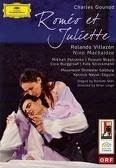
Romeo and Juliette. DVD. Salzburg Festival 2008. Production: Bartlett Sher. Cast: Nino Machaidze (Juliette), Rolando Villazón (Romeo), Mikhail Petrenko (Frére Laurent), Cora Burggraaf, Susanne Resmark(Gertrude). Conductor: Yannick Nézet-Séguin with the Mozarteum Orchestra.
The ticket-scalpers worst nightmare must have come through when Anna Netrebko cancelled her participation in this Salzburg production of Romeo and Juliette, to be replaced by Nino Machaidze next to Rolando Villazón. Blackmarket ticket prizes have fallen from approximately 1000+ Euros to something approximating the ordinary ticket prize, which at 360 Euro for the top seats may not exactly be called cheap either.
Bartlett Sher was accused of commercialism at it´s worsts well as selling out Salzburg´s soul by the Salzburg Festival critics when this production opened the 2008 Salzburg Festiva. Audiences loved it, though. Though exactly how Bartlett Sher´s rather minimalistic staging elegantly utilizing the special stage of the Felsenreitschule represents commercialism at it´s worst is not apparent to me. All characters wore period costumes and the direction was engaging. Admittedly Bartlett Sher was not overly inventive, but I was nevertheless rather well entertained.
49-year old American Bartlett Sher, who previously directed the Barber of Seville at the Metropolitan Opera commented on the production: "My inspiration for the staging came from Patrice Chéreau´s film Bartholomeus Night. The costumes were inspired by Fellini´s Casanova.".."I intend to show Romeo and Juliette´s innocence in a decadent world...after each period of decadence a catastophe occurs before a new development may begin".
Obviously Anna Netrebko-replacement and Angelina Jolie look-a-like Nino Machaidze was chosen more for her looks than for her singing, where she was seriously overparted, but of a 25-year being thrown onto the glitzy Salzburg main stage and filmed mostly at her opening night, she was rather impressive. Supposedly if she had been more ordinarily-looking, her casting would have seemed less superficial..
Rolando Villazón was back in his right element vocally, now he only needs to be on pitch as well to be back on the track of old times. Susanne Resmark was excellent as Gertrude, the rest of the gentlemen less so, apart from the engaging performance from conductor Yannick Nézet-Séguin.
Rolando Villazón and Nino Machaidze, O nuit divine:
The ticket-scalpers worst nightmare must have come through when Anna Netrebko cancelled her participation in this Salzburg production of Romeo and Juliette, to be replaced by Nino Machaidze next to Rolando Villazón. Blackmarket ticket prizes have fallen from approximately 1000+ Euros to something approximating the ordinary ticket prize, which at 360 Euro for the top seats may not exactly be called cheap either.
Bartlett Sher was accused of commercialism at it´s worsts well as selling out Salzburg´s soul by the Salzburg Festival critics when this production opened the 2008 Salzburg Festiva. Audiences loved it, though. Though exactly how Bartlett Sher´s rather minimalistic staging elegantly utilizing the special stage of the Felsenreitschule represents commercialism at it´s worst is not apparent to me. All characters wore period costumes and the direction was engaging. Admittedly Bartlett Sher was not overly inventive, but I was nevertheless rather well entertained.
49-year old American Bartlett Sher, who previously directed the Barber of Seville at the Metropolitan Opera commented on the production: "My inspiration for the staging came from Patrice Chéreau´s film Bartholomeus Night. The costumes were inspired by Fellini´s Casanova.".."I intend to show Romeo and Juliette´s innocence in a decadent world...after each period of decadence a catastophe occurs before a new development may begin".
Obviously Anna Netrebko-replacement and Angelina Jolie look-a-like Nino Machaidze was chosen more for her looks than for her singing, where she was seriously overparted, but of a 25-year being thrown onto the glitzy Salzburg main stage and filmed mostly at her opening night, she was rather impressive. Supposedly if she had been more ordinarily-looking, her casting would have seemed less superficial..
Rolando Villazón was back in his right element vocally, now he only needs to be on pitch as well to be back on the track of old times. Susanne Resmark was excellent as Gertrude, the rest of the gentlemen less so, apart from the engaging performance from conductor Yannick Nézet-Séguin.
Rolando Villazón and Nino Machaidze, O nuit divine:
The bottom line (scale of 1-5, 3=average):
Rolando Villazon: 4
Nino Machaidze: 4
Mikhail Petrenko: 3
Yannick Nezet-Seguin: 5
Bartlett Sher´s production: 4
Overall impression: 4
Rolando Villazon: 4
Nino Machaidze: 4
Mikhail Petrenko: 3
Yannick Nezet-Seguin: 5
Bartlett Sher´s production: 4
Overall impression: 4
Subscribe to:
Posts (Atom)