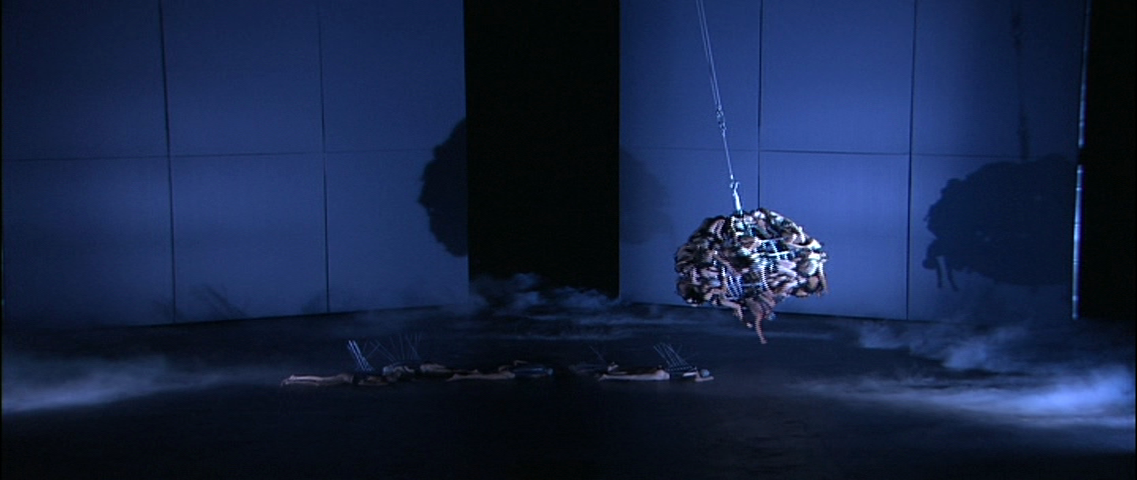
Les Troyens. DVD. Palau de les Arts Reina Sofia, Valencia, 2009. Production : Fura del Baus (Carlus Padrissa stage director). Conductor: Valery Gergiev. Cast: Elisabete Matos (Cassandre), Daniela Barcellona (Didon), Lance Ryan (Enee), Zlata Bulicheva (Anna), Gabriele Viviani (Chorebe), Stephen Milling (Narbal), Giorgio Giuseppini (Pantheée).
With this production of Les Troyens in Valencia, Fura dels Baus with director Carlus Padrissa has created a visually stunning production,
along the same lines as theirprevious Nibelungen Ring, with essentially the same strenghts and weaknesses.
There is plenty of Star Wars in this production, which
ends with Aeneas, himself a visitor from another planet, failing to recognize the paradise which is Carthage, and instead leaves for Mars.
Troy is a dark and doomed place: Skeletons fill the
shores, dark threatening clouds and post-war smoking images fill the screen. Additional elements: Barbed wires, an eerie boxing contest, Cassandra being wheeled in an out in
wheelchair. The Troyan horse is metallic and menacing. VIRUS ALERT!! pops up on
the screen just before the final breakdown.
On the contrary, Carthage an idealised place, modelled
upon the particle accelerator in CERN (near Geneva), dominated by large red-and-grey tubes and with images of
wind-mills in the background and . A clean society relying on natural energy resources, obviously. However, all may not
be that well perhaps: Several uncanny images shows us the human dogs tracing
their prey in the Royal Hunt.
The costume designer Chu Uroz dresses most of the
characters as ice hockey players or well-padded aliens, thus making the same
mistakes he made in the Nibelungen Ring (anyone still remember Brünnhildesbreastplates?) by distancing the characters from any human interaction. Dido
simply looks silly with her odd three knot hair style and the lack of interaction
between Dido and Aeneas is appalling.
At times, the images are stunning. But the lasting
impression is that of a cold production where the ultimate weakness lies in the
failure to find a balance between imagery and human interaction.
Perhaps a stronger cast could have carried this staging.
However, unfortunately we are presented with weak performances from all three
protagonists, worst in fact from Lance Ryan, who is massively overparted as
Anaeas, no matter how many excuses one may wish to make for him, well knowing how tough the part is.
Elisabete Matos has heft, but no beauty of tone and is no
match for colleagues such as Anna Caterina Antonacci and Eva-Maria Westbroek
(not yet on DVD). Daniela Barcellona struggles as well with a vibrato that
borders on the offensive, though not as bad as Zlata Bulicheva´s as Anna.
It is far from enough that minor parts are well taken care of with Stephen Milling and
Gabriele Viviani, especially since Valery Gergiev also disappoints
in the pit. Though the orchestra seemed to love him and he received a massive
ovation, being very much an on-or-off conductor, this was definitely a day off, where he entirely failed to bring out the grandness in Berlioz´ score.
Turandot. December
2012. Bavarian State Opera, Munich. Production: Fura dels Baus (Carlus
Padrissa). Conductor: Marco Armiliato. Cast: Irene Théorin (Turandot), Yonghoon
Lee (Calaf), Serena Farnocchia (Liu), Alastair Miles (Timur). This may be the most spectacular opera
production you will ever see. Taking the references to Turandot as an Ice
Princess very literally, the Fura dels Baus has created something which may well
be re-used as an an opening show for the 2014 Winter Olympics.
According to Carlus Padrissa, the inspiration to
this staging came from a journey to China. Set in 2048, China has bought
Europes debt and Turandot is now ruler in Europe. The people are happily working
to pay off the debts of their forefathers. This is what Carlus
Padrissa says. This is not what you see on stage, however: On stage you see a splendid/excessive/superfluous futuristic Chinese stage show in a winter world.
I was looking for some repressed Europeans or ethnic diversity to support
Carlus Padrissa´s Europe vs. China claims, but everyone looked Chinese.
Other than that, Padrissa
also speaks about Liu and Turandot being like Ying and Yang as well as the opera
having a positive ending as Turandot is “melted” by Lius death. This is not
immediately apparent from the staging either, however Liu does die quashed by green bamboos, a sign of the appearance of a positive force, life
emerging when the ice is thawed.
This production ends where Puccini´s original score
ends – ie. with Liu´s death, thus Padrissa rejected any of the later composed
endings arguing that masterworks may be more complete without artificial
completions. A reasonable point of view with which I neither agree nor disagree.
To be seen on stage: A massive ice
skating rink, ice hockey games, splendid video projections, the all-seeing
Turandot within a massive eye, strange costumes, a blood-red sunrise, a moving mountain of skulls, neon-signs and glitter everywhere. As well as several 3D elements, preceded by warning signs on the subtitles and administration of 3D glasses to the live audience. Personally I have never seen
anything as spectacular as this on the opera stage. Far, far more spectacular
than any of their other stagings, such as the Nibelungen Ring or Les Troyens. I
cannot imagine that this will not be released on DVD at some point as well.
Some hated it, calling it
superficial. Had it been Parsifal, I would (perhaps?/probably?) have agreed.
However, Turandot is very much as an exotic fairy tale, something to be
entertained by, which Fura dels Baus certainly achieves with this staging.
Personenregie is not really what Fura dels Baus is about and some (who obviously
did not like the show) called this a sort of Zeffirelli production of our time. Perhaps in 30
years of time, when it has been played as long as some of Zeffirelli´s
productions, entirely overstaying their welcome, I may agree. But for now it
remains truly spectacular, though those seeking depth and research into the
motivation of the characters may be well advised to look elsewhere.
Amid all this splendour you may
almost forget the singers, none of whom were exceptional, unfortunately. Irene Théorin seemed to have an off
day not sounding really pleasant. While Yonghoon Lee with his Asian looks
seem a perfect fit for Calaf, the role seems a number to heavy for him. Serena Farnocchia sang nicely but did
not leave the impression Marina Poplavskaya did a couple of years ago and Marco Armiliato was neither
exceptional nor bad.
But no-one really watches this
production to watch the singers. It is the 2014 Olympic Games Opening show that
people want to watch.
Der Ring desNibelungen (complete). DVD. Palau de les Arts Reina Sofia, Valencia 2007-9. Director: Fura dels Baus. Cast includes: Juha Uusitalo (Wotan), Jennifer Wilson (Brünnhilde), Lance Ryan (Siegfried), Matti Salminen (Hagen). Conductor: Zubin Mehta.
Overview and general comments
Fura dels Baus is a Catalan theatre group founded 1979 in Barcelona working with contemporary theatre, opera as well as major events such as the opening ceremony for the 1992 Barcelona Olympic Games. In opera Fura del Baus stagings are renowned primarily for their abstract stylistic settings, where 3D computer animations play a major role.
When Zubin Mehta (then music director at the Bavarian State Opera and in the middle of a Ring Cycle there), was approached in 2002 regarding a Ring Cycle in Valencia, he initially hesitated, thinking he´d done too many already, but then said that if Fura del Baus would stage it, he´d come. Subsequently, Carlus Padrissa, the stage director for this production (one of six stage directors as well as one of the founding members of Fura del Baus) went to Munich, saw his first Ring Cycle with Zubin Mehta, took notes and went home to think and develop his own vision.
The result, the first complete Ring Cycle ever in Spain (according to Padrissa) opened between 2007-9, a coproduction between the new opera house in Valencia and Maggio Musicale Fiorentino (musical festival in Florence, Italy).
The main idea behind Fura del Baus´ staging of the Nibelungen Ring is to show "the degradation of nature by technological man". Carlus Padrissa meticulously followed all Wagner´s original stage directions with "greater freedom and adapting it to our own aesthetics" while at the same time “going back to the spirit of Wagner, to the original mysticism and symbolism”.
The two trademarks of Fura dels Baus´s Ring Cycle is the video projections and the use of stage acrobats and may best be described as a mix of The Lord of the Rings (the movie), Star Wars and street theatre. Simultaneous with the theatre performances, another spectacle with HD projections and acrobats took place outside/on the Palaus des Les Arts Reina Sofia, which is designed by Calatrava.
Franc Aleu´s stunning video projections are the central element and the key to the entire staging, creating "beings of light", music and light. This is the most effort Fura del Baus ever put into video projections, reaching 3500 pixels (3 times HD quality) for some of the images and resulting in some of the most stunning images ever projected onto an opera stage, ranging from National Geographic-like land shapes to projections of the entire earth mixed with plenty images of the human body (with the intention of showing the degeneration of the human race perhaps?) as well as more abstract projections.Traditional sets were generally not used and often the images were projected on/behind the naked stage with ample use of mirrors.
The Fura dels Baus actor-acrobats represent such different entities as: Valhalla, dead heroes, wood beings, Brünnhildes bed pillar, a bear, river grass, Brünnhildes bed-cover when conquered by Gunther/Siegfried with the Tarnhelm. The substance of the living world perhaps?
The street theatre elements come forward in the characterisation and the costumes (by Chu Uroz), which are exaggerated in an almost cartoon-like way, unfortunately making several key characters looks like Anna Russell imitations: The Wälsungs, including Siegfried in tribal costumes including bone fragments, the Gibichungen with dollar-signs on their jacket and oriental-looking face paint. Furthermore, the Gods are locked up into cranes, manipulated by stage extras, 3-4 meters above stage,
Thus Fura dels Baus present straight-forward storytelling using contemporary imagery. They work on the grand level, and though the singers have clearly been directed they cannot help loosing out on the interpersonal relations. However, the production is quite possibly more impressive on DVD, with the many close-ups, than in the theatre and perhaps even more so on blu-ray.
The straightforward storytelling combined with the stunning imagery and an overall acceptable musical quality may make this a first choice for some. In any case, it is an important interpretation, which those with specific interest in Richard Wagner should see.
As a “concept”, this is not entirely unlike Harry Kupfers Berlin/Barcelona Ring, also focusing on degradation of nature, though with a freer interpretation of the original stage directions.
The three Rhinemaidens swim in suspended water tanks and The Rhinegold, originally a golden fetus born out of eggs laid by the Rhinemaiden becomes a black old man when seized by Alberich, who additionally seizes the other eggs laid by the Rhinemaiden, multiplies them and transforms them into human clones, thus building his treasure.
The Gods are locked onto moving platforms 3-4 meters above stage (levelling with the Giants). The earth is the backdrop, while John Daszaks superb Loge flutters around on a moto, as restless as his music.
The spectacular descent into Nibelheim is literally a descent into the middle of the earth, where the cloning of the Golden eggs into small golden fetuses and finally humans becomes obvious. Is this then the beginning of the degradation of manhood – are these clones made by Alberich the future inhabitants of the human world, as seen in Götterdämmerung?
Among the very few visual disappointments are Alberichs transformations – the dragon created by a living chain of acrobat-actors and the frog a simple steel device – no projections here. Also the shock-effect of Erda´s appearance somehow seems to drown in all this imagery.
Some may find that all these video projections, especially in Siegfried and Götterdämmerung but also here in Rheingold tend to draw too much attention to themselves at the expense of the music. I don´t agree and generally find the projections to underline the course of action or simply provide spectacular entertainment.
The Rhinemaidens with the Rhinegold:
Gods, Giants and Loge:
Loge and the Gods gasping for breath after the Giants abducted Freia:
The descent to Nibelheim:
Nibelheim:
Wotan (with the Ring) and Loge:
The appearance of Erda:
Freia with the Giants and the human Nibelungen treasure:
Valhalla:
Rheingold video excerpts:
The individual operas - Walküre
A beautiful projection of the World Ash, with its ever changing colours (and Wotan´s lurking ravens) provide the backdrop for Hunding´s home, here a circle of bones on the naked stage. Costumes are mainly made by fur, bones and tribal paintings and the picture is completed by plenty of feral crawling as Hunding has Sieglinde tied to a rope and drags her along like a dog.
According to Carlus Padrissa Hunding is a Cro-Magnon and the Wälsungs are homo sapiens - this is why Hunding cannot make Sieglinde pregnant, while her brother, another homo sapiens, easily can. Not a bad explanation at all, in fact. The setting is 50.000 BC. While proving the point, all this feral crawling and exaggerated, downright unflattering costumes unfortunately also significantly limits the human drama, the real cornerstone of Act 1 Walküre. And despite some chemistry between Peter Seiffert and Petra Maria Schnitzer (a married couple), and a convincingly Cro-Magnon version of Matti Salminen, the Act I never really takes off.
Equally, locked to their cranes within a circle of stars, true interaction between the Gods prove too difficult, despite splendid singing from Anna Larsson´s Fricka. Later, descended from the crane, during his big monologue, it becomes clear that Juha Uusitalo simply lacks star-quality, despite rather fine singing. Not to mention Jennifer Wilsons appallingly apathic and passive Brünnhilde, a real shame as she has a very fine voice with a brilliant top, of a quality seldom to be heard in this repertoire. Admittedly she is not helped by Chu Uroz´ costumes including a ridiculously looking harness which makes her look even bigger than she already is, resembling an Anna Russell caricature. However, this is an entirely intentional effect, as Chu Uroz intended these costume as a tribute to the "large woman" of the 19th Centure, the "demi-goddesses".
The Valkyries sing and act well, though again, the suspension on cranes at times impedes dramatic interaction. Though even when descended from the cranes, as Wotan and Brünnhilde ultimately do in Act 3, it is clear that dramatic interactions are the weak point of this cycle despite the scene being played on a stunning background of the projected earth. When the emotional interaction during "leb wohl" is missing, something is not quite right.
The Ash overlooking Hunding´s circle of bones:
Confrontation between Wotan and Fricka:
Wotan´s monologue:
Siegmund and Sieglinde during their escape:
Siegmund´s death:
The Valkyries:
Brünnhilde sleeping on the rock:
Video of Siegmunds death:
The individual operas - Siegfried
Perhaps the most successful of the four operas as the wide spaces decreed perfectly suits Fura del Baus´ video projections.
We travel deep inside the earth to arrive in Mime´s high-tech smithy. Retrospective video projections accompany much of the action such as the Wanderer´s questioning of Mime (and vice versa) and we see how Siegfried has to completely destroy the sword to forge it anew.
In a stunningly beautiful Act 2, the ever-changing background incorporates cartoon elements with actor-acrobats representing various forest animals as well as carrying the string of white boxes, representing Fafner.
Perhaps one of the musical highlights of the entire cycle, Wotan´s call for Erda in Act 3 is accompanied by stunning National Geographic mountain videography with Erda herself appearing from the centre of the earth (here: India). Equally Siegfrieds passing through the fire is spectacular, again demonstrating in the closing scene between Siegfried and Brünnhilde than the one-to-one interactions is the weak point of this cycle, despite some fine acting and nuanced singing from Lance Ryan´s Siegfried. Thus, this is a statement with modifications as always, as Gerhard Siegel (Mime) seems fully capable of inhabiting the stage.
Mime´s smithy:
Mime tries to reforge Nothung:
Outside Fafner´s cave:
Fafner:
The wood bird pointing Siegfried to Brünnhildes Rock:
Wotan calls for Erda:
Erda appears:
Wotan confronts Siegfried:
Siegfried and Brünnhilde:
Video presenting some of the most stunning images:
The individual operas - Götterdämmerung
The Gibichungen world is cruel and grim. Fura del Baus suggests we could be in a major city such as Shanghai, accentuated by the Chinese-looking face paint of the Gibichungens, here seen as grotesque stock brokers with dollar signs attached to their clothes and stock exchanges rates projected on the screen. A grotesque, superficial world of extremely bad taste, where Gutrune runs on a tread-mill within a cylinder suspended in air. The contrast to the Siegfrieds prehistoric costumes is fully intended and his transformation from a caveman into stockbroker after getting drunk is champagne shows impressive acting from Lance Ryan. However, though dressed like the others, Siegfried never learns how to act in this world, which eventually becomes his downfall.
Understatement is not a trademark of this Ring, where especially Götterdämmerung at times seem over-exaggerated. Though definititely not without it´s moments, such as a second act staged like a thriller complete with snipers and a searching eye. Also Siegfrieds Funeral March is a highlight, with Siegfried´s body being moved from stage, through the audience.
Jennifer Wilson´s apathy is again a serious drawback, and even Matti Salminen´s Hagen is more mobster-calculating than evil, though Lance Ryan´s Siegfried transformation is quite impressive and generally he fares better in Götterdämmerung than in Siegfried.
As Fura del Baus closely follows Richard Wagners stage directions, the Ring is given back in the end and the net of acrobat-actors symbolizing Valhalla is dispersed. Though inventive, I couldn´t help finding the ending a bit disappointing, perhaps expectations were raised too high based on the preceding imagery.
The Norns:
Gunther:
Brünnhilde and Waltraute:
Hagen and Alberich:
Brünnhilde confronts Siegfried (the latter head-down):
The Act II trio, staged as a thriller:
Siegfried meets the Rhinemaiden:
The scene of Siegfrieds death:
Siegfrieds Funeral March:
The Immolation Scene:
Video - Götterdämmerung highlights:
The singers
General comments:
A list of some of the most respected Wagner singers of today (eg. Matti Salminen, Stephen Milling, Peter Seiffert etc) combined with relative newcomers such as Lance Ryan and Jennifer Wilson. The individual singers:
Wotan:Juha Uusitalo, a bass-barytone, generally sings well, though without leaving a truly individual mark. Essentially he lacks the energy, seen with John Tomlinson (for Barenboim) or the class of James Morris (only as Wanderer, though). And, as a bass-barytone, as opposed to a bass Wotan, the deep resonant voice for the Wanderer he simply does not have.
Fricka:Anna Larsson with the wonderfully deep expressive voice is perhaps the best Fricka on DVD, with an impressive combination of royalty, class and vulnerability showing that Fricka is far from the mono-dimensional character often seen.
Alberich:Franz-Josef Kapellmann has more stage presence than voice at this point of his career. And in this, his second Alberich on DVD, he more than occasionally relying on yelling and exclamation, clearly past his prime, but still to be reckoned with.
Loge: Strong performance, vocally as well as dramatically from John Daszak.
Fasolt:Matti Salminen (see below), ages well vocally, but has lost quite a lot of his strength and is no match for Stephen Milling.
Mime: Gerhard Siegel commands the stage and delivers a vocally satisfying performance as well.
Sieglinde: A convincing, though not exceptional performance from Petra Maria Schnitzer, who is not helped by either costume designer or director with her cave-like appearance and manners.
Siegmund:Peter Seiffert fails to make a lasting impression in this role and though he sings the notes, his acting skills leave a lot to be desired. We are a long way from the intensity of Peter Hofmann/Jeannine Altmeyer.
Hunding: The Cro-Magnon outfit quite suits Matti Salminen, though he, in his 60s, has lost the sonorous, menacing profound tones. This is his second Hunding on DVD.
Hagen:Matti Salminen´s voice ages well, being steady and almost vibratoless. Nevertheless, in this his third Hagenon DVD, he does not live up to his past attempts and despite an ever strong stage presence he more often than not resorts to barking and yelling without earlier times punch and power. Stephen Milling would have been a better choice.
Brünnhilde: It is very frustrating to watch and listen to Jennifer Wilson: Vocally she has got the goods, with a beautiful voice high above average for this part being both solid and with a shining top. Unfortunately, she severely lacks in dramatic expression, both vocally and acting-wise, which ultimately makes her Brünnhilde one of the major disappointments. Not too mention she is a large woman, who simply does not move well on stage.
Siegfried:Lance Ryan is as good a Siegfried as anyone today: He looks the part and after some indifferent acting especially in the first two acts of Siegfried, he becomes quite interesting to watch after his transformation in Götterdämmerung. Vocally, his is perhaps not the biggest voice, but he is solid throughout, though not without a certain monotony and dryness. However, he is capable of producing some finely nuanced singing, especially in Siegfried Act III and Götterdämmurung Act I after his transformation. All in all a very promising performance.
Erda: In Siegfried Catherine Wyn-Rogers sings the notes but fails to convey the drama. More dramatic is Christa Mayer in Rheingold, though she still fails to project the primal force of the Earth Goddess.
Waltraute: Waltraute´s part is probably a bit too high for Catherine Wyn-Rogers, whose dramatic strengths lie in her lower register declamations. However, her excessive middle-register vibrato combined with a stiff stage presence makes no competition for excellent DVD Waltraute´s such as Waltraud Meier or Anette Bod.
Gutrune: Elisabete Matos, essentially a dramatic soprano, seems miscast in this essentially lyric part, where she simply sounds too harsh.
Gunther: A dry voiced Ralf Lukas effectively conveys what is here a very unsympathetic character.
The conductor and the orchestra
A young orchestra initially assembled by Lorin Maazel and conducted here in their first Wagner production by veteran Zubin Mehta. In this context, their performance is impressive though it does not measure up to the best on DVD. According to Mehta, the biggest challenge was getting the brass sections to work. This part worked out well and the strings sound fine.
I suspect the problem lies with Zubin Mehta´s interpretation: He simply plays too undynamic and without applying the small shifts in tempo so essential for the dynamic of the work. On the contrary, on several key points in the score (such as Siegmunds death, the Wotan/Fricka scene in the Valkyrie, Wotans “wer meine speeres spitze”), he slows the tempo markedly creating a vacuum.
Despite the impressive effort by the orchestra, they are no match for the twoBayreuth DVDs, the Metropolitan Opera Orchestra or the Royal Danish Orchestra.
In brief - the highlights and lowlights
Highlights – The stunning images and inventive use of actor-acrobats.
Lowlights – no real lowlights, but weak points were the interpersonal relations, weakest between Siegfried and Brünnhilde. Some of the costumes, notably the Wälsungen incl. Siegfried and the Valkyries resemble Anna Russell caricatures and make their characters look outright ridiculous
The bottom line (scale of 1-5, 3=average)
Juha Uusitalo (Wotan): 4 Anna Larsson (Fricka): 5 Franz Josef Kapellmann (Alberich): 3 John Daszak (Loge): 5 Matti Salminen (Fasolt): 4 Stephen Milling (Fafner): 5
Gerhard Siegel (Mime): 4
Christa Mayer (Rheingold-Erda): 3
Catherine Wyn-Rogers (Siegfried-Erda): 2
Catherine Wyn-Rogers (Waltraute): 2
Peter Seiffert (Siegmund): 3
Petra Maria Schnitzer (Sieglinde): 3-4
Matti Salminen (Hunding): 4
Matti Salminen (Hagen): 4
Lance Ryan (Siegfried): 3-4
Jennifer Wilson (Brünnhilde): 2-3
Elisabete Matos (Gutrune): 3
Ralf Lukas (Gunther): 3
Fura dels Baus´ staging: 4 (5 for Siegfried, 4 for the rest)