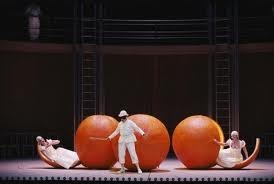
The love for three Oranges. Bastille Opera, 13th of July 2012. Production: Deflo. Conductor: Alain Altinoglu. Cast: Charles Workman (Prince), Patricia Fernandez (Clarice), Alain Vernhes (King of Clubs), Vincent Le Texier (Tchelio), Marie-Ange Todorovich (Fata Morgana), Nicolas Cavallier (Leandre).
Disappointingly the DVD with the close-ups is more outstanding than actually attending a performance in the theatre, where the big auditorium of the Bastille Opera seems to drown many details of the production.
I already reviewed Deflo´s pantomime-inspired production in details for the DVD production and among the principal characters, Charles Workman as the principal repeats performance.
Interestingly, there were quite a few children in the opera.
A true ensemble opera: No singers mentioned, none forgotten.
Peter Mattei - Great Baritone Arias. 2011. Lawrence Renes conducts the Royal Stockholm Philharmonic Orchestra. Peter Mattei (born 1965 in Sweden) has been internationally active for more than a decade, performing at all the major operatic venues in a variety of high-profile roles. Yet, for some reasons he is not (yet) a house-hold name. Perhaps it is a combination of his reluctance to take on too many engagement and too many roles. And then there is the (lacking) recordings as this 2011 solo recital disc is in fact his first.
On stage Peter Mattei´s main calling cards are Don Giovanni (title role), the Figaro Count and Eugene Onegin and these we do have on DVD, though the Don Giovanni is from 2002 and hopefully the La Scala Opening performance from 2011 with Daniel Barenboim will be released at some point.
There is universally agreement that in his core repertoire, Peter Mattei is among the very few best in the world, and subsequently he sang title role in the two most prestigious openings of Don Giovanni last year: At the opening evening of the La Scala 2011-12 season with Daniel Barenboim and at the premiere of the new Don Giovanni production at the Metropolitan Opera (though substituting for an ailing Mariusz Kwiecien).
Peter Mattei has a very exceptional voice characterized by a formidable open sound, a strong high register, and a very distinctive middle register with a sound almost bordering on the metallic. Combined with a very straight delivery, for me, at least, his may be the most attractive voice in a repertoire which includes Simon Keenlyside, Dmitri Hvorostovsky and Mariusz Kwiecien among the prominent interpreters.
On this disc we have three excerpts from Don Giovanni including a Deh, vieni probably not to be heard more beautiful. Another of his calling cards, the Count in Figaro is represented with "hai gia vinto la cause" as well as Figaro´s "Se vuol ballare" sung with the elegant voice underlining why his calling card i the Count and not Figaro. The elegance continues in the two arias from Eugene Onegin.
I have heard Peter Mattei´s Posa (Don Carlo) live, a role he should sing more often, here represented with "O Carlo ascolta". The same goes for Valentin in Faust, where it is clear he would be among the top performers of the role, did he just opt to sing it.
Peter Mattei has been wary moving into the heavier repertoire, cancelling a Macbeth in Stockholm a couple of seasons ago. Next season he is scheduled as Amfortas in the Metropolitan Opera new production of Parsifal (not represented here) however we have the more lyric part of Wolfram in Tannhäuser, here with two excerpts including the famous Song to the Evenstar , I don´t recall him having performed on stage, but his delivery is very beautiful.
A recital disc like this can hardly avoid a certain sameness to creep in at point. However, in Peter Mattei´s case it is a very beautiful and elegant sameness and this disc presents him at his best. Now, would he only perform a bit more on the international stages..
Deh, vieni - not from this CD, but from Aix-en-Provence 2002:
Nationality: Norwegian. Born: 1977, Harstad, Norway. Education and career in brief: State Academy in Oslo and Opera Academy Copenhagen. First major roles were Count Almaviva (2008) and Eugene Onegin (2009) in at the Danish Royal Opera. Voice: Lyric baritone. Main repertoire includes:Eugene Onegin, Count Almaviva (Figaro), Don Giovanni (title character) Main events until now: Albert (Werther, London RO 2010 including CD recording), Eugene Onegin (ENO 2011 and Bolshoi 2012), Marcello (London RO 2012), Figaro (Glyndebourne 2012) Upcoming major events: Barber in Sevilla (San Francisco 2013 Fall) Future performanceshere. Webpage incl. full bio here.
Eugene Onegin final scene - with Amanda Echalaz, ENO 2011:
Rarely do you her a song recital, which blows you away the way this new disc with Schubert songs from Swedish soprano Camilla Tilling does.
Born in 1971, Camilla Tilling is mostly known on the opera stage for her interpretation of parts such as Sophie (Rosenkavalier) and Pamina and I remember hearing her as a vivid Oscar a couple of years ago in Paris.
Her new Schubert recital disc "Bei dir allein!" is simply one of the best lied recital disc I have heard in a long time. Engaged and fresh-voiced, Camilla Tilling creates myriads of moods and she has that rare ability to turn on and completely off her vibrato with many degrees in between, as well as a varied attack even at the highest notes, as also Irmgard Seefried had. This extraordinary disc is in that league.
Previously, Camilla Tilling she released a disc with Richard Strauss lieder, where she demonstrated many of the same qualities, though to lesser effects as many of the Richard Strauss lieder for her voice type benefit from a more soaring voice than Camilla Tillings.
This Schubert disc, however, presents the finest lieder singing to be heard and is a clear must-have.
Erwin Schrott: Arias. Vienna Radio Symphony orchestra conducted by Daniele Rustoni. 2012.
From an artistically point of view I simply do not see the rationale behind the release of this new solo album by Erwin Schrott. From a pure commercial point of view, however, it could make sense:
In 2008, under his contract with Decca, Erwin Schrott released his first solo CD, an album not unlike the current one, with a selection of bass-barytone arias. The album was received with mixed reviews and subsequently Erwin Schrott has signed with Sony. Yes, there are differences between the two albums of course, but mostly in favour of the first album, where Erwin Schrott included some of Mozart roles such as Figaro and Leporello, which he has successfully performed on stage. On this new album, the arias are different, but with an overweight into repertoire, which simply does not find Erwin Schrott at his best and exposes his vocal weaknesses: Méphistopheles Veau d´Or (Faust), Scintille Diamant (Hoffmann), Tre sbirri (Scarpia in Tosca), three pieces from Mefistofele (Boito)..
A sticker on the disc states that this album presents Erwin Schrott in his signature roles. This is simply not true. He may have performed the Faust-Mephistopheles and Escamillo a few times on stage, but his calling cards are still Mozart roles such as Leporello, Don Giovanni, Figaro. Not represented at all on this current CD. And this, I don´t think will change. Schrott simply does not have the vocal qualities to distinguish himself in the basso cantante repertoire: He is practically unable to hold a vocal line, his intonation is shaky with major weaknesses in both upper and lower registers. Furthermore, I don´t reallly hear anything interpretatively.
We have a number of unrecorded bass-barytones active today, who would have done a better job than Schrott in the recording studios. And he is simply no match for those already recorded in the same repertoire (from present day: René Pape and Bryn Terfel, from the past: Samuel Ramey, George London).
On stage, however, in his core repertoire, Erwin Schrott is among the best there is today, not least due to his excellent combination of stage presence and physical acting.
So why release an album so similar to his previous one? Has his public profile been raised sufficiently with his big venue concerts with Anna Netrebko to make this album a commercial success? Honestly, I don´t think so.
Le veau d´or - from a Barcelona concert in 2011:
Ein Deutsches Requiem. Copenhagen Concert Hall. June 9th 2012. Conductor: Herbert Blomstedt with the Danish National Symphony Orchestra and Radiokoret. Soloists: Camilla Tilling (soprano), Peter Mattei (baryton).
84-year old Herbert Blomstedt was chief conductor of the Danish National Symphony Orchestra between 1967-77 and his continued annual visits are always major events, as he is immensely popular with the orchestra. Often, as today, this popularity translates into great playing and this was simply a wonderful afternoon in a sold-out DR Concert Hall.
Blomstedt´s Brahms is dense as well as straightforward, conducte, of course, without the score as this is his core repertoire. The climaxes with the choir was simply magnificant, and I don´t remember when I have heard a better, or even a performance of the same level, from the orchestra.
Peter Mattei has a wonderful straight deliveryt, while Camilla Tilling never quite got to glow.
When Blomsted took over the orchestra it was semi-professional (if not necessarily on paper, then in sound) and he, if any, initiated the development into an orchestra performing on the international level we saw today. Ironically, the new chief conductor of the orchestra Rafael Frühbeck De Burgos is the same age as Blomstedt, his age being a major point of criticism in Danish media. Though somehow I doubt we´d heard the same complaints had Pierre Boulez been hired?
Love and longing. CD. 2012. Songs by Ravel, Dvorak and Mahler. Simon Rattle conducts the Berlin Philharmonics.
Even after pondering the question, I still think that Magdalena Kozena (born 1973) probably has the most beautiful voice around anywhere on stage today. And she just becomes better and better.
In my book, she is essentially a concert and lied singer, though she regularly performs in opera. Projecting mixure of shyness and awkwardness (not vocally mind you) on the operatic stage, I have seen her as both Octavian and Melisande. And her Idamante is available on DVD. However, it is on the concert stage, she does her finest work. And nothing she has done is really better than this recent disc with songs by Ravel (Sheherazade), Dvorak (Biblical Songs op. 99), and Mahler (Rückert-lieder) entitled "Love and longing" in accordance with recent record labelling trends.
With a creamy voice of incredible beauty, even throughout the register, she possesses an instrument as few (really is there anyone else?) today. Combined with profound textual understanding as well as faultless phrasing, I really do not have a critical word to say of this disc. Not to forget the superb accompanying provided by the Berlin Philharmonics under Simon Rattle. They just show us just how important the orchestra is in orchestral songs, with a performance far far above average.
Gerald Finley (barytone) and Julius Drake (piano): Winterreise. Bruxelles, Theatre de Monnaie. June 20th 2012.
Gerald Finley´s Winterreise is truly an emotional journey. Passing from an initial state of repressed anger to to true anger, then to madness and ultimately we see the naked grief. I don´t remember when I have heard a Winterreise with these changes of emotion presented so contrastingly as Gerald Finley does. And always without sentimentality, he started many of the songs half-turned away from the audience. However, as a performer he is far from introvert and oozes a patrician elegance which suits Schubert so well.
The voice, of course I´d almost say, is superb and fully capable of displaying every emotional state Finley desires to display.
All sensitively and dynamically accompanied by long-time recital partner Julius Drake, Winterreise do not get delivered much better than this. Lieder singing at the highest level.
Il trovatore. Opera Monnaie, Bruxelles. June 19th 2012. Production: Dmitri Tcherniakov. Conductor: Marc Minkowski. Cast: Misha Didyk (Manrico), Marina Poplavskaya (Leonora), Scott Hendricks (Luna), Sylvie Brunet (Azucena), Giovanni Furlanetto (Ferrando).
Right at the beginning a signboard tells us that ” years have passed since some of the events of Il Trovatore”. In fact, we are inside a deserted patrician villa in present time. Azucena has invited the participants Manrico (a rock-musician), Luna (a businessman), Leonora (a femme fatale) and Ferrando (Luna´s father?) to participate in “a role play to elucidate their common past” as written on a signboard.
Initially, the singers read their lines from a piece of paper, but as the opera moves on, the characters identify more and more with their Trovatore counterparts: Luna grows increasingly mad, Leonora and Manrico have a love affair, and Azucena, a jaded beauty, eventually becomes mad.
According to the programme notes, director Dmitri Tcherniakovs rationale was that, in his opinion, the first 2,5 acts consist mainly of flash-backs and story-telling and only the last 3 scenes represent present day. As he feels the role of the chorus is secondary and static they are placed in the pit. All the small roles (Ines etc.) have been dispersed with and their parts are sung by some of the other characters and we are presented with a true chamber play facilitated by Tcherniakovs superb personal direction.
All this culminates in a last act, where Luna have gone completely mad and kills Manrico, after Leonora poisoned herself (he already killed Ferrando in the end of Act 3), only to die of a heart attack when Azucena told him, he´d kill his brother.
For me, there are some major logical gaps, that I can´t seem to get around: 1) It was my impression that these 5 people did not know each other beforehand. Then, however, there is a logic gap in Act 4, when Luna shoots his brother Manrico. So this shabby musician was the brother of the business man? And how did that come about? And where does all the gypsy business then fit in? 2) According to Dmitri Tcherniakov´s program notes, however, the protagonists shared a common past. In that case Act 4 makes sense, however, everything sung about troubadours and gypsies does not as I don´t assume Tcherniakov meant them to have known each other in some metaphysical way 800 years earlier??
You sometimes hear the saying that the action in Il trovatore is so improbable, that a realistic staging does not makes sense. Not necessarily true as David McVicar does a fine job at the DVD from the Metropolitan Opera in a relatively traditional staging focusing on the drama between the protagonists.
Such a deconstructional version of Il Trovatore as Dmitri Tcherniakovs is rarely seen in a major opera house. Tcherniakovs version has nothing to do with the libretto, of course, but nevertheless the idea is quite intriguing and gives reason for afterthought for a long time. However, the concept is 100% reliant upon the theatrical qualities of the singers, and here Dmitri Tcherniakov worked with an exceptionally committed team. As theatre however, I am ambiguous as too whether it worked out. You´d have to appreciated the finesses in the chamber play, otherwise you´d be terribly bored as I couldn´t help being for the first two acts, at least.
Now to the singing – aiaiai - applause after several of the major arias was no more than barely polite. First, and worst, Misha Didyk: A couple of notes in his middle register sounded about right. The rest, vast majority were indeterminable. Needless to say, he was massively overparted here.
Then, Marina Poplavskaya, a singer with an exceptionally beautiful middle register and a fascinating stage presence- whatever is meant by X-factor, she definitely has it. The singing however, was to put it very diplomatically, not quite at the level demanded by the challenges of the part. Her legato-lines are virtually non-existent, often she retorted to shrieking out her top notes and the coloraturas were not to be repeated. Why she signed on to this is beyond me. I sincerely hope she will never sing this part again.
I didn´t quite take to Scott Hendricks rather grainy baritone, but as a singer-actor he is quite formidable, in many ways dramatically carrying the show. Last, and best, was Sylvie Brunet as Azucena, a solid as well as unusually elegant performance. Deservedly she got the biggest applause of the evening.
Also superb was Marc Minkowski in the pit, a swift dynamic reading, with a interesting emphasis on the woodwinds, that I haven´t heard before.
Arabella. Paris Opera Bastille. June 17th 2012. Production: Marco Arturo Marelli. Conductor: Philippe Jordan. Cast: Renée Fleming (Arabella), Michael Volle (Mandryka), Julia Kleiter (Zdenka), Joseph Kaiser (Matteo), Kurt Rydl (Waldner), Doris Soffel (Adelaide), Iride Martinez (Fiakermilli).
Renée Fleming obviously has reached a level where she can chose which directors to work with, apparently preferring to work in stylish, minimalistic production straying not too far from the libretto. Thus a couple of years ago she was a quite superb Cappriccio Countess in Vienna in a production of Marco Arturo Marelli, also behind this new production of Arabella at the Bastille Opera in Paris. Here, however, she was somewhat less than superb and her performance underlined an evolution, which has become increasingly visible in her performances during the past years, at least in Richard Strauss operas:
First of all Renée Fleming is definitely not in her vocal prime anymore. Much of the bloom of her top register has gone, and her middle register, by some still called creamy, is far from creamy now with a timbre, which simply does not appeal to me.
Secondly, I have some issues with her performance style. Some call it mannerisms. In my native Danish language there is a very good word for it, which directly translated read affected. Affected language, affected acting. Renée Fleming may aim to communicate sophistication, as she applies the same style with her Marschallin in Rosenkavalier, however ultimately she portrays Arabella as a superficial character. Which, on the other hand, is a valid interpreation, of course, if not the libretto and music suggest otherwise. She was audible, but not audible enough for me to actually distinguish the words she was singing.
However, however...for those not familiar with Renée Flemings previous vocal status, and even for those well familiar with it, it is easy to understand why she is admired and received huge ovations here: She has a firm grip of Straussian style and first and foremost she has a distinctness to her performance that really does make her stand out. On a technical point, some may find her use of portamento excessive, though personally I do not mind.
And finally, despite my reservations about her voice, she is still among the very finest around. Who today, can perform a finer Arabella? Adrienne Pieczonka in Vienna a couple of years ago was rather superb. Anne Schwanewilms undoubtedly also. But else?
Michael Volle, on the other hand, I don´t have any reservations about. He was simply superb, vocally strong, a straightforward and engaging stage actor, convincingly portraying Mandryka as a sincere man unfamiliar with the sophisticated Viennese way, but thankfully without the overacting often seen. Several of his scenes were in fact unusually moving.
No reservations about Julia Kleiter neither, a clear and pure voice, almost overpowering Renée Fleming at times. Just as fine as her Zdenka on the 2007 Zurich Arabella DVD, alongside Renée Fleming as well.
Despite fine singing I have always found Joseph Kaiser, a bit indistinctive as a performer. Here as well. Finally Kurt Rydl and Doris Soffel were feisty as the elderly couple.
Marco Arturo Marelli´s production was superb. Stylish, minimalistic and elegant. A naked white room with some furniture (gradually removed), a built-in white circular stage and some sliding doors.
Philippe Jordan conducts Arabella like it was Elektra, emphasising the contrasts and highlighting the darker thematic elements of the score to a degree I haven´t quite heard before.