Tuesday, 17 June 2008
The Copenhagen Ring - Rheingold
The Copenhagen Ring - overview and concept.
The Copenhagen Ring - Rheingold.
The Copenhagen Ring - Walküre.
The Copenhagen Ring - Siegfried.
The Copenhagen Ring - Götterdämmerung.
Reviews of The Copenhagen Ring DVD to be found here.
Das Rheingold. Premiere 2003. Part of The Copenhagen Ring Cycle 2006. Royal Danish Opera. Michael Schønwandt, conductor. Kasper Bech Holten, director.
Cast on The Copenhagen Ring DVD (scheduled release July 2008): Johan Reuter (Wotan), Randi Stene (Fricka), Sten Byriel (Alberich), Michael Kristensen (Loge), Anne Margrethe Dahl (Freia), Bengt-Ola Morgny (Mime), Stephen Milling (Fasolt), Christian Christiansen (Fafner). Further cast information here.
To the first tones of the prelude, Brünnhilde enters the attic of her family´s home and strikes a match, rummaging through the family archives to understand her past. Upon reaching the final part of Götterdämmerung, we learn that this in fact takes place while Gunther and Hagen goes out to kill Siegfried, making the The Copenhagen Ring a flash-back of Brünnhildes life-story. Though this, in my opinion is a somewhat depressing view of Wagner work, as I´ve mentioned previously in a general post on The Copenhagen Ring, this is basically all we see of this Feminine angle in Rheingold.
Set in the 1920-30´s we move from the Charleston-clad Rhinemaids to Wotan´s tent camp outside Valhalla, mimicking an archeology camp in Egypt, complete with Loge, the photographing journalist and representative of the free press, in many ways the key figure in this production. Constantly looking for his lighter (!). Can Wotan accept his presence once he has moved into Valhalla? Of course not.
The Nibelheim scenes and the violent acquisition of the Ring by Wotan cutting off Alberich´s arm are among the highlights of the entire cycle. Since this IS a Feminine Ring, Wotan is not perceived as being central to the tetralogy (as opposed to Brünnhilde) and the character seems slightly underdeveloped. The main problem with this approach of course being, that Wotan IS the center of the Rheingold, both vocally and dramatically, participating in all the scenes except the first one. In this staging he (Wotan) is portrayed as cynical, a bit superficial, not overly sympathetic, but nevertheless charming.
The production is highly entertaining with plenty interesting points, such as:
Wotan´s slaying of Loge, who has seen too much. Fasolt´s tender relationship with Freia (though not a new idea, still interesting). Wotan cutting off Alberich´s arm to get the gold in a torture scene worthy of Dr. Mengele. The Nibelheim scene is (for once) well done, with Alberich entering a rotating metal cylinder reappearing as a toad and dragon, respectively. Wotan´s eye is not covered, but mutilated (except for one performance where the mutilated eye was broken and a black cover had to be applied over James Johnson´s eye..).
James Johnson was very fine as this subtly underplayed Wotan figure with plenty of irony and humour. He alternated the part with the young Danish barytone Johan Reuter, who was also fine and who will appear on the upcoming DVD release as Rheingold-Wotan. Poul Elming initially was a superb Loge, however due to illness he did not sing in the complete cycles, where Loge was done by the also fine Michael Kristensen.
Sten Byriel was Alberich, for once not portrayed as an idiot, but rather approaching a more interesting position as a worthy adversary of Wotan. Randi Stene and Susanne Resmark alternated as Fricka, Stene the more elegant, Resmark the more forceful. Randi Stene will appear on the DVD. Susanne Resmark will be seen as Erda. Michael Schönwandts light, almost transparent approach to the work, was at the most successful here in Rheingold.
The staging step by step with photographs:
We are at the bottom of an empty swimming-pool. The water is outside. Clad in 1920´s Charleston dress we see the Rhinemaids. The Rhinegold is symbolized by a naked young man swimming outside and visible through a glass window in the background. Alberich´s acquisition of the Rhinegold is violent and bloody, as he simply tears out the young mans heart:
Wotan with Fricka, as they have set up camp outside Valhalla:
Loge, the ever-photographing journalist:
Fafner, leader of the two-person construction company:
In Nibelheim:
Wotan cuts the Ring off Alberichs arm in one of the strongest scenes in the entire cycle:
Wotan, Lord of the Ring:
Wotan with Erda, as she persuades him to let the Ring go:
Loge, the journalist documenting everything, suddenly knows too much. So in the end Wotan has to kill him:
Now, the Gods may finally move into Valhalla:
All photos from the Royal Danish Opera and the website of The Copenhagen Ring
The Copenhagen Ring
This post is part of a series of posts on The Copenhagen Ring, consisting of:
The Copenhagen Ring - overview and concept (this post)
The Copenhagen Ring - Rheingold.
The Copenhagen Ring - Walküre.
The Copenhagen Ring - Siegfried.
The Copenhagen Ring - Götterdämmerung.
Review of The Copenhagen Ring DVD here.
The Copenhagen Ring Cycle 2003-6 culminated with three complete Ring cycles performed in 2006 by the Royal Danish Opera. These performances marked the first complete Ring Cycle in Copenhagen for more than 80 years as well as the transition from the Old Royal Danish Opera to the new Copenhagen Opera on the waterfront, inaugurated in 2005.
The Copenhagen Ring will be released on DVD in July 2008 by Universal (Decca).
I have seen the production around 20 times.
The Copenhagen Ring Concept
The director is the 1973-born artistic director of the Royal Danish Opera Kasper Bech Holten, in what I believe to be his first Wagner staging, though already an experienced operatic stage director with previous productions such as Nozze di Figaro, Le Grand Macabre and Rosenkavalier. Kasper Bech Holten allegedly was fascinated by the Nibelungen Ring from childhood, setting up a puppet version at home as a teenager...Also labelled The Feminine Ring, the main concept of The Copenhagen Ring was to tell the story of a dysfunctional family from Brünnhilde´s point of view. A family saga played out over the entire 20th century where the timeless myths are replaced by the miniature perspective.
Director Kasper Bech Holten outlines The Copenhagen Ring production concept:
Along with Brünnhilde we journey through the 1920s and 1930s in Das Rheingold, in which the great ideological structures are raised, until we reach the 1950s in Die Walküre where the Cold War has frozen those structures into fortresses through which the great powers zealously guard each other in excruciating anticipation. Siegfried brings us to 1968 where the eponymous young hero naively rebels against his father’s rules and ideals until the fin-de-siècle joy he expresses in Götterdämmerung comes to an abrupt end in a clash with pure evil of the type seen in Bosnia or Rwanda.
The over-all style of the production is modern and the staging may perhaps best be described as moderately revisionistic (photographs may be seen in the posts on the individual operas).
Compared to the other DVD Rings available, The Copenhagen Ring may on the surface seem closest to the Stuttgart production, though still distinctly different in both concept and execution.
The main characteristics of Kasper Bech Holten´s work in this cycle is a keen sense of individual characterization as well as an attempt to de-mythologize the Nibelungen Ring without being overly deconstructive. Holten does not focus on social power struggles or the macrocosmos of the work and instead choses the family saga perspective as seen from Brünnhildes point of view. Aesthetic theater per se does not seem to be a major goal of Kasper Bech Holten, though the sets are generally simple, though not as simple as those usually applied by reknowned minimalist contemporaries such as Willy Decker.
The sets were by Marie í Dali and Steffen Aarfing and lights by Jesper Kongshaug. Dramaturgy by Henrik Engelbrecht. The entire team worked closely together to develop the entire production concept (an excellent book has been published in Danish by Henrik Engelbrecht on this), which by no means relies solely on Kasper Bech Holten but rather is a group effort, though the final responsibility for the overall outcome, being the director, obviously is his.
The most important question remains: Does the concept work? Is it exciting music theater of high quality? Without doubt, the answer is yes. Whether one approves wholeheartedly of the concept or not, it works within the reference frames applied and is consistent in both vision and execution throughout the Cycle, which by no means is a small accomplishment.
That said, obviously some aspects appealed more to me than others:
The strong points: The direction of the singers is very engaging and many fine points are brought forward. Humour is often applied and as a whole the production is highly entertaining. Reading Kasper Bech Holten´s Feminine Ring intentions, in my opinion, was always quite depressing, since it reduces this vast work to the perspective of one person, but watching the actual production fold itself out on stage, was very uplifting.
The less strong points: Ideally, I´d wish for more mythology, more pathos and a more unifying approach to the work on a grander scale, regardless this has admittedly been done numerous times previously including the focus on the Wotan figure. Thus, I am not overly enthusiastic about the Feminine Staging concept per se, but it didn´t seem to dominate the production anyway. I was seldom truly moved by this Ring, though I was excellently entertained. In all fairness, I should add that I know of many fellow audience members that felt the exact absence of mythology and refraining from focusing on the Wotan figure to be one of the major strong points of this production. Another case of "you have to see and judge for yourself" I suppose...
The Copenhagen Ring Cast
From a local-patriotic viewpoint, The Copenhagen Ring was a tremendous achievement for the Royal Danish Opera, since all the major roles (with the exception of Walküre-Wotan and Hagen) at some point were cast from within the company and mainly with singers of high international quality.Based on the live performances, I would expect the major standouts of the upcoming DVD release of The Copenhagen Ring to be:
Stephen Milling as Hunding. By all standards superb. I suspect he will turn out the best Hunding available on DVD. A major loss he didn´t take on Hagen as well.
Stig Fogh Andersen as both Siegfried and Siegmund. Due to sudden illness of Poul Elming, the originally scheduled Siegmund, Stig Andersen tackled both parts. His Siegfried was a major achievement by all standards.
Ylva Kihlberg as a superb Gutrune.
Iréne Theorin (Isolde in the upcoming Bayreuth Tristan) as a powerful Brünnhilde.
Both Johan Reuter (Rheingold-Wotan) and James Johnson (Walküre-Wotan and Wanderer) should be fine on the DVDs. Both were very good in the theatre, with convincing stage presence and vocal command of the role, though none of them have particularly large voices.
Susanne Resmark as Erda had a remarkable command of the stage, particularly in Siegfried.
The major joker is Michael Schönwandt´s orchestra, or rather: How the orchestral sound will be transferred to the DVDs. Schönwandt´s Ring (and general Wagner) conducting style, borders on the passive, creating an exquisite, transparent sound. In the house I perceived it as being orchestra playing of the highest international quality, though I personally would have preferred a more powerful orchestra sound with more brass and heavy string playing. How the orchestra sound will be transferred to the DVD will doubtless be a major determinant of the DVD-success of the production.
Best case scenario, the quality of orchestra playing will be at the level of Haenchen´s performance with the Concertgebouw in the Audi Amsterdam Ring Cycle DVD, which I rate above the orchestral quality of the Kupfer Barcelona (disappointing) and Stuttgart (very good) productions. Worst case scenario I do not want to think about....
The Copenhagen Ring Sources and general impressions
The Copenhagen Ring as a whole was generally very well received by the Danish press: Universal praise for Michael Schönwandt and the orchestra and for almost all singers, Stig Andersen, Stephen Milling, James Johnson and Iréne Théorin in particular.
As always of directors, opinions on Kasper Bech Holten´s staging were varied, though firmly rooted in the positive camp. The most common criticisms have been concerning the wealth of details, the lack of mythology and the whole Feminine Ring concept. By others, these exact issues were counted among the highlights..
Reviews in English of The Copenhagen Ring:
New Statesman
Bloomberg
Financial Times (Götterdämmerung)
The Confidential Attachées
Other sources on The Copenhagen Ring in English:
The Copenhagen Ring webpage
Kasper Bech Holten´s blog on The Copenhagen Ring
Thursday, 12 June 2008
St Francoise d´Assise
This opera requires: 150 singers, four ondes Martenot (electronic keyboards) apart from the normal orchestra. It is in every sense monstrous: Messiaen´s only opera St Francoise d´Assise from 1983 is a 5 hour confession of faith (according to the composer), consisting of scenes of the life of St Francis of Assisi (parallelling the life of Jesus Christ). Not characterised by its outer action, it may perhaps approximate a staged oratorio with tableau's from St Francis´s life such as: The Cross, The Kissing of the Leper, The journeying Angel, The Stigmata, Death and The New Life.
Not unsurprisingly, this opera is rarely staged and the 2008 production from Amsterdam was something of an event, not unsurprisingly finding its way to a DVD.
An aesthetic, semi-abstract (as always I´d say) production by Pierre Audi is of great beauty with the orchestra placed in the middle of the stage (as he also did in this Ring) and Ingo Metzmacher´s dynamic, yet transparent reading of this massive score is nothing short of fabulous.
Rodney Gilfry, again a major accomplishment in the title role, with his semi-neurotic stage appearance accompanied by Camilla Tilling´s Angel.
As much as I love Messiaen, however, this is a long one to sit through, not least on DVD....
Production video:
Wednesday, 11 June 2008
Wagner - five DVD recommendations for those who do not like (know?) Wagner
My main criteria for selecting these videos are simply those that I find provide the best introduction to Wagner´s music in relatively updated productions of a reasonable quality. Thus no Tristan, no Parsifal, no Ring, no vintage DVDs with historic singers. Comments and suggestions are, of course, most welcome.
A brief look at the attached videos may hopefully help to decide before buying..
1. The Flying Dutchman. Highly acclaimed production from Bayreuth 1985 by Harry Kupfer, who essentially sees the opera as Senta´s dream.
Final scene below with Simon Estes (Dutchman) and Lisbeth Baslev (Senta):
2. Lohengrin. Either 1) Konwitschny´s class-room staging from Barcelona Liceu in 2006. Very innovative Regietheater, where the opera takes place in a class-room, the protagonists being children. Definitely a fresh view on the work. To be honest, I do not like it, as it takes too much focus away from the music, but for those unacquainted with Wagner, it may serve as an entertaining introduction.
Lohengrin and Elsa´s wedding in the classroom (John Treleaven, Emily Magee and Luana DeVol):
or 2) the elegant Lohengrin choice: Lehnhoff´s production from Baden-Baden 2006 - my personal Lohengrin favourite, not the least because this features the incomparable Waltraud Meier as Ortrud.
Below - the confrontation between Ortrud and Elsa in front of the church (Waltraud Meier and Solveig Kringelborn):
3. Tannhäuser: David Alden´s modern, very aesthetic Tannhäuser production from Munich 1994.
Confrontation between Tannhäuser (René Kollo) and Venus (Waltraud Meier):
4. Walküre - Patrice Chéreau´s historic staging from Bayreuth 1976. Still the most moving version I have seen of this work. Perhaps my top-recommendation for introducing oneself to Wagners work...
Below: Confrontation between Matti Salminen (Hunding), Peter Hofmann (Siegmund) and Jeannine Altmeyer (Sieglinde):
5. For those not keen on modern productions: Meistersinger from The Metropolitan Opera 2001. The best "traditional" Wagner DVD on the market, to my taste. With Karita Mattila, James Morris, Ben Heppner and René Pape.
Scene from Act 3 in Hans Sachs´ living room :
Tuesday, 10 June 2008
Bayreuth Festival House - behind the scenes
Originally posted by DrStraughn on Youtube.
Monday, 9 June 2008
Don Carlos at the Paris Bastille Opera with Morris, Hvorostovsky, Naef, Iveri, Secco etc
Reader nv has just written an excellent report from this production in comment number 1 to this post. Thank you! I find it particularly interesting what he writes on James Morris as I suspect these to have been my sentiments as well, had I been there (discussed in the comments section).
Another review (without Dmitri Hvorostovsky) in English at Out West Arts. And with Dmitri Hvorostovsky at Pêcheurs des Perles.
For the historically interested, here is a review from when this production opened in 1998 with Samuel Ramey, Carol Vaness, Neil Schicoff, Vladimir Chernov and Dolora Zajick!
Thursday, 5 June 2008
The Verdi Requiem in the memory of Princess Diana and Sir Georg Solti
In the end Colin Davis conducted the performance in the memory of both Princess Diana and Sir Georg Solti.
René Pape: Confutatis (preceded by Frank Lopardo with Ingemisco):
Olga Borodina, René Pape and Frank Lopardo in Lux Aeternam:
Wednesday, 4 June 2008
The infamous booing of Renée Fleming in the 1998 Lucrezia Borgia at La Scala
Numerous explanations as to why she was actually booed (from low quality singing and lack of bel canto style to anti-American La Scala fractions) are discussed here. Renée Fleming herself has stated that she in retrospect probably took on too many new parts that season, and that she didn´t feel she was singing her best.
As I know nothing of bel canto, my opinion may count for very little, but apart from the somewhat strange ornamentation dividing the two sections of the aria (is that a high F?), I think she sounded just fine.
You may now judge for yourselves:
Renée Fleming: Era desso from Lucrezia Borgia. La Scala 1998.
Posted on Youtube by WilhelmMeister01
Tuesday, 3 June 2008
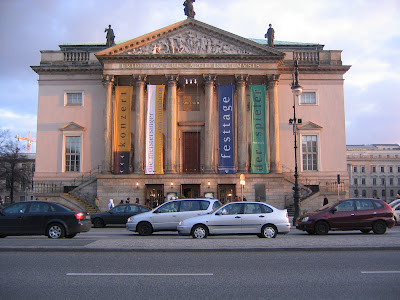
Berlin State Opera (Staatsoper Unter den Linden): Practical information and photographs
The Berlin State Opera (Staatsoper Berlin) is located on the central Unter den Linden boulevard in the former East Berlin. The history of the house may be seen here. The Berlin State Opera house was destroyed at the end of the Second Wold War and the current house and interior (in adapted baroque style) dates from 1955 . The company will close for renovation within a couple of season, a hotly debated topic in Berlin, which will not be further discussed in this post (but elsewhere on this blog).
Daniel Barenboim is music director and de facto leader of the house which is renowned internationally for top-class Wagner performances of a quality hard to match anywhere else, but also for baroque opera productions with René Jacobs as a frequent guest conductor. An annual Easter Festival is held (at outrageously high ticket prices), often including a premiere of a significant work - 2012 will feature Rheingold and Walküre with René Pape as Wotan as well as a new production of Lulu.
Practical information:
Tickets are very reasonably priced, relatively easy to come by and may be ordered via the company website, where you, as a new feature, now may print them out at home. The Berlin State Opera has no standing room spaces.
The season schedule is also available via the company website.
The view is not optimal from quite a few of the cheaper seats - something hopefully improved by the forthcoming renovation of the auditorium...
The best drink is a "bowle" mixing raspberrys with sparkling wine for about 6 Euros...
Public transportation to and from the house is straightforward, with plenty of busses right outside the door. Train station Friedrichstrasse is app. 500 meters away. Subway station Unter den Linden is a bit closer by.
Note, that at the moment, and until at least 2013, the company plays in the Schillertheater located close to the Deutsche Oper, awaiting renovation of the building Unter den Linden.
Productions are generally modern and inventive. The orchestra is top-class when Daniel Barenboim conducts, while the quality at other times may vary considerably.
Significant singers to regularly appear here include: René Pape (a company member), Dorothea Röschmann, Rolando Villazon, Waltraud Meier, Christine Schäfer etc.
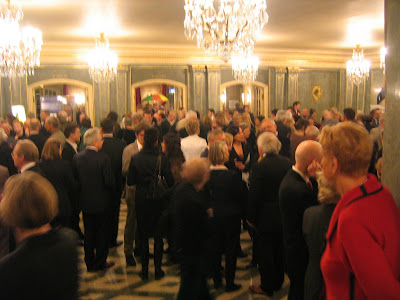
The place for drinks during intermission:
In the corridors:
The auditorium:
The perhaps biggest asset of the house: Daniel Barenboim and the orchestra:
All photographs taken at 2008 performances of Meistersinger, Don Carlo, Don Giovanni and the Rólando Villazón recital.
Monday, 2 June 2008
DVD: London 2002 Il trovatore
Moshinsky´s Il Trovatore is mostly a dark, traditional affair, which seems to be set in late 18th century Italy. The filmic quality no doubt may be attributed to set designer Dante Ferretti, well-known for his previous work in film.
Superbly acted Manrico from José Cura, though vocally he strayed rather far away from pitch and was patchy at times. Equally fine dramatic acting from Veronica Villaroel, who furthermore sang a fine Leonora, though perhaps not an ideal voice type for this sort of spinto role. Yvonne Naef was a strongly sung Azucena with the required heft, though a bit restrained. And Dmitri Hvorostovsky was a beautifully sung Count di Luna, a part very suitable to his exquisite legato-lines. Not normally a notable actor, he nevertheless seemed quite into the part as well.
Carlo Rizzi conducted without being memorable one way or the other.
Dmitri Hvorostovsky, Il balen del suo sorriso:
The bottom line (scale of 1-5, 3=average):
José Cura: 3
Veronica Villaroel: 3-4
Dmitri Hvorostovsky: 4
Yvonne Naef:4
Elijah Moshinsky´s staging: 3
Carlo Rizzi: 3
Overall impression: 3
Posted by yvonnedesire on YouTube